


Can Journaling Really Help With Stress and Anxiety Management?
Some days, stress just sits in your chest with nowhere to go. You replay the same worries, the same conversations, the same what-ifs — and nothing seems to quiet them down.
- What Does Journaling Actually Do to Your Stress Levels?
- The Brain Science Behind Writing Your Worries Down
- Why Journaling Works Differently Than Just “Venting”
- Key Journaling for Stress Relief Benefits You Should Know
- Better Emotional Regulation Over Time
- Clearer Thinking When Everything Feels Chaotic
- Physical Benefits You Might Not Expect
- Types of Journaling That Help With Stress and Anxiety
- Free Writing — No Rules, No Pressure
- Gratitude Journaling for Shifting Your Mindset
- Structured Prompts for Anxiety-Prone Thinkers
- Journaling Prompts for Anxiety and Stress Relief (Beginner-Friendly)
- Prompts for Processing What You Are Feeling Right Now
- Prompts for Understanding Your Stress Triggers
- Prompts for Returning to a Calmer State
- Stress Journaling Tips for Absolute Beginners
- How Long Should You Actually Journal Each Day?
- The Best Time of Day to Journal for Stress Relief
- Paper vs. Digital Journaling — Which One Reduces Stress Better?
- Common Mistakes That Make Journaling Less Effective
- Writing to Vent Instead of Writing to Understand
- Expecting Results Too Quickly and Giving Up
- Making It Feel Like a Chore Instead of a Choice
- How Journaling Fits Into a Broader Stress Management Routine
- Conclusion
If that sounds familiar, you are not alone. And there is something simple, free, and backed by research that might actually help: writing it down. The journaling for stress relief benefits are well-documented, and the practice does not require any special skill, expensive tools, or a lot of time.
This article breaks down exactly how journaling works on your stress and anxiety, which styles suit beginners best, and gives you real prompts you can use today — no experience needed.
What Does Journaling Actually Do to Your Stress Levels?
Most people think journaling is just “writing about your feelings.” And while that is part of it, something more specific is happening in your brain when you do it.
Psychologists call it affect labeling — the act of putting an emotional experience into words. When you write about something that is stressing you out, you are not just venting. You are actually changing how your brain processes that experience.
Research from UCLA found that when people label their emotions verbally or in writing, activity in the amygdala (the brain’s alarm system) decreases. At the same time, the prefrontal cortex — the part responsible for reasoning and calm decision-making — becomes more active.
In plain terms: writing about stress helps your thinking brain take over from your reactive brain.
That shift is small at first. But over time, it builds into something meaningful.
The Brain Science Behind Writing Your Worries Down
Here is a simple way to understand it. Imagine your anxious thoughts as a song stuck on repeat in your head. The more you try to ignore it, the louder it gets.
Writing forces you to press pause. You pull that thought out of your head, give it a shape, and look at it on the page. That act of externalizing creates distance between you and the emotion — and distance is exactly what reduces its intensity.
Neuroscientists describe this as creating “cognitive space.” You are not suppressing the feeling. You are processing it from one step back, which makes it far less overwhelming.
This is why journaling works even when you do not feel like you have anything to say. The act of writing itself does the work.
Why Journaling Works Differently Than Just “Venting”
There is an important distinction to make here. Venting — whether to a friend or in a notebook — can actually make stress worse if it turns into rumination. Rumination means going over the same painful thoughts repeatedly without moving toward any new understanding.
Structured expressive writing is different. It is not about replaying what went wrong. It is about asking what it means, what you need, and what you can do.
Research by psychologist James Pennebaker, who has studied expressive writing for decades, consistently shows that people who write with some structure around their emotions report lower stress and better psychological health than those who simply vent without reflection.
The difference comes down to one thing: are you writing to dump, or writing to understand?
Key Journaling for Stress Relief Benefits You Should Know
Journaling is not a trendy wellness habit. It has been studied seriously for decades, and the evidence for its benefits is consistent across multiple areas of health.
Here are the ones that matter most for anyone dealing with stress or anxiety.
Better Emotional Regulation Over Time
When you journal regularly, you start to notice patterns you would otherwise miss.
Say you have been feeling irritable every Sunday evening. Without journaling, you might chalk it up to the “Sunday scaries” and move on. With journaling, you start to see that the irritability shows up specifically after checking your work emails. That is new information. And new information gives you something to work with.
Consistent journaling trains your brain to process emotions more quickly because you are practicing the skill of noticing, naming, and understanding your feelings rather than pushing them aside. Over weeks, this becomes more automatic — less effort, more clarity.
Clearer Thinking When Everything Feels Chaotic
Mental clarity writing is one of the most underrated uses of a journal.
When your mind is full of competing thoughts, your brain has to keep cycling through them to avoid forgetting anything. It is exhausting. Writing everything down essentially tells your brain: “I have recorded this — you can let it go for now.”
Think of it as clearing your mental RAM. Once the clutter is on the page, your mind is free to think in a calmer, more focused way.
This is why many people report that journaling before a difficult conversation or big decision helps them feel more grounded and clear-headed going in.
Physical Benefits You Might Not Expect
The connection between mental stress and physical symptoms is well-established. Chronic stress raises cortisol levels, disrupts sleep, tightens muscles, and contributes to headaches and digestive issues.
Journaling has been linked to measurable physical improvements. Studies in psychosomatic medicine have found that expressive writing can lower blood pressure, improve immune function, and reduce the frequency of stress-related tension headaches. Sleep quality also tends to improve, particularly when people journal in the evening as a way of mentally offloading the day before bed.
These benefits are not dramatic overnight changes. They build gradually with consistent practice.
Types of Journaling That Help With Stress and Anxiety
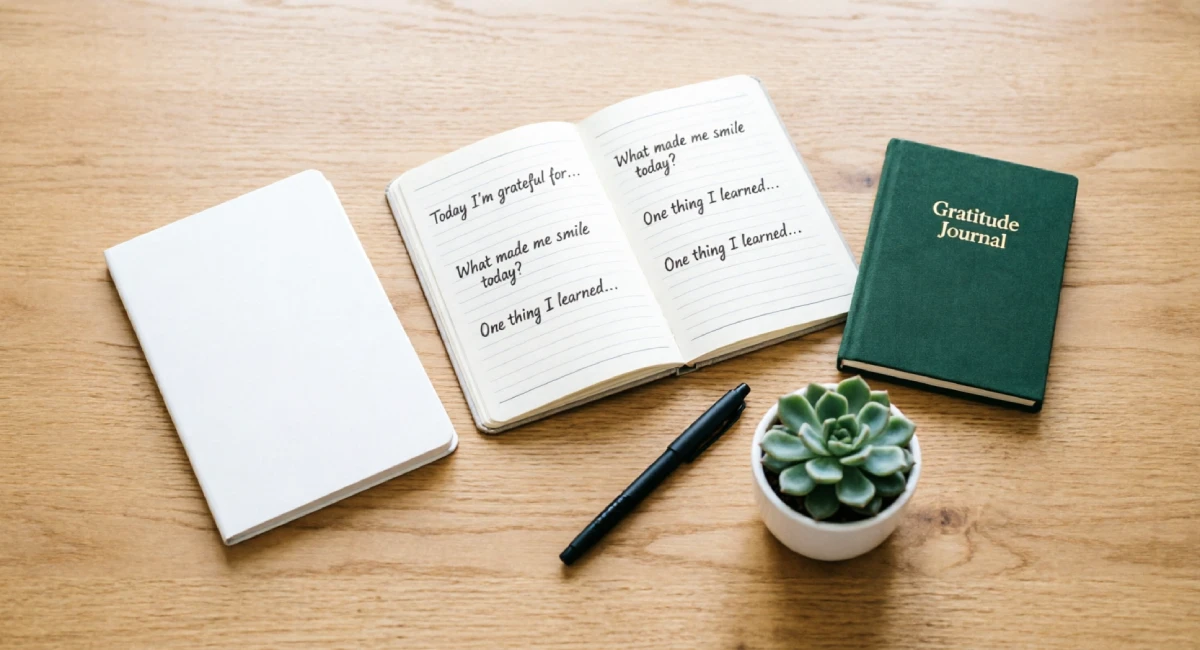
There is no single “correct” way to journal. Different approaches work better for different people, and finding one that feels natural to you makes it far easier to stick with.
Here are four styles worth knowing about, especially if you are new to this.
Free Writing — No Rules, No Pressure
Free writing means setting a timer for five to ten minutes and writing continuously without stopping to edit, correct, or judge what comes out.
It does not need to make sense. It does not need to be coherent. The goal is simply to keep the pen moving.
This style works particularly well for people who feel mentally blocked or emotionally stuck. When you remove the pressure to write “well,” something honest tends to surface.
Author Julia Cameron popularised a version of this called “morning pages” — three pages of longhand writing done first thing in the morning as a way of clearing mental clutter before the day begins. Many people find it significantly reduces their baseline anxiety over time.
Gratitude Journaling for Shifting Your Mindset
Gratitude journaling involves writing down two to five things you are genuinely thankful for each day. They can be small: a good cup of coffee, a kind text from a friend, ten minutes of quiet.
This is not about pretending everything is fine. It is about deliberately broadening your attention beyond what feels threatening.
Positive psychology research, including studies by Robert Emmons at UC Davis, consistently shows that regular gratitude practice reduces stress hormones, improves mood, and builds emotional resilience. The brain has a natural negativity bias — it notices threats more readily than good things. Gratitude journaling is a gentle way of rebalancing that.
Structured Prompts for Anxiety-Prone Thinkers
If open-ended writing feels overwhelming, you are not alone. Many anxious people find that staring at a blank page makes their mind spin rather than settle.
That is exactly where journaling prompts for anxiety become useful. A prompt gives your brain a specific question to answer, which narrows the focus and reduces the “I don’t know what to write” paralysis.
The next section of this article includes fifteen prompts grouped by purpose — so if free writing feels like too much right now, skip ahead and start there instead.
Journaling Prompts for Anxiety and Stress Relief (Beginner-Friendly)
These prompts are designed to be approachable. There are no right or wrong answers. Write as much or as little as feels comfortable, and do not edit yourself as you go.
Prompts for Processing What You Are Feeling Right Now
Use these when you feel overwhelmed and need a starting point:
- What is taking up the most space in my mind today?
- If my stress had a colour, a shape, or a weight, what would it be?
- What am I most afraid of right now, and is that fear based on something real or something I am imagining?
- What do I wish someone understood about how I am feeling today?
- If I could say one honest thing about my current stress without worrying about judgment, what would it be?
Write without stopping to fix your sentences. This section is for you alone.
Prompts for Understanding Your Stress Triggers
These prompts build self-awareness over time. Come back to them regularly:
- When did I last feel genuinely calm? What was different about that time?
- What situation or person keeps coming up in my thoughts this week?
- Is there a pattern to when my anxiety tends to spike? What is usually happening around me?
- What is one expectation I am placing on myself right now that might be unrealistic?
- If I look back at the last month, what consistently drained my energy and what consistently restored it?
These are not quick answers. Let yourself sit with them.
Prompts for Returning to a Calmer State
Use these at the end of a stressful day or after a difficult moment:
- What is one small thing I can actually control today?
- What would I tell a close friend who was feeling exactly the way I feel right now?
- What has gone okay today, even if other things have not?
- What is one thing I can do tonight that would genuinely help me feel better tomorrow?
- What does rest look like for me right now, and am I giving myself permission to take it?
These prompts are not about solving problems. They are about returning to a steadier place so you can think more clearly.
Stress Journaling Tips for Absolute Beginners
The biggest barrier to journaling is not ability. It is starting. Here are five practical ways to make that first step smaller.
Start before you feel ready. You do not need the perfect journal, the perfect mood, or the perfect words. Open a notebook and write one sentence about how today felt. That is enough to begin.
Let go of the idea that it has to be good. Your journal is not an essay. It is not going to be read, graded, or judged. Writing badly is still writing, and it still works.
Use the prompts in this article. If you open a blank page and freeze, go back to the prompt section and pick one. Just one. Answer it in three to five sentences.
Keep your journal somewhere visible. Out of sight genuinely means out of mind. Leave it on your pillow, your desk, or beside your toothbrush — wherever you are most likely to see it at a natural pause in your day.
Be patient with yourself. You may not notice a difference in week one. That is completely normal. The benefits of journaling build with repetition, not speed.
How Long Should You Actually Journal Each Day?
Most people assume journaling requires thirty minutes of deep reflection. It does not.
Research on expressive writing suggests that five to ten minutes of focused, honest writing produces meaningful results. You do not need more time than that, especially as a beginner.
On days when even that feels like too much, try the three-sentence minimum: write one sentence about what happened, one about how it made you feel, and one about what you need. That is a complete journaling session, and it counts.
The Best Time of Day to Journal for Stress Relief
There is no universally perfect time, but three windows tend to work best:
Morning is useful for setting intention and reducing anticipatory anxiety. Writing briefly about what you are thinking or dreading before the day begins helps your brain feel more prepared and less reactive.
Evening is ideal for mental decompression. Writing before bed helps you process the day rather than lie awake replaying it, which research links to better sleep quality.
In-the-moment writing is underused but highly effective. When something stressful happens, taking three minutes to write about it immediately can prevent the emotional build-up that makes stress harder to manage later.
Pick the window that fits your existing routine and start there.
Paper vs. Digital Journaling — Which One Reduces Stress Better?
Both work. The best format is the one you will actually use consistently.
That said, some research does suggest handwriting has a slight edge for emotional processing. Writing by hand is slower and more deliberate, which encourages deeper engagement with what you are feeling. It also removes the distraction of notifications and apps.
Digital journaling, on the other hand, is more accessible for people who spend most of their day on screens or who type significantly faster than they write. Apps like Day One or even a simple notes application can work well.
If you are unsure which to try first, start with paper. You can always switch.
Common Mistakes That Make Journaling Less Effective
Journaling is forgiving as a practice, but a few habits can reduce its effectiveness. Recognising them early saves a lot of frustration.
Journaling only when things are bad. Many beginners only reach for their journal at peak stress. This makes journaling feel like a crisis tool rather than a daily habit, which is much harder to build. Regular low-stakes entries are what create the long-term benefits.
Staying surface-level. Writing “I had a bad day” and stopping there does not give your brain much to process. Aim to go one layer deeper: what made it bad, how it felt, and what it brought up for you.
Judging your writing as you go. If you stop every few sentences to re-read and edit, you interrupt the processing that makes journaling work. Write first, read later — or not at all.
Expecting a journal to fix the problem. Journaling helps you understand and process. It does not solve difficult situations, change other people, or replace professional support. Going in with realistic expectations keeps you from feeling disappointed.
Writing to Vent Instead of Writing to Understand
Here is the difference in practice.
A venting entry might look like: “My manager criticised my report in front of everyone. She is so unfair. I cannot believe she did that. It ruined my whole day. I am so angry.” The emotion is valid, but the writing stays in the loop.
A reflective entry asks one step further: “My manager criticised my report in front of everyone and I felt humiliated. What bothers me most is not the feedback itself, but being corrected publicly. That tells me I care deeply about being respected at work. What do I actually need here: to talk to her, to let it go, or to address the situation differently next time?”
Same event. Very different outcome.
The shift comes from asking one question: What does this situation tell me about what I need right now?
Expecting Results Too Quickly and Giving Up
Most studies on expressive writing measure outcomes over two to four weeks of consistent practice. Changes in anxiety levels, sleep, and emotional regulation do not show up after three days.
If you do not notice anything in your first week, that is completely normal. You are still building the habit and training the reflex.
A practical way to stay committed: set a 14-day journaling challenge for yourself. Write something every day for two weeks, even if it is just a few sentences. At the end of day fourteen, look back at your earlier entries. Most people are genuinely surprised by what they notice.
Making It Feel Like a Chore Instead of a Choice
If journaling starts to feel like homework, something has gone wrong with the setup, not with you.
Small environmental details matter more than people expect. Use a notebook you actually like the feel of. Write somewhere that feels comfortable, whether that is a corner of your sofa, a quiet spot in a garden, or a favourite cafe. Pair the habit with something that already feels good, like a cup of tea, a particular playlist, or the quiet after everyone else has gone to bed.
Journaling should feel like something you do for yourself, not to yourself.
How Journaling Fits Into a Broader Stress Management Routine
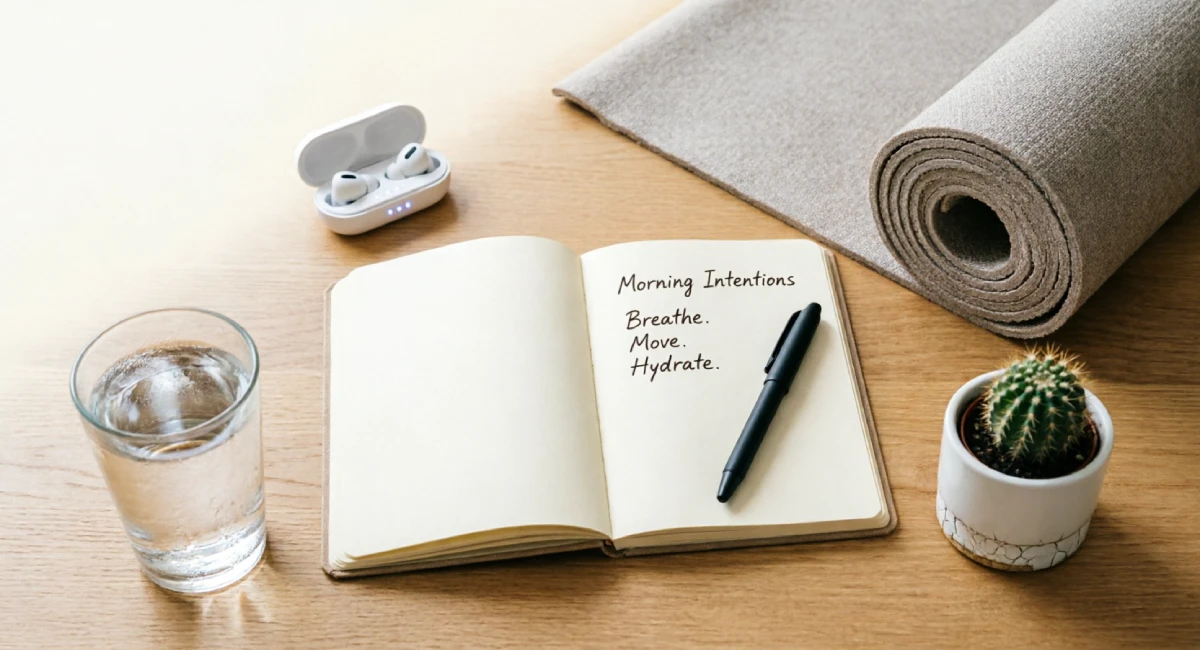
Journaling is a valuable tool. It is not, on its own, a complete stress management plan.
Sustainable mental wellness tends to involve several practices working alongside each other: regular physical movement, adequate sleep, meaningful social connection, and some form of intentional mental rest. Journaling fits naturally within that wider routine as the reflective layer, the part of the day where you check in with yourself.
For people exploring the relationship between stress and burnout specifically, journaling also serves a useful monitoring function. Writing consistently about how you feel, what drains you, and what restores you creates a personal record that can help you notice when stress is shifting into something more serious.
Combining Journaling With Mindfulness for Stronger Results
Pairing journaling with a brief mindfulness practice tends to deepen both.
Here is a simple five-minute ritual worth trying. Set a timer for two minutes and breathe slowly with your eyes closed, paying attention to the sensation of each breath. When the timer goes off, open your journal and write for three minutes about whatever surfaced during those two minutes, whether that is a thought, a feeling, or simply how your body feels right now.
The breathing creates a moment of stillness that makes the writing more honest. The writing anchors what the mindfulness uncovered. Together, they tend to produce greater clarity than either does alone.
You do not need experience in meditation for this. Two minutes of slow breathing counts.
When Journaling Alone Is Not Enough
It is important to say this clearly: journaling is a support tool, not a substitute for professional care.
If you are experiencing persistent anxiety that disrupts your daily life, signs of clinical depression, or symptoms that feel like more than everyday stress, please speak with a doctor or mental health professional. These are things a journal cannot address on its own, and reaching out for support is not a sign of failure.
Journaling can absolutely be part of your recovery or management alongside professional support. Many therapists actively encourage it. But if what you are carrying feels heavy, a journal entry is a good start, not a final answer.
Conclusion
You do not need perfect words, a beautiful notebook, or an hour of free time. The journaling for stress relief benefits are real, and they are available to anyone willing to write a few honest sentences each day.
Start small. Pick one prompt from this article, set a five-minute timer, and write without editing yourself. Do that for fourteen days and see how you feel at the end.
Stress does not disappear because you wrote about it. But when you write about it regularly, you begin to understand it better, react to it less automatically, and carry it more lightly. That is not a small thing.
If you found something useful here, consider bookmarking this article and returning to the prompts whenever you need them. And if you are curious about whether what you are feeling goes beyond everyday stress, the next article in this series explores how to tell the difference between burnout and normal stress.