


Which Smartphone Features Actually Matter Most?
Every time a new phone launches, the same cycle plays out. Brands throw around numbers — 200MP cameras, 16GB RAM, 165Hz displays — and most people walk away more confused than when they started. If you have ever stood in a store comparing spec sheets and still had no idea which phone was actually better, you are not alone.
- Why Most Phone Specs Don’t Tell the Whole Story
- The Smartphone Features That Matter Most in Daily Use
- Battery Life and Charging Speed
- Processor Performance and What It Means for You
- Display Quality Over Display Size
- Camera Performance Beyond Megapixels
- Software Support and Long-Term Updates
- Build Quality and Durability Ratings
- Important Phone Features That Are Often Overhyped
- Zoom Cameras and the Periscope Lens Debate
- RAM Numbers and Why More Isn’t Always Better
- Refresh Rate Marketing at 144Hz and Above.
- Smartphone Buying Tips Based on How You Actually Use Your Phone
- Heavy Users: Calls, Video, and Long Hours
- Casual Users: Social Media, Messaging, and Light Photography
- Budget Buyers: Where to Spend and Where to Save
- How to Read Phone Specs Without Getting Misled
- The Features That Actually Matter Are the Ones You Will Use Every Day
The truth is, the smartphone features that matter most have very little to do with the biggest numbers on the box. They have everything to do with how the phone holds up six months after you buy it — during long commutes, rushed mornings, and low-light birthday photos.
This article skips the marketing language and focuses on what genuinely affects your daily experience. By the end, you will know exactly what to look for and what you can safely ignore.
Why Most Phone Specs Don’t Tell the Whole Story
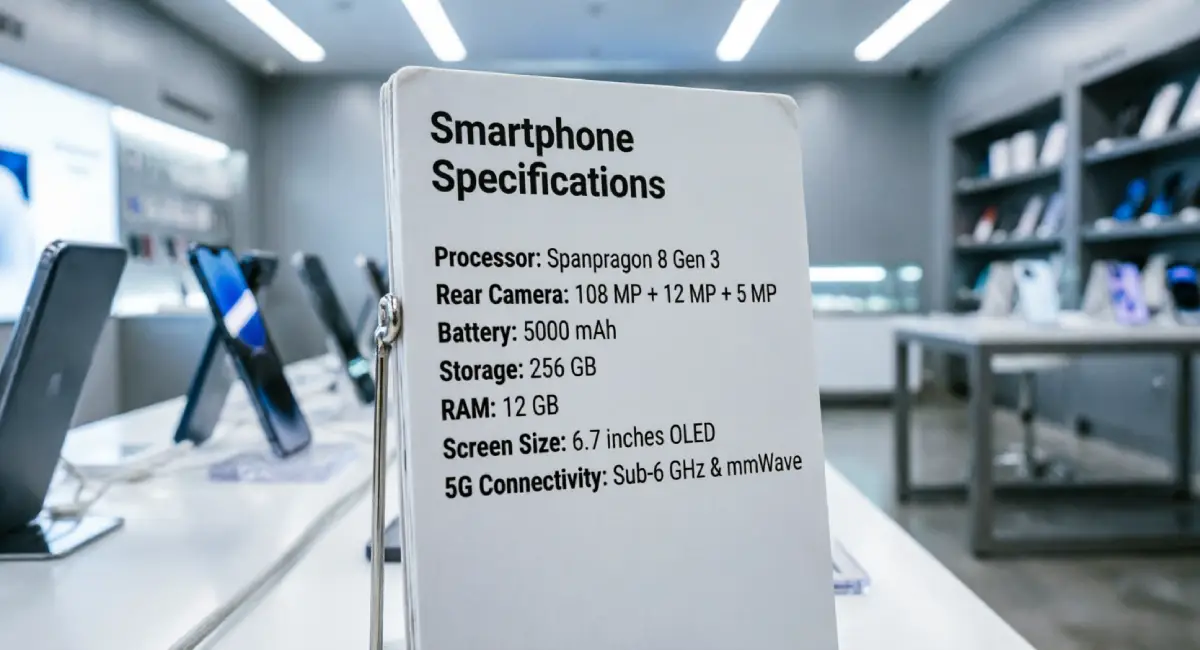
Pick up any phone listing, and you will see a wall of numbers. Processor cores, megapixels, milliamp hours, gigabytes. It all looks measurable and objective. The problem is that raw numbers rarely tell you how the phone actually performs in your hands.
Take cameras as a simple example. A phone with a 200MP sensor sounds like it should take better photos than a 12MP phone. In most real-world situations, it does not. Photo quality depends on sensor size, the quality of the lens, and the software processing the image — none of which show up as a single number on a spec sheet.
The same gap exists everywhere. A phone with a massive battery can still die by mid-afternoon if the software is poorly managed. A phone with a top-tier processor can feel sluggish if the manufacturer layers on heavy software on top of it.
This is the core problem with phone marketing: it rewards impressive-sounding numbers over real-world results. Understanding this gap is the first step toward making a smarter buying decision — and it connects directly to a bigger question worth asking before any tech purchase: are you buying what you actually need, or what a company has told you to want?
The Smartphone Features That Matter Most in Daily Use
Not all specs are equal. Some genuinely affect how your phone feels to use every single day. Others only matter in very specific situations that most people rarely encounter.
The features below are the ones that consistently shape daily experience: battery life, processor performance, display quality, camera output, software support, and build quality. Each one is worth understanding before you hand over your money.
Battery Life and Charging Speed
Battery capacity is measured in milliamp hours (mAh), and manufacturers treat it like a selling point. A 5,000mAh battery sounds better than a 4,000mAh one — but that logic only holds if everything else is equal, and it rarely is.
What actually determines how long your phone lasts is a combination of three things: the battery size, the efficiency of the processor, and how well the software manages power in the background. A phone with a 4,000mAh battery running a well-tuned operating system can easily outlast a 4,500mAh phone whose software is constantly running unnecessary processes in the background.
The number to look for is screen-on time — how many hours the phone lasts with the screen actively in use. This is how real-world battery reviewers measure it, and it is far more useful than mAh figures alone.
Charging speed matters too, but in a practical way. A phone that supports 65W fast charging can go from near-empty to 80% in about 30 minutes. That changes how you use the phone day to day — a quick top-up becomes genuinely useful rather than a long wait. Wireless charging is convenient for overnight charging, but wired fast charging is still meaningfully faster in most situations.
The takeaway: look for screen-on time benchmarks in real-world reviews, not just battery size on a spec sheet.
Processor Performance and What It Means for You
The processor is the brain of your phone. It affects how quickly apps open, how smoothly you can switch between tasks, and whether the phone still feels quick two years from now.
Flagship chips — like the Snapdragon 8-series or Apple’s A-series — offer the best sustained performance. Mid-range chips, like the Snapdragon 7-series or MediaTek Dimensity 7000-series, handle everyday tasks just as well for most users. The difference becomes noticeable in demanding situations: heavy gaming, 4K video recording, or running multiple apps at once.
For most people checking messages, browsing, watching videos, and taking photos, a mid-range chip is more than enough. Paying a significant premium for a flagship chip makes sense if you genuinely push your phone hard.
There is one thing spec sheets never mention: thermal throttling. This is when a processor gets too hot and automatically slows itself down to prevent damage. Some phones with powerful chips throttle heavily under sustained load, which means they perform brilliantly in short bursts but slow down during longer tasks. Long-term reviews that test phones under sustained workloads are the only way to catch this — it will not appear anywhere in the official specs.
Display Quality Over Display Size
Screen size is easy to measure and easy to market. But the factors that actually affect how your display looks and feels every day are resolution, refresh rate, and brightness.
Resolution determines how sharp text and images appear. On most phones above 6 inches, 1080p (Full HD) is sharp enough that most people cannot tell the difference from higher resolutions in everyday use. Anything lower than 1080p starts to look noticeably soft.
Refresh rate is the number of times the screen updates per second. At 60Hz, scrolling looks acceptable. At 90Hz or 120Hz, scrolling and animations feel noticeably smoother — especially if you use your phone a lot. If you have ever used a 120Hz phone and gone back to 60Hz, the difference is immediately obvious.
Brightness, measured in nits, determines how well you can see the screen outdoors. Anything below 600 nits tends to struggle in direct sunlight. Phones with 1,000 nits or above are genuinely comfortable to use outside.
Panel type also matters. OLED screens produce deeper blacks, better contrast, and use less battery when displaying dark content because black pixels are simply turned off. LCD screens are generally fine, but the difference is real — especially in dim environments. This is not a luxury upsell; it is a practical difference that affects daily use.
Camera Performance Beyond Megapixels

Megapixels measure how many individual pixels a camera captures. They do not measure how good the image looks. This is one of the most misunderstood areas in the entire smartphone buying process.
What actually determines photo quality is sensor size, aperture, and the software processing the image after the shot is taken. A larger sensor captures more light, which is why photos look better in low-light situations. A wider aperture (a lower f-number, like f/1.8 compared to f/2.4) lets more light in. And good computational photography software — the code that processes the image after you press the shutter — can make a significant difference in colour accuracy, sharpness, and noise reduction.
A practical example: a phone with a 12MP camera, a large 1/1.28-inch sensor, and strong night mode software will produce better low-light photos than a phone advertising 200MP with a tiny sensor and weak processing. The spec sheet favours the second phone. Real-world photos favour the first.
Before buying, look for these specific tests in reviews: night mode performance, video stabilisation quality, and whether camera output is consistent or varies widely depending on lighting. Consistency matters more than peak performance in ideal conditions.
Software Support and Long-Term Updates
This is one of the most overlooked important phone features, and it directly affects how long your phone stays useful.
Every phone runs on an operating system — Android or iOS —, and manufacturers push updates that include security patches, new features, and performance improvements. When a manufacturer stops supporting a phone, those updates stop. The phone does not immediately break, but it gradually becomes less secure, less compatible with newer apps, and slower as the software around it moves on without it.
Apple typically supports iPhones for five to six years. Google supports its Pixel phones for seven years. Samsung has committed to seven years of updates for its flagship and mid-range Galaxy lines. Many other Android manufacturers offer only two to three years of support, which means a phone bought today could be unsupported before the end of its third year.
When you factor in the total usable lifespan of a phone, software support changes the value calculation completely. A phone with a slightly lower spec sheet but seven years of guaranteed updates can be a better long-term investment than a higher-spec phone that loses support in two years.
Build Quality and Durability Ratings
A phone’s build quality affects two things: how it survives daily wear, and how much it will cost you if something goes wrong.
IP ratings are the standard measure of water and dust resistance. IP67 means the phone can survive submersion in up to one metre of water for 30 minutes. IP68 means it can handle deeper water — usually 1.5 to 2 metres — for the same period. In practical terms, both ratings protect against rain, spills, and accidental drops into shallow water. Neither is rated for swimming or salt water, regardless of what marketing materials imply.
Glass backs look premium and support wireless charging, but they shatter more easily than polycarbonate (plastic) backs. Polycarbonate phones are more resistant to cracks and chips, even if they feel less expensive. For most people, a polycarbonate back with a quality glass front is a more durable combination than glass on both sides.
Repairability is worth considering too. Some phones are designed in ways that make screen and battery replacements straightforward and affordable. Others are sealed so tightly that any repair requires expensive professional work. Given that battery replacement is the most common phone repair, a phone that supports easy battery access has a longer practical lifespan.
Important Phone Features That Are Often Overhyped
Some features get heavy marketing attention without making a meaningful difference for general users. That does not make them useless — but they should not drive your buying decision unless you have a specific reason to need them.
Zoom Cameras and the Periscope Lens Debate
Zoom capability is one of the most aggressively marketed features in smartphones today. Brands advertise 10x, 50x, and even 200x zoom as headline numbers. The reality is more complicated.
There are three types of Zoom. Optical zoom uses the lens physically to magnify the subject — this produces clean, sharp images. Digital zoom is just cropping and enlarging a photo in software, which degrades quality. Hybrid zoom is a mix of both. When a brand advertises “100x Space Zoom,” most of that range is digital zoom, not optical.
Periscope lenses — the folded optical system that enables high optical zoom in a thin body — are genuinely impressive engineering. But most people use their phone camera at default (1x) or wide-angle. Check your own camera roll: how often do you actually zoom past 5x?
For general users, a phone with a strong main sensor and a decent wide-angle lens covers the vast majority of real photography situations. An extra telephoto camera is useful for occasional portraits or travel photography, but it should not justify buying a more expensive phone if the main sensor is weaker.
RAM Numbers and Why More Isn’t Always Better
RAM (Random Access Memory) helps your phone hold multiple apps open at once without reloading them. Up to a certain point, more RAM genuinely helps. Beyond that point, it makes almost no difference for typical use.
For most Android users, 8GB of RAM is sufficient to run everyday tasks without apps constantly refreshing in the background. For heavier users running multiple apps simultaneously or mobile gaming, 12GB offers a comfortable buffer. Beyond 12GB, real-world gains are minimal for general use.
There is also an important platform difference. iOS manages memory very efficiently, which is why iPhones with 8GB of RAM perform comparably to Android phones with 12GB in most tasks. You cannot compare RAM numbers directly across the two platforms.
The pattern to watch for: phones advertising 16GB or 18GB of RAM as a premium selling point often lean on a number that sounds impressive but delivers minimal practical benefit. That money is better spent on a better processor or camera sensor.
Refresh Rate Marketing at 144Hz and Above.
The jump from 60Hz to 120Hz is real and noticeable. Scrolling feels smoother, animations look cleaner, and the phone feels more responsive. For most users, 120Hz is the sweet spot — genuinely useful and worth choosing over a 60Hz screen.
The jump from 120Hz to 144Hz or 165Hz is far less obvious. In casual daily use, most people cannot tell the difference. The human eye processes motion at rates that make 120Hz and 144Hz effectively the same in the vast majority of tasks.
Where higher refresh rates offer real benefit is competitive mobile gaming, where frame-rate margins matter. For everyone else, a phone marketing 144Hz or 165Hz is selling a number more than a meaningful experience upgrade.
An important side effect: higher refresh rates drain battery faster. A phone running at 165Hz continuously is working harder than the same phone at 120Hz. Some phones adjust refresh rate automatically based on what you are doing, which reduces the impact. But a fixed high-refresh screen without adaptive control will cost you battery life for a difference you are unlikely to notice.
Smartphone Buying Tips Based on How You Actually Use Your Phone
Specs only tell part of the story. The other part is understanding how you personally use your phone and matching the hardware to those real patterns. Not every user needs the same things, and buying the wrong phone for your usage style wastes money regardless of where it sits on a spec sheet.
Heavy Users: Calls, Video, and Long Hours
If your phone is on constantly throughout the day, your priorities shift significantly. Battery life and thermal performance move to the top of the list.
A phone that throttles its processor under sustained load will feel sluggish after an hour of video calls or navigation. A phone with a thin body and a small battery may look sleek but run out of power before your day ends. For heavy users, these are not minor inconveniences — they affect work and daily routines.
Practical advice: look for phones with large batteries (5,000mAh or above), verified screen-on time of six hours or more in real-world testing, and reviews that specifically test performance under sustained workloads. Bright displays (above 1,000 nits) matter too, especially if you work outdoors or in varied lighting.
A mid-range phone with excellent battery optimisation will often serve heavy users better than a flagship phone designed around a thin profile that compromises on thermal management.
Casual Users: Social Media, Messaging, and Light Photography
For users who check their phone regularly but are not pushing it hard, flagship-level specs are rarely necessary or worth the cost.
What matters for this group is a reliable main camera, a clean and responsive interface, consistent software updates, and a durable build. These factors determine day-to-day satisfaction far more than processor benchmarks or RAM counts.
Mid-range phones in the $300 to $500 price range frequently offer the best real-world value for casual users. They handle social media, messaging, music, and everyday photography without any noticeable compromise. The money saved over a flagship can go toward a good case, screen protector, or simply staying in the budget.
The one area worth spending slightly more on, even for casual users, is software support. A phone with five or more years of guaranteed updates will stay useful and secure longer than a cheaper option that ages out of support in two years.
Budget Buyers: Where to Spend and Where to Save
Buying a phone on a tight budget requires clear priorities. Not every trade-off is equal.
Worth spending more on:
- Main camera sensor quality (affects photos every single day)
- Battery capacity and optimisation (affects every single day of ownership)
- Software update commitment (affects how long the phone stays useful)
Safely traded off:
- Zoom cameras (rarely used by most people)
- Premium glass build materials (polycarbonate is more durable for the price)
- Refresh rates above 90Hz (60Hz or 90Hz is fine for most casual use)
- RAM above 6GB (sufficient for most everyday tasks on a budget phone)
A simple checklist before buying any budget phone: Does it have at least three years of software support confirmed? Does it have a decent main camera sensor, not just high megapixels? Does it have at least a 4,500mAh battery? If those three boxes are checked, the rest is secondary.
How to Read Phone Specs Without Getting Misled
Understanding phone specs explained in plain terms gives you a significant advantage when comparing options. Most marketing material is designed to highlight strengths and quietly ignore weaknesses. Knowing where to look changes that.
The most important habit is checking multiple sources before buying. A spec sheet from a manufacturer tells you what they want you to know. A long-term review tells you what the phone is actually like to live with.
Use Benchmarks as a Guide, Not a Verdict
Benchmark tools like Geekbench and AnTuTu measure how fast a phone performs under controlled test conditions. They are useful for comparing processors from the same generation, but they have clear limits.
Synthetic benchmarks test peak performance in short bursts. They do not test what happens when a phone runs hot for an extended period, how performance holds up after a year of use, or how the processor performs during typical multitasking rather than maximum load.
A phone can score impressively in benchmarks and still throttle significantly during a 30-minute gaming session or a video export. The benchmark captures a moment; real-world use is continuous.
Use benchmarks as a rough guide for comparing chips within the same generation. Then look for reviews that ran performance tests over extended periods or came back to the phone several months after launch.
Check for Real-World Reviews, Not Just Launch-Day Coverage
Launch-day reviews are written quickly, often under time pressure, and based on limited use. They are useful for first impressions but rarely capture the full picture.
The reviews worth reading are the ones published three to six months after a phone’s release. By that point, reviewers have seen how the battery holds up after charge cycles, whether software updates introduced or fixed problems, how the camera performs across varied real-world conditions, and whether any thermal or performance issues emerged under extended use.
Look for reviews that include long-term notes, user feedback after software updates, and battery health observations over time. Tech publications that run dedicated long-term review formats, independent YouTube channels that revisit devices months after launch, and community forums where actual users report daily experience over time are all worth consulting before a purchase.
A phone that gets consistently positive feedback from real users three months after launch is a far more reliable signal than a glowing review written on launch day.
The Features That Actually Matter Are the Ones You Will Use Every Day
It is easy to get drawn in by the biggest numbers. Brands spend significant resources making sure you notice them. But the smartphone features that matter most are not the ones that look impressive on paper — they are the ones that shape your experience every single morning when you pick up the phone.
A battery that lasts your full day. A display that is comfortable to look at indoors and outdoors. A camera that takes a decent photo without fussing with settings. Software that stays updated and secure for years. A build that survives daily life without falling apart.
Those are the features worth prioritising. Everything else is context-dependent, and in many cases, it is just marketing dressed up as progress.
Before your next purchase, take five minutes to honestly assess how you use your phone day to day. That answer will point you toward the right features faster than any spec sheet ever will.
For a broader look at how to evaluate tech purchases without getting pulled in by hype, check out the full guide: How Do You Choose Tech Products Without Falling for Hype?