


What Should You Look for in a Profitable Investment Property?
Most investors who lose money in real estate do not lose it because the market failed them. They lost it because they bought the wrong property for the wrong reasons. Knowing what to look for in an investment property before you sign anything is the difference between a rental that builds wealth and one that drains it.
- Why Property Evaluation Matters Before You Commit
- What to Look for in an Investment Property: The Core Checklist
- Location Factors That Directly Affect Your Return
- Proximity to Employment Hubs and Economic Drivers
- Neighbourhood Growth Indicators to Check
- School Districts, Safety, and Tenant Demographics
- Financial Metrics Every Investor Must Calculate
- Gross Rental Yield vs. Net Rental Yield
- Cash-on-Cash Return and Why It Beats Yield Alone
- The 1% Rule and Its Limitations
- Assessing Property Condition Before You Buy
- Structural and Foundation Checks
- Electrical, Plumbing, and HVAC Systems
- Estimating Renovation Costs Accurately
- Rental Demand and Vacancy Rate Analysis
- How to Research Local Vacancy Rates
- Matching Property Type to Tenant Demand
- Seasonal Demand and Short-Term Rental Viability
- Legal and Regulatory Factors in the Property Evaluation Process
- Zoning Laws and Permitted Use
- Title Search and Encumbrances
- Landlord-Tenant Laws That Affect Cash Flow
- Property Management Considerations as Part of Your Investment Checklist
- Red Flags to Watch for During Your Property Evaluation
- Conclusion
This article gives you a clear, practical evaluation process. No vague advice about “buying in a good suburb.” Just a structured checklist that covers the five areas that actually determine whether a property will perform: location, financials, condition, tenant demand, and legal factors.
Work through each section before you make an offer on anything. Your future self will thank you.
Why Property Evaluation Matters Before You Commit
Skipping a proper evaluation does not save time. It creates problems that cost far more to fix than the evaluation would have taken.
Here is a common scenario. An investor walks through a property, likes the street, likes the layout, and makes an offer the same week. Six months later, after settlement, they discover the roof needs full replacement, the drainage runs toward the foundation, and the suburb has a vacancy rate above 8%. The property sits empty for four months while repair bills pile up.
That is not bad luck. That is the result of buying on first impressions.
A thorough property evaluation protects you from four specific outcomes:
- Negative cash flow caused by expenses that were never factored in
- Negative equity when you overpay relative to the real market value
- Problem tenants in areas with weak rental demand or poor demographic fit
- Costly repairs that were visible before purchase but never inspected
The goal of evaluation is not to find a perfect property. No property is perfect. The goal is to know exactly what you are buying, price the risks accurately, and make a decision based on facts rather than feeling.
The checklist mindset that runs through this article treats every property the same way. You remove emotion from the process and replace it with a consistent set of criteria. That consistency is what separates investors who build long-term portfolios from those who make one expensive mistake and stop.
What to Look for in an Investment Property: The Core Checklist
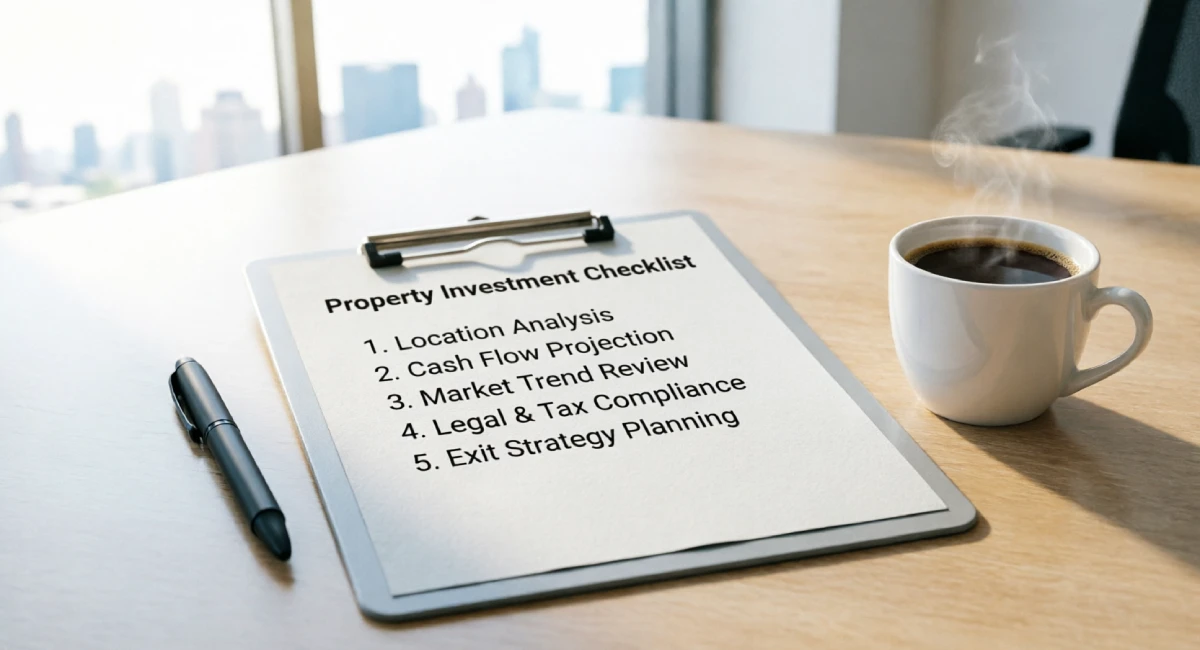
Every property you evaluate should pass through the same five-part filter. Think of it as a due diligence framework that keeps you honest and consistent, regardless of how much you like the look of a place.
The five areas are:
- Location – Is the area one that tenants actually want to live in, and is it growing?
- Financials – Do the numbers produce a return worth the risk and capital?
- Property condition – What will this cost to maintain, repair, or improve?
- Tenant demand – Is there a reliable pool of renters for this type of property?
- Legal factors – Are there any title, zoning, or regulatory issues that could limit your returns?
Each area gets its own section below. Every item on the checklist is expanded with specific things to check, not just general principles.
How to Use This Checklist Effectively
The checklist works the same way whether you are evaluating a single-family home, a duplex, or a small multi-unit building. The questions are the same. The answers will vary.
Not every item carries equal weight. For a long-term buy-and-hold strategy, location and financials matter most. For a short-term rental play, tenant demand and legal factors may outweigh the others. For a value-add renovation deal, property condition becomes the central calculation.
Before you start evaluating any property, decide on your investment strategy. That context shapes how you score each factor and which trade-offs you are willing to accept.
Location Factors That Directly Affect Your Return
Location is the one variable you cannot change after purchase. You can renovate a kitchen. You can repaint walls. You cannot move a property closer to an employment hub or away from a declining area.
That is why location sits at the top of every serious investment checklist.
Proximity to Employment Hubs and Economic Drivers
Tenants rent where they work, or close to it. Properties within commuting distance of major employers, hospitals, universities, logistics centres, and business districts consistently maintain lower vacancy rates than those in areas with limited local employment.
Research published by multiple property analytics firms has shown that suburbs within 10 kilometres of a major employment hub tend to see vacancy rates 30 to 50 per cent lower than comparable suburbs further out. That gap directly affects your rental income and the quality of applicants you attract.
When evaluating a location, look at what drives the local economy. A single large employer creates concentration risk. A diverse mix of employers, a hospital, a university, and a commercial district creates the kind of stable demand that holds up through economic cycles.
Neighbourhood Growth Indicators to Check
A good location today is worth something. A good location that is still improving is worth considerably more.
Look for these signals of genuine neighbourhood growth:
- New infrastructure announced or under construction (roads, public transport, schools)
- Rising median household incomes over the past three to five years
- Declining vacancy rates year-on-year
- Increased residential and commercial building permit activity
- New retail and dining openings (businesses follow population growth, not the reverse)
Most of this data is publicly available. Census bureaus, municipal planning portals, and regional housing authorities publish regular reports. Real estate data platforms also aggregate permit and price trend data at the suburb level. Use these sources to verify what agents tell you, rather than relying on their narrative.
School Districts, Safety, and Tenant Demographics
School quality and safety statistics affect two things simultaneously: the type of tenant you attract, and the long-term resale value of the property.
For family rentals, proximity to well-rated schools is often the primary search filter for tenants. A property in a strong school district commands higher rent and sees lower turnover because families are reluctant to move mid-year. That stability has real financial value.
For student housing or short-term rentals, school ratings matter less. What matters more is proximity to the university, nightlife, or tourist attractions that drive that specific tenant type.
Crime data is relevant across all strategies. Consistently high crime rates increase tenant turnover, attract lower-quality applicants, and suppress both rental income and capital growth. Most national and local government websites publish crime statistics by area. Check them for every property you seriously consider.
Financial Metrics Every Investor Must Calculate
A property can be in a great location, in excellent condition, and still be a poor investment if the numbers do not work. Running the financial calculations before you make an offer is not optional. It is the job.
Gross Rental Yield vs. Net Rental Yield
Gross rental yield is the starting point. It tells you what the property returns as a percentage of its purchase price, before any costs.
Formula: (Annual Rent / Purchase Price) x 100
Example: A property priced at $350,000 with $24,000 annual rent ($2,000/month) has a gross yield of 6.86%.
That number looks reasonable. But gross yield ignores every cost associated with owning the property.
Net rental yield accounts for those costs: property management fees, insurance, rates and taxes, maintenance, and periods of vacancy.
Example continued: If annual costs total $8,000, your net income drops to $16,000. Net yield becomes 4.57%.
In competitive markets like major capital cities, net yields between 3.5% and 5% are common for properties with strong capital growth prospects. In regional or high-yield markets, investors often target 6% or above on a net basis. Neither threshold is universally correct. What matters is that the net yield covers your holding costs and meets your return requirements.
Cash-on-Cash Return and Why It Beats Yield Alone
If you are using a mortgage to purchase the property, the yield alone does not tell you what you are actually earning on the money you put in. Cash-on-cash return does.
Formula: (Annual Pre-Tax Cash Flow / Total Cash Invested) x 100
Example: You purchase the $350,000 property with a $70,000 deposit (20%). Annual mortgage repayments are $18,000. Annual operating costs are $8,000. Annual rent is $24,000.
Pre-tax cash flow = $24,000 – $18,000 – $8,000 = -$2,000
Cash-on-cash return = -$2,000 / $70,000 = -2.86%
In this example, the property is negatively geared. That may still be acceptable if capital growth is strong and the tax treatment is favourable in your jurisdiction. The point is: without this calculation, you would not know. Investors who rely on gross yield alone frequently discover the gap between what they expected and what they actually pocket each month.
The 1% Rule and Its Limitations
The 1% rule is a quick screening tool, not a final verdict. It states that the monthly rent should equal at least 1% of the purchase price.
Example: A $200,000 property should rent for at least $2,000 per month to pass the 1% test.
In high-yield markets such as parts of the US Midwest or regional areas with strong industrial employment, the 1% rule is achievable and a useful filter. In major capital cities across the US, UK, Canada, and Australia, where prices are high relative to rents, almost nothing passes the 1% test.
Use it to quickly eliminate properties that are obviously overpriced for their rental potential. Do not use it as the sole reason to buy or reject a property. Always follow up with the full yield and cash-on-cash calculations.
Assessing Property Condition Before You Buy

The purchase price is what you pay on settlement day. The true cost of a property includes everything you spend on it after that. Investors who skip the physical due diligence often discover expensive problems after the contract is signed, and they have no legal recourse.
Structural and Foundation Checks
Foundation and structural issues are among the most expensive repairs a property can require, and they are often invisible to the untrained eye.
During a walkthrough, look for:
- Cracks running diagonally from the corners of windows or doors (can indicate foundation movement)
- Uneven or sloping floors
- Doors and windows that stick or do not close flush
- Water staining on lower walls or ceilings near roof lines
- Signs of subsidence in garden areas near the building
A licensed building inspector will assess all of these properly. A standard building inspection typically costs between $300 and $600, depending on the market and property size. That fee can prevent repair bills that run into tens of thousands of dollars. There is no rational argument against it.
Ask the inspector specifically about the roof age and condition, drainage direction, load-bearing wall placement, and any signs of prior structural repair.
Electrical, Plumbing, and HVAC Systems
These three systems fail expensively, and their condition is rarely visible during a standard open-home walkthrough.
Ask the selling agent for the age of the hot water system, HVAC unit, and switchboard. Ask whether any electrical or plumbing work has been done, and whether it was permitted and inspected. Unpermitted work creates liability for the new owner.
Typical replacement cost benchmarks to keep in mind:
- Full electrical rewire: $8,000 to $20,000, depending on property size
- Hot water system replacement: $800 to $3,000
- HVAC system replacement: $4,000 to $12,000
- Major plumbing repair or re-pipe: $5,000 to $15,000
Include these in your pre-purchase inspection checklist and get written estimates if any system is near the end of its life. Factor those costs into your offer price.
Estimating Renovation Costs Accurately
If the property needs work, you need accurate numbers before you commit. Agent estimates are not accurate numbers. Agents have an interest in making the property sell; they do not have an interest in your renovation budget.
Get at least two quotes from licensed contractors for any significant work identified during inspection. For rough early-stage calculations, cost-per-square-foot benchmarks are useful: basic cosmetic renovation typically runs $15 to $40 per square foot; mid-level renovation runs $40 to $80; full structural renovation can exceed $100 per square foot, depending on the market.
Always add a contingency buffer of 15 to 20 per cent on top of quoted costs. Renovations almost always surface additional issues once walls are opened or floors are lifted. Budget for those surprises before they happen.
Rental Demand and Vacancy Rate Analysis
A property only generates income when someone is paying rent. Evaluating a location’s rental demand before purchasing is one of the most direct ways to protect your cash flow.
How to Research Local Vacancy Rates
Vacancy rate measures the percentage of rental properties in an area that are currently unoccupied. It is one of the most reliable indicators of rental demand.
A vacancy rate below 3% is generally considered a tight rental market, which favours landlords: low supply of available properties relative to tenant demand means faster leasing times and stronger rent growth.
A vacancy rate above 5% signals an oversupplied market. Properties sit empty longer, tenants have more choice, and upward pressure on rent is limited.
Free and low-cost sources for vacancy data include:
- National and regional census databases
- Real estate listing portals (track how long properties in your target suburb stay listed)
- Local property management companies (call and ask directly – they often share market data willingly)
- National housing data providers such as CoreLogic, ATTOM, or local equivalents
Track the trend, not just the current number. A vacancy rate that has moved from 5% to 3% over two years tells a very different story than one that has moved from 2% to 4%.
Matching Property Type to Tenant Demand
The most common mismatch in investment property decisions is buying what you like rather than what the local tenant market actually wants.
If the dominant tenant demographic in a suburb is young professional couples, a four-bedroom family home will be harder to lease and may sit vacant longer than a two-bedroom apartment or townhouse. Conversely, if a suburb has a high proportion of families with school-age children, a studio apartment may struggle to attract long-term tenants.
Research the demographics of your target area. Local council data, census breakdowns, and property management companies can all give you a clear picture of who is renting there and what they are looking for. Let that data, not your personal preference, drive the property type decision.
Seasonal Demand and Short-Term Rental Viability
For investors considering short-term rentals through platforms like Airbnb or VRBO, vacancy analysis becomes more complex. Seasonal peaks matter significantly, but so do the slow months.
A beachside property may generate strong revenue from November through February but sit largely empty for four months of the year. Model the annual average, not the peak season, when calculating projected income.
Also, check local short-term rental regulations before purchasing. Many cities and municipalities have introduced restrictions on short-term rental operations, including permit requirements, night caps, and outright bans in certain zones. Buying a property for short-term rental income in a location where that activity is restricted or being phased out is a preventable mistake.
Legal and Regulatory Factors in the Property Evaluation Process
Legal issues do not always show up in photos or during walkthroughs. They show up after settlement, when they become your problem. Checking the legal and regulatory status of a property is a non-negotiable part of the investment checklist.
Zoning Laws and Permitted Use
Zoning determines what you are legally allowed to do with a property. A zoning classification that restricts subdivision, granny flat construction, duplex conversion, or short-term rental use can significantly limit your investment options.
Before purchasing, look up the zoning classification through the local council or municipal planning portal. Common classifications include residential single-family, residential multi-family, mixed-use, and rural residential. Each carries different rules about what structures can be built and how the land can be used.
If your investment strategy depends on adding a secondary dwelling, subdividing the block, or running a short-term rental, confirm that the current zoning permits this activity before you sign anything. Assuming it is allowed and finding out later that it is not is an avoidable and expensive mistake.
Title Search and Encumbrances
A title search reveals the legal ownership history of a property and any encumbrances attached to it. Encumbrances are rights or interests held by parties other than the owner. They can include:
- Liens: Outstanding debts secured against the property, including unpaid taxes or contractor fees
- Easements: Rights granted to third parties to access or use part of the land (e.g., utility access strips, shared driveway rights)
- Rights of way: Similar to easements, but specifically related to passage across the property
- Caveats or ownership disputes: Unresolved legal claims on the title
A title search must be conducted by a licensed conveyancer or solicitor before you sign a purchase contract. This is not something to handle yourself or skip in the interest of saving fees. An unresolved lien or easement that is not discovered before settlement becomes your financial and legal responsibility the moment you take ownership.
Landlord-Tenant Laws That Affect Cash Flow
Tenancy law varies by country, state, and sometimes by city. These laws directly affect your ability to manage the property, adjust rent, and recover possession when needed.
Key areas to research for your target market:
- Rent control or rent stabilisation: Some jurisdictions cap annual rent increases or limit rent to a percentage above a set baseline
- Eviction procedures: How long does it legally take to recover possession from a non-paying or problematic tenant in this market?
- Minimum notice periods: How much notice must you give before entry, rent increases, or termination of tenancy?
- Required disclosures: What must you legally disclose to tenants before or at lease signing?
Understanding these rules before purchasing helps you project cash flow accurately and avoid legal disputes that cost far more in time and fees than the rent they were meant to protect.
Property Management Considerations as Part of Your Investment Checklist
Owning a rental property and managing a rental property are two different jobs. Many investors are surprised to discover that the management side has a significant effect on their net return, regardless of how well the property performs on paper.
Self-Management vs. Hiring a Property Manager
Self-managing a rental saves money but costs time and creates direct exposure to tenant issues. You handle maintenance coordination, lease renewals, rent collection, and legal compliance yourself. For investors with flexible schedules, local knowledge, and some experience dealing with tenants, this can work well.
Hiring a property manager outsources that work at a cost. Standard property management fees range from 6 to 12 per cent of collected rent, with the lower end typical in competitive urban markets and the higher end common in regional areas or markets with fewer management companies. Some managers also charge letting fees (typically one to two weeks’ rent for placing a new tenant), maintenance coordination fees, and lease renewal fees.
The right choice depends on your time availability, your proximity to the property, your experience, and your tolerance for direct tenant interaction. Investors managing multiple properties across different locations almost always find professional management essential.
How Management Costs Affect Your Return Calculation
The impact of property management fees is straightforward but frequently underestimated.
Example using the same $350,000 property:
- Annual rent: $24,000
- Management fee at 8%: $1,920
- Letting fee (one week per year average): $462
- Net rent after management: $21,618
That reduction of approximately $2,400 per year lowers your net rental yield from 4.57% to roughly 4.11% on the same property. Over a five-year hold, that is over $12,000 less in net income than your gross figures suggested.
Include management costs in every financial projection you run. If you plan to self-manage initially but may need to hire a manager later, model both scenarios. A deal that works on paper with self-management but fails when professionally managed is more fragile than it appears.
Red Flags to Watch for During Your Property Evaluation
The checklist tells you what a good property looks like. Equally important is knowing what a bad one looks like. These warning signs should prompt you to either walk away or renegotiate significantly before proceeding.
Overpriced Properties in Declining Markets
The most direct way to assess whether a property is fairly priced is to pull recent comparable sales (commonly called “comps”) for similar properties in the same suburb, sold within the past six months. If the asking price is materially above the recent comp range without a clear justification, the property is overpriced.
Beyond individual property pricing, watch for these market-level red flags:
- Days on market consistently above 60 to 90 days for most properties in the area
- Median prices are trending downward over 12 to 24 months
- Population decline shown in census or council data
- Major employer closures or industry contraction in the local area
- High proportion of properties with multiple price reductions before selling
Buying an overpriced property in a declining market is a compounding problem. You overpay today, and the market works against you from the moment you settle. Avoid both conditions, but especially avoid them together.
Properties With Deferred Maintenance or Cosmetic Disguise
Some sellers present properties in a way that draws attention toward cosmetic appeal and away from structural problems. Common tactics include:
- Fresh paint applied directly over damp or mould-affected walls
- New carpet laid over a damaged or uneven subfloor
- Landscaping or garden beds positioned to obscure drainage problems or foundation cracks
- Freshly sealed driveways hiding surface cracking
- Strong cleaning products or air fresheners masking moisture or mould odours
During inspections, slow down and look past the presentation. Lift the edges of rugs. Check inside cupboards for moisture staining. Look at the garden perimeter and the base of exterior walls. Smell rooms when you first enter, before any masking scent has time to work.
A property that has been freshly prepared for sale is not automatically a red flag. Sellers are entitled to present their property well. The concern is when the presentation appears designed to conceal rather than simply to improve. If something feels off, bring it up with your building inspector and ask them to pay specific attention to that area.
Conclusion
Knowing what to look for in an investment property is not about having the best eye for real estate. It is about following a consistent process every single time.
The five areas covered in this article: location, financials, property condition, tenant demand, and legal factors form a complete evaluation framework. Work through each one before you make an offer on any property. Some deals will not survive the process. That is the point.
The properties that pass all five checks are the ones worth buying. The ones that fail on one or two criteria are either worth renegotiating or worth walking away from.
Use this checklist on every property you evaluate. Print it out, save it to your phone, or build it into your own analysis spreadsheet. The most expensive mistakes in real estate happen when investors skip steps because a property “felt right.” The checklist removes that risk.
If you are just getting started, read our related guide on how to start investing in real estate with little money for context on how this evaluation process fits into a broader entry strategy.