


Fixed vs Variable Mortgage Rates Explained: What Every Buyer Needs to Know
Picking a mortgage rate type is one of the biggest financial decisions you will make as a buyer. Yet most people walk into it without a clear picture of what they are actually choosing between.
- What Fixed and Variable Mortgage Rates Actually Mean
- Fixed vs Variable Mortgage Rates Explained: A Direct Comparison
- Pros and Cons of a Fixed Mortgage Rate
- Pros and Cons of a Variable Mortgage Rate
- How to Decide Which Mortgage Rate Type Suits Your Situation
- Mixed and Hybrid Mortgage Options: A Brief Look
- How Interest Rate Decisions Affect Your Mortgage Over Time
- Conclusion
Understanding fixed vs variable mortgage rates explained properly is not about chasing the lowest number on a page. It is about knowing how each rate type behaves over time, what it costs you in different scenarios, and which one fits your life right now.
This article covers both options honestly, compares real numbers, and gives you a clear way to think through the decision. By the end, you will know exactly what questions to ask and what factors to weigh before you sign anything.
What Fixed and Variable Mortgage Rates Actually Mean
At their core, these two rate types represent a choice between predictability and flexibility.
A fixed rate locks your interest in place for a set period. No matter what happens in the wider economy during that time, your rate stays exactly where you agreed it would be. A variable rate moves in step with a benchmark rate set by your lender, which itself follows central bank decisions. When rates across the economy rise, yours rise too. When they fall, you benefit.
Neither type is inherently better. One gives you certainty at a price. The other gives you flexibility with some risk exposure. The right choice depends entirely on your circumstances.
How a Fixed Rate Is Set and What Keeps It Stable
Lenders do not set fixed rates arbitrarily. They base them primarily on government bond market yields, which reflect what the broader market expects interest rates to do over the coming years.
When you lock in a fixed rate, your lender is essentially pricing in the cost of that security upfront. Once the deal is agreed, your rate does not move regardless of what happens with central bank decisions or inflation.
Fixed-rate terms typically run for 2, 3, 5, or 10 years, depending on what the lender offers and what the market supports. After that term ends, you will need to renegotiate, or you may roll onto a different rate type automatically.
That stability has a price. Fixed rates generally start slightly higher than variable rates for the same loan. You are paying a premium for the certainty.
How a Variable Rate Moves and What Influences It
Variable rates are tied to your lender’s prime rate, which tracks the central bank’s key policy rate. In the United States, that is the Federal Reserve’s federal funds rate. In the United Kingdom, it is the Bank of England base rate. In Canada, it is the Bank of Canada’s overnight rate.
When the central bank raises rates to control inflation, lenders raise their prime rates, and variable mortgage holders pay more. When the central bank cuts rates to stimulate the economy, the opposite happens.
Here is a straightforward example. If your mortgage is priced at prime minus 0.5%, and prime sits at 5%, your rate is 4.5%. If the central bank raises rates and prime moves to 5.5%, your mortgage rate becomes 5%. That 0.5% shift on a $300,000 loan adds roughly $75 to $90 per month to your payment, depending on your amortisation period.
Fixed vs Variable Mortgage Rates Explained: A Direct Comparison
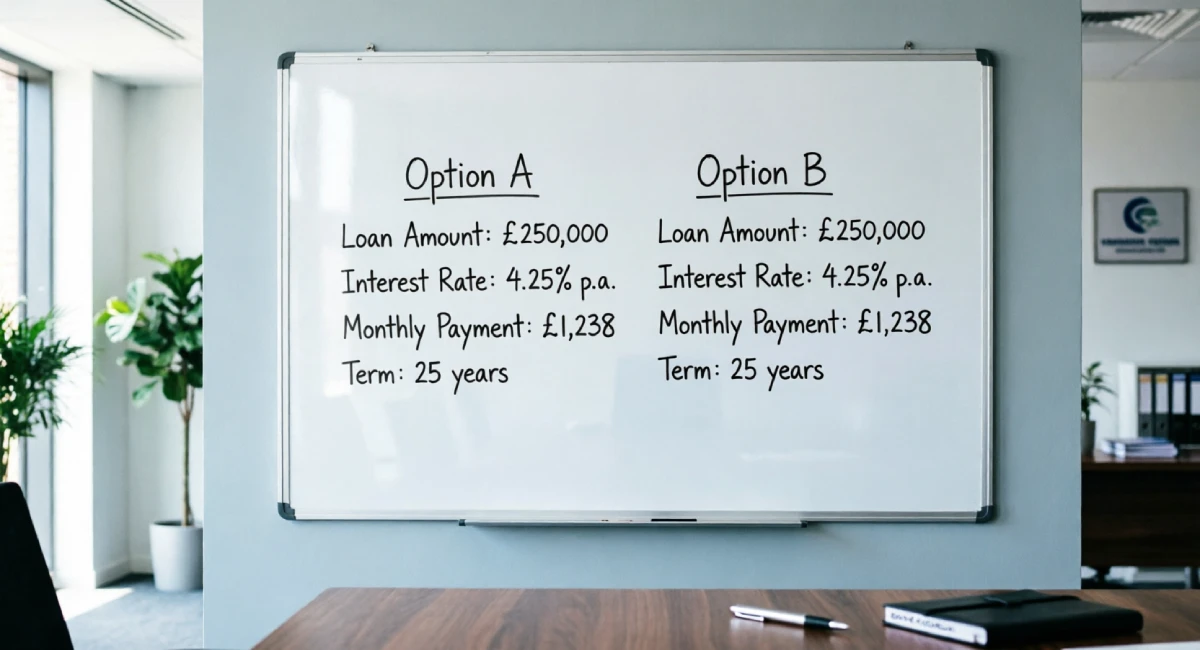
Here is a side-by-side look at how both options compare across the factors that matter most to buyers:
| Factor | Fixed Rate | Variable Rate |
|---|---|---|
| Starting rate | Typically higher | Typically lower |
| Payment stability | Guaranteed for the term | Changes with central bank decisions |
| Early exit penalties | Can be significant (ERCs or break penalties) | Usually lower or more flexible |
| Best-case scenario | Rates rise sharply after you lock in | Rates stay flat or fall during your term |
| Worst-case scenario | Rates drop well below your locked rate | Rates spike and payments become difficult |
The table captures the trade-off clearly. Fixed rates protect you when the market moves against you. Variable rates reward you when the market stays calm or moves in your favour.
Monthly Payment Differences Over a 5-Year Term
To make this concrete, consider a $300,000 mortgage with a 25-year amortisation period.
At a fixed rate of 5.5%, your monthly payment sits at approximately $1,844. Over five years, you pay roughly $104,000 in total, of which around $79,000 goes toward interest.
On a variable rate starting at 4.8%, your opening monthly payment is around $1,717 — about $127 less per month. If rates stay flat for the full five years, you save roughly $7,600 in interest compared to the fixed option.
Now introduce a rate increase. If the variable rate rises by 1.5% over that same five-year term, your monthly payment climbs to approximately $1,900 during the higher-rate periods. Total interest paid over the term moves close to the fixed-rate figure and, depending on the timing of the increases, can exceed it.
The key takeaway: the variable rate offers real savings when rates stay stable, but that advantage erodes quickly in a rising rate environment.
Interest Rate Types and How Lenders Price Each Option
Every lender carries interest rate risk. With a fixed mortgage, the lender takes on that risk because they have agreed to hold your rate regardless of market changes. To compensate, they price fixed rates with a built-in margin above current market levels.
With a variable mortgage, you carry the risk. The lender passes it on to you in exchange for a lower starting rate. That is the fundamental pricing logic behind both interest rate types.
One detail buyers often miss: the way interest compounds can differ between rate types and between markets. In Canada, for example, fixed mortgages compound semi-annually while variable mortgages compound monthly. This affects your effective rate. Always confirm the compounding frequency with your lender before you compare two offers side by side, because a lower advertised rate with monthly compounding can cost more than a slightly higher rate with semi-annual compounding.
Pros and Cons of a Fixed Mortgage Rate
Fixed rates suit a particular kind of buyer. Understanding exactly who benefits and where the drawbacks sit will help you assess whether this is the right structure for you.
Advantages:
- Your monthly payment stays the same for the entire fixed term, making budgeting straightforward
- You are fully protected if central bank rates rise sharply after you lock in
- Peace of mind has real value, especially for first-time buyers managing a new financial commitment
- You can plan long-term finances without accounting for payment variability
Drawbacks:
- Fixed rates start higher than variable rates, meaning you pay more upfront for that security
- If market rates fall during your term, you are stuck paying above the going rate
- Exiting a fixed-rate mortgage before the term ends can be expensive
- Less flexibility if your circumstances change
When a Fixed Rate Works in Your Favour
Fixed rates are a strong choice for first-time buyers who are stretching their budget and cannot absorb unexpected payment increases. If a $300 rise in monthly payments would cause genuine financial stress, the certainty of a fixed rate is worth the premium.
They also make strong sense for buyers entering the market at the beginning of a rising rate cycle. If rates have started moving up and are expected to keep climbing, locking in before they peak can save a considerable amount over the term.
Buyers who intend to stay in the property for the full fixed term also benefit most. If you are confident you will not need to sell, refinance, or restructure the loan during the term, you avoid the break penalties that catch other buyers off guard.
One useful rule of thumb: if the gap between the best fixed rate and the best variable rate is less than 0.5%, the cost of certainty is very low. In that scenario, the fixed option often makes practical sense even for buyers who might otherwise lean toward a variable.
Where Fixed Rates Fall Short
The biggest drawback of fixed rates is the early repayment charge (ERC), also called a break penalty in some markets. If you need to exit the mortgage before the term ends because of a sale, a job move, or a change in finances, you may face a significant penalty.
How are break penalties calculated? Lenders typically use one of two methods. The first is a set number of months of interest, often three months. The second, more expensive method is the Interest Rate Differential (IRD), which calculates the difference between your locked rate and the current rate, applied to the remaining loan balance and remaining term. In a falling rate environment, IRD penalties can run into thousands.
Many buyers do not read the penalty terms carefully when they sign. Knowing this before you commit gives you a much clearer picture of the real cost of the flexibility you are giving up.
Pros and Cons of a Variable Mortgage Rate
Variable rates get a reputation for being the risky choice. That framing is not entirely accurate. The actual picture is more balanced.
Advantages:
- Lower starting rate means lower initial payments and less interest in the early months
- Full benefit when central bank rates fall during your term
- Break penalties are typically lower and simpler than fixed-rate penalties
- More flexible if you plan to sell or refinance within a few years
Drawbacks:
- Payment amounts can rise if central bank rates increase
- Harder to budget precisely when payments are not stable
- Requires active attention to rate news and central bank decisions
- Can be stressful for buyers who prefer financial predictability
When a Variable Rate Can Save You Money
Historically, variable-rate borrowers have paid less interest over time in markets where rates trended downward or stayed relatively stable across a multi-year period. That track record is real, though it comes with the caveat that past rate behaviour does not guarantee future outcomes.
Variable rates are particularly well-suited to buyers with a short-to-medium term horizon. If you plan to sell the property or refinance within two to three years, a variable rate lets you take the lower starting rate without committing to a long fixed term. And when you do exit, the break penalties are typically far smaller than those on a fixed loan.
Buyers with a solid financial buffer also handle variable rates more comfortably. If your monthly budget has room to absorb a payment increase of $200 to $400 without disrupting your finances, the flexibility of variable can work in your favour, especially if rates stay flat or fall.
Buyers entering a period when central banks are expected to cut rates are also well-positioned on variable rates. A falling rate environment means your cost of borrowing drops without you having to do anything.
The Real Risks of Choosing Variable
The 2022 to 2023 rate cycle is the most instructive recent example of what variable rate risk looks like in practice. Central banks across major markets raised rates at a pace not seen in decades. In Canada, the Bank of Canada moved its overnight rate from 0.25% in early 2022 to 5% by mid-2023. Buyers who had taken variable-rate mortgages at record-low rates in 2020 and 2021 saw their payments rise sharply in a very short window.
Some variable rate products include a payment cap, where the actual payment does not change even when rates rise. This sounds like protection, but it creates a different problem: when the payment no longer covers the full interest owed, the shortfall gets added to the loan balance. This is called deferred interest or negative amortisation, and it can leave buyers owing more than they originally borrowed.
Variable rates also require a level of ongoing attention that fixed rates do not. You need to understand how central bank decisions affect your mortgage and be ready to act if your situation changes.
How to Decide Which Mortgage Rate Type Suits Your Situation
There is no universal right answer here. The best mortgage for you depends on three things: your financial resilience, how long you plan to stay in the property, and your honest read on where rates are likely to go.
Financial resilience is the most important factor. If your budget is tight and a payment increase of a few hundred dollars per month would create genuine hardship, predictable payments are worth more than the potential savings of a variable rate.
Your timeline in the property shapes the break-penalty risk. Short-term ownership and fixed rates are a poor combination because of the exit costs involved. If you are confident you are buying a long-term home, fixed rates make more structural sense.
Your view on the rate environment matters too, with the important caveat that nobody predicts rates accurately with consistency. Even professional economists get rate forecasts wrong regularly. Factor in rate direction as one input, not the main driver.
Questions to Ask Yourself Before Choosing
Work through these before you make a decision:
1. Can I comfortably absorb a payment increase of $300 to $500 per month? If not, a fixed rate removes that risk entirely. If yes, a variable rate becomes viable.
2. Do I plan to sell or refinance within three years? If yes, the lower break penalties on variable rates may save you money regardless of what happens with rates. Fixed rates and short timelines are an expensive combination.
3. Am I buying near the top of a rate cycle? If central bank rates are already high and cuts are expected, a variable rate may serve you better over the term. If rates are low and expected to rise, locking in now may make sense.
4. How stable is my income over the next three to five years? Consistent income makes variable rates easier to manage. If your income is project-based or irregular, the certainty of fixed payments has added value.
5. What is the actual gap between the fixed and variable rate on offer? If the fixed rate is 5.5% and the variable is 4.8%, the gap is 0.7%. That is meaningful. If the gap is 0.2%, the case for fixed becomes much stronger on a cost-to-benefit basis.
6. What are the break penalties if I need to exit early? Ask your lender to walk through the exact penalty calculation before you sign. This one question can shift your thinking considerably.
What a Mortgage Comparison Should Include Beyond the Rate
The headline rate is the starting point of a mortgage comparison, not the end of it.
Total cost over the term matters more than the monthly payment. Run the numbers on what you will actually pay in interest over the full fixed term for each option. A lower monthly payment is not always a better deal.
Portability is a feature worth checking. A portable mortgage lets you transfer your existing rate and terms to a new property if you move during the fixed term. Without portability, selling and buying again could trigger break penalties even if you are simply moving home.
Overpayment allowances tell you how much extra you can pay each year without triggering a penalty. Many fixed-rate mortgages allow overpayments of 10% to 20% of the outstanding balance per year. If you plan to pay down your loan faster, confirm this before you commit.
Finally, understand what happens when your fixed term ends. In many markets, if you do not renegotiate, you automatically revert to the lender’s standard variable rate, which is often higher than the rates available if you actively shop around. Build that renegotiation into your calendar from day one.
Mixed and Hybrid Mortgage Options: A Brief Look

Some lenders offer a middle path between fixed and variable, often called a split or hybrid mortgage. This structure lets you divide your loan into two portions, with one portion on a fixed rate and the other on a variable rate.
It is not a perfect solution, but it does offer a genuine compromise for buyers who want partial payment stability without fully giving up the potential savings of a variable.
How Split Mortgages Work in Practice
Here is a practical example. You have a $400,000 mortgage. You put 60% ($240,000) on a fixed rate of 5.5% and 40% ($160,000) on a variable rate starting at 4.8%.
The fixed portion gives you a predictable base payment that will not change regardless of rate movements. The variable portion means you still benefit if rates fall, and your exposure to rising rates is limited to the smaller portion of the loan.
This structure adds a layer of complexity to your mortgage comparison because you are now managing two rate types simultaneously. Not all lenders offer this product, and the terms on each portion need to be evaluated separately. Break penalties on the fixed portion still apply if you exit early. It is worth asking your lender whether the flexibility justifies that added complexity before going this route.
How Interest Rate Decisions Affect Your Mortgage Over Time
Central banks use interest rates as their primary tool to manage inflation and economic activity. When inflation runs above target, central banks raise rates to slow borrowing and spending. When the economy weakens, they cut rates to encourage activity.
Both fixed and variable mortgage holders feel the effects of these decisions, just at different times and in different ways. Variable rate holders feel changes almost immediately, typically within one to two billing cycles of a central bank decision. Fixed-rate holders are insulated during their term but face the consequences when they come to renegotiate.
For buyers evaluating loan options, understanding this connection helps frame the longer-term picture. Your mortgage does not exist in isolation. It is priced against a broader economic backdrop that shifts over the years you hold it.
What Rate Cycles Look Like and Why Timing Matters
Rate cycles follow a recognisable pattern. Central banks lower rates to stimulate the economy, rates stay low during periods of slow growth, and then they raise rates as inflation picks up. That cycle can span several years in each direction.
The 2020 to 2023 period is a vivid recent example. Central banks cut rates to near zero in 2020 in response to the global economic shock of that year. Rates stayed exceptionally low through 2021 as recovery was prioritised. Then, inflation accelerated rapidly into 2022, and central banks reversed course aggressively. By 2023, rates in several major economies had risen to their highest levels in fifteen years. Subsequent adjustments have varied by market.
The stage of the cycle at the time you buy has a real bearing on which rate type performs better over your term. Buying at the bottom of a rate cycle and locking into a low fixed rate has historically been an excellent outcome. Buying near the top of a cycle and taking a variable rate has often led to savings as rates eventually came back down.
The honest caveat: no buyer can time the market reliably. Use the cycle as context, not as a prediction.
Conclusion
Neither fixed nor variable is the universally better choice. Both do exactly what they are designed to do. Fixed rates give you payment certainty in exchange for a premium. Variable rates give you flexibility and a lower entry point in exchange for some exposure to rate movements.
The question is not which rate type is objectively better. It is the one that fits your financial position, your timeline, and your ability to handle payment uncertainty.
If you are working through this decision, take the questions in this article seriously. Run the actual numbers on both options using your loan size and the rates currently on offer. Ask your lender to show you the break penalty calculations in writing. And if your mortgage term is longer than five years, factor in what happens at renewal.
Having fixed vs variable mortgage rates explained in full is only the first step. The next step is matching that understanding to your own situation. For more context on how mortgages work as a whole, take a look at our parent guide: How Does a Mortgage Work for Beginners? And before you commit to any mortgage product, speak with a qualified mortgage adviser who can review your complete financial picture.