


You have three deadlines before noon, your inbox is filling up faster than you can read it, and somewhere between your second coffee and your fourth meeting, a tight feeling settles in your chest. Sound familiar?
- Why Anxiety Hits Harder on Busy Days
- Quick Breathing Techniques You Can Use at Your Desk
- Managing Anxiety During a Busy Day Through Task Structure
- Grounding Techniques That Work Without Leaving Your Workspace
- How Nutrition and Hydration Affect Anxiety on High-Demand Days
- Micro-Movement Breaks That Reduce Anxiety Without Disrupting Work
- Setting Conversational and Digital Boundaries to Protect Your Focus
- Mindset Shifts That Make Anxiety Coping Strategies Stick Long-Term
- Conclusion
Managing anxiety during a busy day is hard because it shows up exactly when you have no time to deal with it. You cannot pause your work, leave the room, or overhaul your routine.
This article gives you low-effort tools that fit inside an already packed day. Every technique here works without privacy, equipment, or more than a few minutes.
Why Anxiety Hits Harder on Busy Days
Most people assume anxiety is a personality trait or a sign that they cannot handle pressure. Neither is true. A demanding schedule creates biological responses that make anxiety worse, regardless of how capable you are.
When you face a packed schedule, your brain registers the volume of tasks as a form of threat. Cortisol, the body’s primary stress hormone, starts rising. That is a normal response. But when it stays elevated throughout the day because the pressure never lets up, you move from ordinary stress into genuine anxiety.
Decision fatigue adds another layer. Every small choice you make during the day draws from the same mental reserves. By mid-afternoon, even simple decisions feel heavier than they should, and that drain feeds directly into anxious thinking.
The other reason standard advice fails busy people is timing. Being told to “take a break” or “step away and breathe” is not useful when you are ten minutes from a meeting or halfway through a timed exam. What you need are tools that work inside the pressure, not around it.
The Role of Cognitive Overload in Daily Anxiety
Your working memory can hold roughly four to seven pieces of information at once. When you push past that limit, which happens quickly on a busy day, your brain starts treating the overflow as a threat to your ability to function.
Picture a student managing three assignment deadlines, a part-time job shift on the weekend, and a group project that has gone quiet. None of those things individually is catastrophic. But held simultaneously in the mind, they create a persistent background hum of worry that is hard to switch off.
This is also where overthinking starts. When your working memory is at capacity, the mind loops over unresolved items rather than moving forward. That cycle of repetitive thinking is closely tied to stopping overthinking. The overload is often what triggers the loop in the first place.
How the Body Reads a Busy Schedule as a Threat
Your nervous system does not have a category for “important deadline.” It only understands safe or unsafe.
When your calendar is stacked and demands keep arriving, your body activates the same fight-or-flight response it would use if you were in physical danger. Heart rate goes up. Muscles tighten. Breathing becomes shallow. Digestion slows.
The problem is that none of those physical responses help you finish a spreadsheet or sit an exam. They were designed for short bursts of physical action, not hours of cognitive work. When you understand this, the anxiety you feel becomes a mechanical response, not a reflection of your competence.
Quick Breathing Techniques You Can Use at Your Desk

Breathing is the one part of your nervous system you can consciously control. That makes it one of the most accessible quick calm techniques, and you do not need privacy, equipment, or more than three minutes to use it.
The two methods below are backed by research and used by people who work in high-stakes conditions. Pick the one that fits your situation.
Box Breathing: A Four-Step Reset for Tense Moments
Box breathing is used by emergency room staff, military personnel, and competitive athletes because it works fast and requires no preparation.
Here is the exact sequence:
- Inhale through your nose for 4 counts
- Hold your breath for 4 counts
- Exhale slowly through your mouth for 4 counts
- Hold again for 4 counts
Repeat the cycle three to five times. The whole thing takes under two minutes.
It works because the extended exhale activates the parasympathetic nervous system, which is your body’s natural calm-down mechanism. Use this before a presentation, at the start of a long study block, or any time your thoughts race ahead of what you can control right now.
The Physiological Sigh: Fastest Known Method to Drop Tension
Researchers at Stanford University identified the physiological sigh as the fastest way the body naturally reduces stress. You have likely done it without knowing — that involuntary double-inhale that sometimes happens when you are overwhelmed.
The technique is simple:
- Take a full inhale through your nose
- Without exhaling, take a short second sniff to top up your lungs completely
- Release it all in one long, slow exhale through your mouth
One or two repetitions are usually enough. Unlike box breathing, this does not require you to count or time anything. It works best for sudden, sharp spikes of anxiety — reading an unexpected email, being put on the spot in a meeting, or receiving difficult news mid-day.
If box breathing is a deliberate two-minute reset, the physiological sigh is a ten-second emergency release. Both belong in your toolkit.
Managing Anxiety During a Busy Day Through Task Structure
How you organize your work has a direct effect on how anxious you feel doing it. This is not about productivity for its own sake. It is about reducing the mental weight that comes from uncertainty. When you do not know what to tackle next, your brain treats that ambiguity as a low-grade threat, and stress at work builds quietly in the background.
Two of the most effective structural approaches are simple enough to start using today.
Why Open Task Lists Make Anxiety Worse
There is a psychological pattern called the Zeigarnik effect. Your brain gives priority attention to unfinished tasks. It keeps them active in the background, nudging you toward them repeatedly because they are unresolved.
An unstructured to-do list leaves everything open at once. Your mind cannot settle because it sees twenty incomplete items with no order, no priority, and no defined time for each.
Compare these two versions of a morning task list:
Unstructured: Write report, reply to emails, prep for meeting, read chapter 4, call supplier, check invoices
Structured: 9:00 am – Write report introduction (30 min), 9:30 am – Reply to three priority emails (15 min), 9:45 am – Review meeting notes (15 min)
The second version creates closure. Your brain knows what is handled and what is not. That alone reduces the background alertness that feeds anxious thinking throughout the day.
Time-Blocking as an Anxiety Coping Strategy
Time-blocking means assigning specific hours to specific types of tasks rather than responding to whatever feels most urgent in the moment.
A student might structure it like this:
- 8:00 to 10:00 am: focused study, no phone
- 10:00 to 10:15 am: short break
- 10:15 am to 12:00 pm: assignments and writing
A professional version might look like:
- 9:00 to 11:00 am: deep work, notifications off
- 11:00 to 11:30 am: emails and messages
- 2:00 to 3:00 pm: meetings or calls
The goal is not to follow the schedule perfectly. It is to remove the daily decision of what to do next. That one change cuts a large amount of friction-related anxiety. When the plan already exists, your mind does not need to stay on alert waiting to figure it out.
Grounding Techniques That Work Without Leaving Your Workspace
When anxiety spikes, the mind tends to leave the present moment and land somewhere in the future — on the thing that might go wrong, the conversation that is coming, the outcome you cannot control yet. Grounding techniques pull attention back to what is physically real right now. They interrupt the spiral before it takes hold.
These are among the most practical anxiety coping strategies because they require no tools, no privacy, and no time away from what you are doing.
The 5-4-3-2-1 Method: A Full Sensory Reset
This technique works by engaging each of your five senses in sequence, which forces your attention into the present and out of the loop of anxious thought.
Work through it in order:
- 5 things you can see right now in your environment
- 4 things you can physically feel (your feet on the floor, the chair under you, your clothes, the temperature of the air)
- 3 things you can hear (background noise, your own breathing, sounds outside)
- 2 things you can smell (or two things you like the smell of, if your environment is neutral)
- 1 thing you can taste
The reason it works is neurological. Your brain cannot fully focus on sensory detail and future-based worry at the same time. Grounding techniques like this are a core part of cognitive behavioral therapy (CBT), used specifically to interrupt rumination and return the mind to the present moment.
A Two-Step Micro-Grounding Method for Time-Pressed Moments
When five steps are not realistic, this shortened version delivers the core benefit in under thirty seconds.
Step 1: Notice one clear physical sensation. Your feet pressed flat on the floor. Your hands resting on a desk or table. The weight of your chair beneath you.
Step 2: Name one thing you can see directly in front of you. Not in your head. Something real and visible right now.
That is it. Two steps, thirty seconds, no tools required.
This works best in moments when anxiety spikes suddenly but you cannot pause — the minute before an exam begins, during a tense exchange with a colleague, or while waiting for feedback that makes you nervous. It does not resolve the situation, but it stops the spiral from accelerating.
How Nutrition and Hydration Affect Anxiety on High-Demand Days
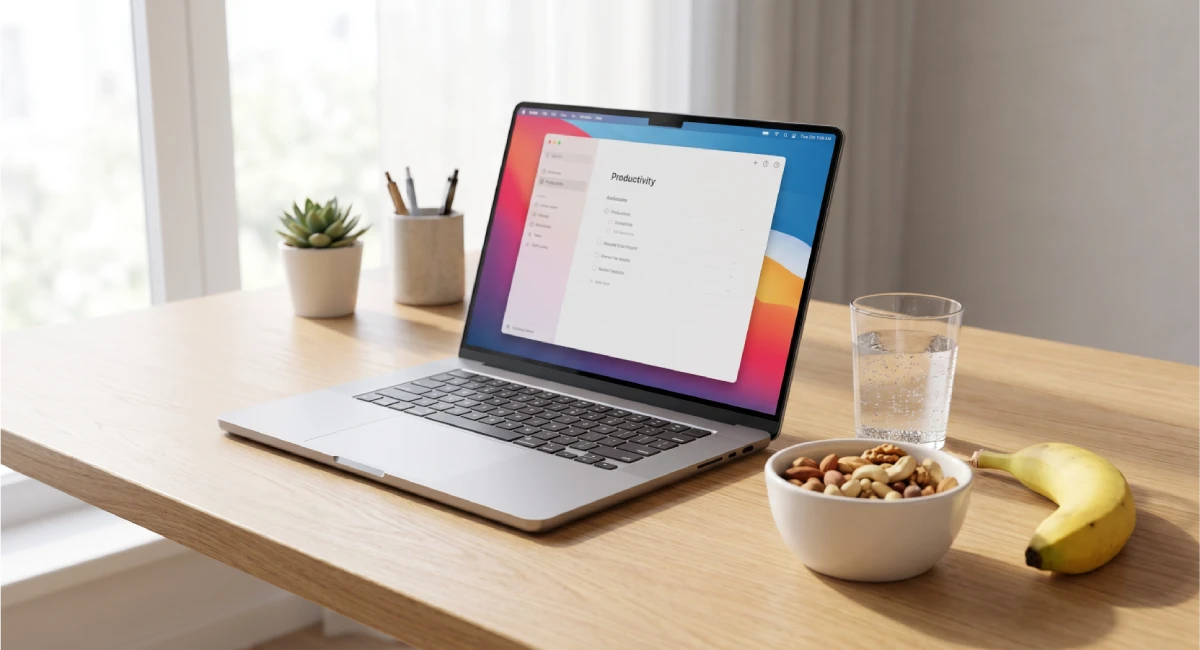
This is the part of anxiety management most people skip because it does not feel psychological enough. But what you eat and drink during a busy day has a direct effect on how your nervous system behaves. Skipping meals, drinking too much caffeine, and going hours without water are common contributors to worsening stress at work and mid-day anxiety spikes.
Caffeine and Anxiety: Where the Line Is
Caffeine works by blocking adenosine, the chemical that tells your brain to slow down. It also raises cortisol and adrenaline. In moderate amounts, that combination sharpens focus. In higher amounts, especially when you are already under pressure, it mimics anxiety symptoms almost exactly: elevated heart rate, jitteriness, rapid breathing, and a sense of being on edge.
Research suggests that up to 400mg of caffeine daily (roughly three to four standard cups of coffee) is safe for most healthy adults. But if you already feel anxious, you are likely hitting the ceiling of what your system can tolerate, even at lower doses.
A practical alternative is green tea. It contains roughly 30 to 50mg of caffeine per cup, paired with L-theanine, an amino acid that produces a calming effect and smooths out the harder edges of caffeine. Many people find they get sustained focus without the jitteriness that black coffee can produce under pressure.
Blood Sugar Dips and Mid-Day Anxiety Spikes
When blood sugar drops, the brain reads it as a threat. The adrenal glands release cortisol and adrenaline to push glucose back into the bloodstream. The side effects of that response — shakiness, difficulty concentrating, irritability, and a vague sense of unease — are nearly indistinguishable from anxiety.
The fix is not complicated. Eat something that stabilizes blood sugar rather than spikes and crashes it. These options work for people who do not have access to a kitchen during the day:
- A small handful of unsalted nuts (almonds or cashews)
- A banana or an apple
- Whole-grain crackers with a small portion of nut butter
- A protein bar with low added sugar
None of these need refrigeration, and all of them provide sustained energy without triggering a blood sugar spike that leads to an afternoon crash.
Micro-Movement Breaks That Reduce Anxiety Without Disrupting Work
Sitting still for long periods is not a neutral state. Physical stillness combined with mental pressure causes tension to build in your body, and that tension feeds the feeling of anxiety. Short, low-visibility movements are one of the most underused quick calm techniques, and most of them take sixty seconds or less.
Desk-Friendly Movements That Signal Safety to the Nervous System
Intense exercise releases cortisol, which is helpful in the right context but counterproductive when you are trying to settle anxiety during a workday. Gentle movement does the opposite. It signals to the nervous system that no threat is active, which is what the body needs to shift out of a stress state.
These four movements can be done at your desk without drawing attention:
- Shoulder rolls: Roll both shoulders slowly forward five times, then backward five times. Releases tension that accumulates from screen posture.
- Neck tilt: Gently drop one ear toward your shoulder and hold for five seconds on each side. Targets the neck and upper back where stress settles.
- Seated forward fold: While seated, drop your head toward your knees and let your arms hang. Hold for ten to fifteen seconds. Activates the parasympathetic response.
- Wrist stretch: Extend one arm, pull your fingers back gently with the other hand, hold five seconds, then switch. Helps if typing is a significant part of your day.
Short Walks as a Pattern Interrupt for Anxious Thinking
Research from Stanford and other institutions has found that even brief walking reduces repetitive negative thinking, the kind that feeds anxiety loops.
A two-to-three-minute walk changes your sensory input completely. New sights, sounds, and physical movement interrupt the mental loop that anxiety relies on to sustain itself. You do not need to go outside. A lap around your office floor, a walk to a different part of your campus building, or even a short trip to refill your water bottle counts.
The key is to walk without your phone. The point is the interruption itself, and checking messages immediately defeats the purpose.
Setting Conversational and Digital Boundaries to Protect Your Focus
A major driver of anxiety that does not get enough attention is the feeling of being constantly accessible. When every notification, message, or passing colleague can interrupt you at any moment, your brain stays in a state of continuous partial attention. It cannot fully commit to any task because it is always waiting for the next interruption. That is a direct contributor to stress at work.
Boundaries do not have to be confrontational. They just need to exist.
Notification Management Without Disconnecting Completely
Checking messages reactively, every time a notification appears, keeps your nervous system in a mild alert state throughout the day. The alternative is notification batching: choosing two or three set times to check and respond, rather than doing it continuously.
Practically, this looks like:
- Turning on Focus Mode (available on both iOS and Android) during your deep work blocks
- Using browser extensions like Freedom or Cold Turkey to block notification-heavy sites during specific hours
- Setting your messaging status to “busy” or “in a meeting” as a signal to colleagues
The psychological benefit here is significant. When you know you will check messages at 11:00 am and 3:00 pm, the pressure to monitor them constantly disappears. Your brain stops treating every unread notification as an open loop. That alone can reduce background anxiety over the course of a day.
Simple Phrases That Set Boundaries Without Conflict
Having a set of pre-written responses for common interruptions removes the pressure of figuring out how to redirect people in the moment. That cognitive load is small but real, and it adds up.
These phrases are neutral, professional, and broadly usable:
- “I have a hard stop at noon. Can we schedule fifteen minutes later today?”
- “I am in the middle of something. Can I get back to you by the end of the day?”
- “Let me put this in my calendar so I do not lose it. I will follow up tomorrow morning.”
- “This sounds important. I want to give it proper attention. Can we talk after 2:00 pm?”
None of these phrases pushes back or creates conflict. They redirect and commit to a specific time, which is far more reassuring to the person asking than a vague “I am busy.”
Mindset Shifts That Make Anxiety Coping Strategies Stick Long-Term
Knowing a technique exists and actually using it when you need it are two different things. Most people have read advice about managing anxiety before. The reason it has not stuck usually has nothing to do with the technique itself.
Treating Anxiety as Information, Not a Problem to Eliminate
There is an important difference between managing anxiety and trying to eliminate it. Trying to eliminate anxiety usually makes it worse, because the effort of suppressing it requires mental energy and tends to amplify the feeling through resistance.
A more useful position is treating anxiety as a signal. It is telling you something. Maybe the workload is too high. Maybe a conversation needs to happen. Maybe you have been skipping the basics — sleep, food, movement — and the system is flagging it.
This connects directly to stopping overthinking. Overthinking often begins when you try to ignore an anxious signal rather than read it. The moment you acknowledge the signal without judging it — “I notice I am feeling overwhelmed right now” — the loop loses some of its intensity. You are no longer fighting it. You are observing it, which gives you a steadier place to respond from.
The Consistency Gap: Why One Technique Is Better Than Ten
The most common pattern with anxiety management tools is collecting them. Reading articles, bookmarking techniques, downloading apps, and then using none of them consistently when it actually matters.
A single technique used reliably outperforms ten techniques used occasionally. Pick one method from this article and commit to using it deliberately for two weeks before adding anything else.
A student might decide: every time I sit down before an exam or a difficult task, I do three rounds of box breathing before opening anything. That is it. One rule, one situation, two weeks.
A professional might try: every time I feel tension building before a meeting, I do the physiological sigh twice before walking in. Simple, specific, and attached to a moment that already exists in the day.
Consistency is what turns a technique into a reliable tool. And a reliable tool is worth far more than a mental library of methods you never quite remember to use when the pressure is on.
Conclusion
Most of what makes anxiety harder to handle on a busy day is not the anxiety itself. It is the absence of small, deliberate responses to it.
You do not need to overhaul your schedule or commit to a lengthy wellness routine. Managing anxiety during a busy day is mostly about having two or three tools you actually trust and use when you need them. A breathing technique that takes ninety seconds. A structured task list that removes ambiguity. A grounding method you can do without moving from your seat.
Pick one technique from this article today. Not tomorrow, not after the busy period ends. Use it once today, in a real moment when you feel the pressure rise. That single action builds more confidence than reading another list of tips ever will.
If this connected with you, the full guide on stopping overthinking without ignoring your thoughts picks up exactly where this one leaves off.