
What Are My Rights If My Landlord Refuses Repairs?
You sent the message. Maybe you sent three. The leak is still dripping, the heating still cuts out at night, and your landlord has gone quiet.
- What Are Landlords Legally Required to Repair?
- Urgent vs. Non-Urgent Repairs: Why the Difference Matters
- How to Submit a Repair Request That Protects Your Rights
- What to Do When Your Landlord Still Refuses Repairs
- Legal Remedies Tenants Can Use Against an Unresponsive Landlord
- Understanding Uninhabitable Conditions Under Housing Law
- Protecting Yourself Against Retaliation
- Keeping Records: The Foundation of Every Successful Tenant Dispute
- You Have More Rights Than You Think
Here is the good news: you have more legal protection than most renters realise. In most jurisdictions, landlords are legally required to maintain safe, livable conditions — whether or not your lease says so. When they refuse, the law gives you a clear path: written request, formal notice, housing authority complaint, and, if needed, formal legal remedies.
This guide covers exactly what your landlord must fix, how urgency changes the rules, and what steps to take — in the right order — when nothing is getting done.
What Are Landlords Legally Required to Repair?
Most people assume their lease tells them everything about who is responsible for what. It does not. Landlords have legal repair obligations that exist outside any tenancy agreement. Even if your lease says nothing about repairs — or tries to shift responsibility to you — the law overrides those clauses.
The foundation of this is a legal concept called the implied warranty of habitability. It means that when a landlord rents out a property, they are making an automatic legal promise that the unit is safe and livable. This promise does not need to be written anywhere. It applies by default.
The core areas landlords must maintain include:
- Structural elements: walls, roof, floors, and staircases
- Plumbing systems, including hot and cold running water
- Heating and, in some jurisdictions, cooling systems
- Electrical wiring and fittings
- Weatherproofing, including windows, doors, and seals
- Common areas in multi-unit buildings
These are baseline expectations under housing law in the United States, United Kingdom, Canada, and Australia.
Repairs Covered Under the Implied Warranty of Habitability
“Habitable” does not just mean the property has four walls and a roof. It means the unit is safe, functional, and fit for a person to live in without a health or safety risk.
Examples include:
- A broken furnace in winter that leaves the unit without heat
- A leaking roof that allows water into living spaces
- Plumbing failures that cut off hot water for extended periods
- Electrical faults that create fire or shock hazards
- Active mould growth caused by structural dampness
- Pest infestations originating from the building itself
If your home has any of these issues and your landlord has been notified, the law is likely on your side.
What Landlords Are Generally NOT Responsible For
Knowing where your landlord’s responsibility ends is just as useful as knowing where it begins:
- Damage caused directly by the tenant or their guests (a broken window from a football, for example)
- Cosmetic wear over time, such as minor paint fading or small carpet marks from normal use
- Appliances supplied as extras that were not part of the original rental agreement
- Repairs the tenant agreed in writing to handle as part of a rent reduction arrangement
This is not about blame. It is about knowing what ground you stand on before you raise a dispute.
Urgent vs. Non-Urgent Repairs: Why the Difference Matters
Not all repair requests carry the same legal weight or timeline. Housing law recognises that some problems are dangerous enough to demand immediate action, while others can reasonably wait a few weeks. Knowing which category your issue falls into tells you what response to expect — and when you are justified in pushing harder.
This also has a practical side. If you treat an urgent issue as routine, you may wait weeks for action you could have demanded in 48 hours. Framing your request correctly from the start protects your rights.
What Counts as an Emergency Repair
Emergency repairs affect health, safety, or the basic habitability of the property. Most housing codes require a landlord’s response within 24 to 72 hours.
Conditions that typically qualify include:
- Complete loss of heating during cold weather
- Gas leaks or suspected carbon monoxide issues
- Sewage backup or flooding inside the unit
- Broken door or window locks that affect security
- No running water or loss of hot water supply
- Rapidly spreading mould in living areas
If any of these apply, your repair request should clearly describe the issue as urgent. Keep a record of the exact time you reported it.
Routine and Non-Urgent Repair Timelines
For repairs that are important but not immediately dangerous, most jurisdictions give landlords between 14 and 30 days to respond and begin work. A dripping tap, a broken internal door handle, or a faulty extractor fan falls into this category.
The key is documentation. The moment you submit your request, that date becomes legally significant. If your landlord has not responded or begun repairs within the standard timeframe for your region, you have a documented basis to move to the next step. Without a written record of when you reported the issue, that timeline is impossible to prove.
How to Submit a Repair Request That Protects Your Rights

This step matters more than most tenants realise. A verbal conversation about a repair problem is not enough. If you ring your landlord, they say they will sort it, and nothing happens for three weeks, you have no record of any of it. In a formal dispute, that conversation did not happen.
Written repair requests do two things: they put your landlord on formal notice, and they start the legal clock. Every step that follows becomes stronger when built on a clear written record.
Always Put Repair Requests in Writing
The best channels for submitting a repair request are:
- Email (keeps an automatic timestamp and a searchable record)
- Certified or tracked postal mail (creates proof of delivery)
- A landlord-provided maintenance portal (if one exists, use it and screenshot each submission)
- Text or messaging apps (acceptable, but follow up with email to consolidate the record)
A good repair request does not need to be long. Include the date, your unit number or address, a clear description of the problem, any relevant history (for example, if this is a recurring issue), and a reasonable deadline for a response — typically 7 to 14 days for non-urgent matters.
Here is a basic structure:
“Dear [Landlord name], I am writing to report a repair issue at [address/unit number]. [Describe the problem clearly, e.g., the kitchen tap has been leaking continuously since [date]]. Please confirm receipt of this message and advise when repairs will be scheduled. I would appreciate a response within 7 days.”
Keep a copy of everything you send.
How to Document the Problem Effectively
Written requests become even stronger when paired with visual evidence. As soon as you notice a problem, take photos and short videos. Turn on timestamps in your phone camera settings so the date and time are embedded in the file.
Beyond photos, keep a written log. Every time you contact your landlord, note the date, the method (email, text, phone), and a summary of what was said or sent. If they promise something verbally, follow it up in writing: “Just confirming our conversation today — you mentioned the repair would be done by [date].”
This documentation does not just help in court. It strengthens your position at every stage, including when dealing with a housing authority or a tenant advocacy service.
What to Do When Your Landlord Still Refuses Repairs
You have submitted a written request. You gave a reasonable deadline. The deadline passed, and nothing happened. Now it is time to act. The steps below work best in sequence — each one builds on the last and increases pressure legally and effectively.
Send a Formal Written Notice Before Escalating
A formal written notice is different from a regular repair request. It is a direct statement that you are aware of your legal rights and prepared to act on them. Its purpose is to create an unambiguous legal record before you take further steps.
Your formal notice should include:
- A summary of the original repair request, including when it was submitted
- A list of any follow-up attempts and their dates
- A clear description of the problem as it stands now
- A final deadline for the landlord to confirm a repair date, typically 7 to 14 days
- A statement that you will contact the relevant housing authority or seek legal advice if the issue is not resolved
Keep the tone factual and calm. You are not threatening — you are informing. Send it by a tracked method and keep a copy.
File a Complaint With a Local Housing or Code Enforcement Authority
Every region has a government body responsible for enforcing housing standards. In the United States, this is typically a local code enforcement office or a city housing department. In the UK, it falls under the local council’s environmental health team. In Canada and Australia, similar bodies exist at the provincial or state level.
When you file a complaint, an inspector is usually assigned to visit the property. If they find a code violation, they issue a formal notice to the landlord requiring repairs within a set period. Landlords who ignore enforcement notices face fines and further legal action from the authority — not just from you.
To find your local authority, search for “housing code enforcement” or “rental property complaints” combined with your city or region name. Most agencies have an online complaint form.
Contact a Tenant Rights Organisation or Legal Aid Service
Free and low-cost support is available in most regions for renters who cannot afford a private solicitor or attorney. These organisations typically offer:
- Advice calls or chat services to help you understand your rights
- Template letters you can adapt for your situation
- Representation in formal proceedings if the case escalates
Search for “tenant advisory service,” “renter legal aid,” or “tenancy support” in your area. Many operate through local government, housing charities, or legal aid schemes. Using these services early saves time and prevents mistakes that are harder to undo later.
Legal Remedies Tenants Can Use Against an Unresponsive Landlord
When informal steps have been exhausted, the law provides formal remedies. These are tools built specifically for situations like yours. That said, every one of these options has conditions, procedural requirements, and risks if done incorrectly. Legal advice before acting is strongly recommended.
Rent Withholding: When and How It Works
In some jurisdictions, a tenant can legally withhold rent when a landlord has failed to maintain habitable conditions and has been properly notified but has not acted. The logic is simple: rent is payment for a livable home, and if the landlord is not providing one, the tenant’s obligation is reduced accordingly.
However, this is not as simple as stopping your payments. Most jurisdictions that allow rent withholding require tenants to:
- Provide formal written notice before withholding anything
- Place withheld rent in a separate escrow account rather than simply keeping it
- Follow a specific legal process, which varies by location
Getting this wrong can result in eviction proceedings, even if you were right about the underlying repair issue. Always confirm the rules in your specific region before withholding rent.
The Repair-and-Deduct Option
Repair-and-deduct allows a tenant to hire a qualified tradesperson to fix a problem and then deduct the cost from the following month’s rent. This right is available in various forms across many U.S. states, several Canadian provinces, and under certain conditions in the UK.
The rules typically include:
- The landlord must have been given proper written notice and adequate time to act
- The repair must fall within the landlord’s legal responsibility
- There is often a cost cap — commonly one month’s rent — beyond which this option cannot be used
- The tenant must provide the landlord with receipts and documentation of the work
This works well for contained repairs, such as a broken boiler valve or a failed door lock. It is not appropriate for major structural work. Always check your local rules before proceeding.
Constructive Eviction: Leaving When the Unit Becomes Uninhabitable
Constructive eviction applies when a property’s condition becomes so severe that a tenant cannot reasonably continue living there. In legal terms, the landlord’s failure to maintain the property has effectively “evicted” the tenant — even though no eviction notice was issued.
When constructive eviction applies, a tenant may be entitled to vacate the property and terminate the lease without penalty. The bar for proving it is high. The conditions must be genuinely serious, the landlord must have been notified and given time to act, and the tenant must not have contributed to the problem.
Documentation is everything here. Without a clear paper trail showing the severity of the conditions and the landlord’s inaction, a constructive eviction claim is very difficult to support.
Understanding Uninhabitable Conditions Under Housing Law
The phrase “uninhabitable conditions” carries specific legal weight. It is not just a way of saying the place is unpleasant. Under housing law, it refers to conditions that fall below the minimum legal threshold for a property to be rented out.
This distinction matters because it is the point where a tenant’s rights shift most dramatically. Once a property is legally uninhabitable, a landlord is not just failing to be helpful — they are in breach of their core legal obligations.
Common Conditions That Violate Housing Codes
Housing inspectors and courts consistently recognise the following as serious violations:
- Severe mould growth in bedrooms, bathrooms, or living areas that poses a health risk
- Active pest infestations, including rodents or cockroaches, originating from the building structure
- Non-functioning heating systems during cold months
- Structural hazards such as failing ceilings, unstable floors, or damaged staircases
- No access to running water or sewage disposal
- Electrical systems with exposed wiring, frequent trips, or fire risk
Each of these gives a tenant a documented, legally recognised basis to act — whether that means filing a complaint, withholding rent through the proper process, or pursuing lease termination.
How Uninhabitable Conditions Affect Your Lease
Many tenants assume that if something is not mentioned in their lease, they have no legal standing. That is not how housing law works.
The implied warranty of habitability is not a clause — it is a legal baseline that applies regardless of what the lease says. If a landlord allows a unit to fall into an uninhabitable state, they are in breach of this baseline, even if the tenancy agreement is completely silent on the subject.
This means a landlord cannot point to a lease clause to avoid repair obligations, and a tenant does not need a specific clause to enforce their rights. The law fills that gap automatically.
Protecting Yourself Against Retaliation
One of the most common reasons tenants do not act on their rights is fear. Fear that reporting a problem will lead to a rent increase. Fear that pushing back will trigger a non-renewal. Fear that complaining will result in an eviction notice.
These fears are understandable — and addressed directly by law. Retaliatory eviction and retaliatory action by landlords is illegal in most jurisdictions. Acting on your legal rights does not put you at greater risk. It puts you in a stronger position.
What Counts as Landlord Retaliation
Retaliation occurs when a landlord takes adverse action against a tenant specifically because that tenant exercised a legal right — such as filing a repair complaint, contacting a housing authority, or withholding rent through legal channels.
Common examples include:
- Issuing a rent increase notice shortly after a complaint is filed
- Delivering a non-renewal or eviction notice with no prior warning, closely following a formal dispute
- Withdrawing services that were previously provided (such as parking, storage, or maintenance response)
- Becoming hostile or unresponsive in ways that were not present before the complaint
Timing is the most important factor. If adverse action follows a complaint by a matter of days or a few weeks, that pattern is legally significant.
How Anti-Retaliation Laws Protect Tenants
In most jurisdictions, anti-retaliation statutes create a legal presumption in the tenant’s favour when adverse action occurs within a defined period after a complaint. That window is commonly 60 to 90 days, though it varies.
This presumption shifts the burden. Instead of you having to prove the landlord acted out of spite, the landlord must demonstrate that their action had a legitimate, unrelated reason. That is a much harder position for them to be in.
Practical step: once you have filed any formal complaint, document every interaction with your landlord. Note the date, the content, and the tone. If anything changes in their behaviour or your tenancy terms, that record becomes your evidence.
Keeping Records: The Foundation of Every Successful Tenant Dispute
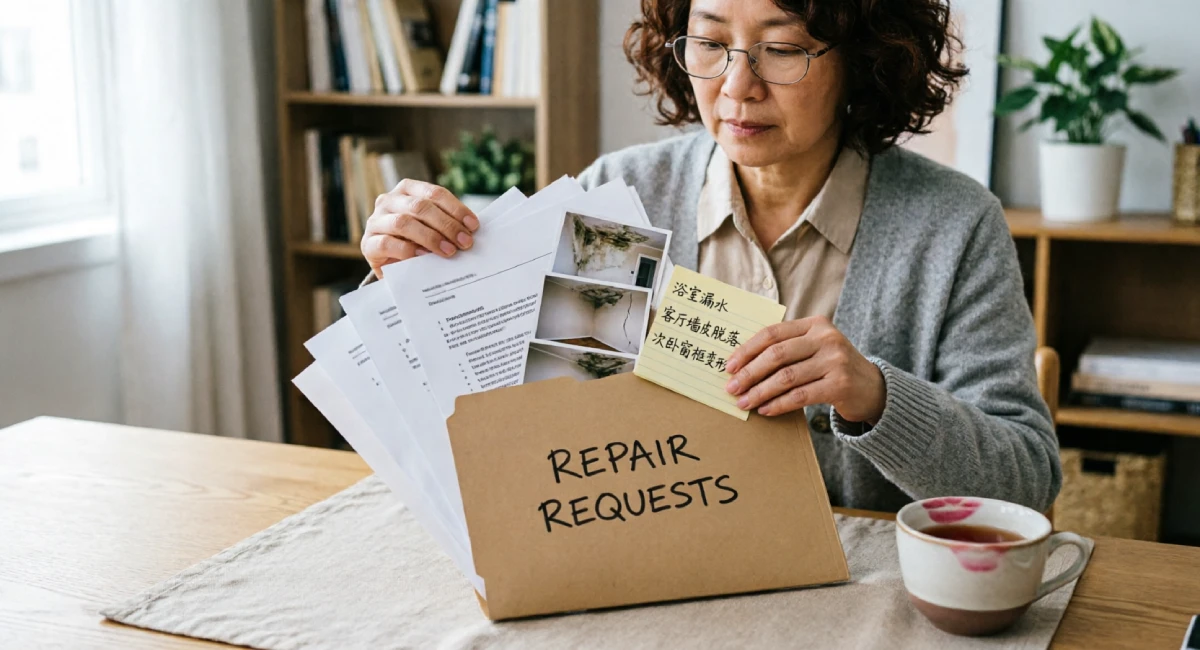
Every piece of advice in this article points back to one thing: documentation. It does not matter how strong your case is if you cannot demonstrate it to a housing inspector, a mediation panel, or a judge. The difference between tenants who get results and those who do not is almost always the quality of their records.
What Records to Keep From Day One
Start building your file from the moment you notice a problem:
- Every repair request you have sent, with the original timestamp intact (forward emails to a personal account as a backup)
- Photos and videos of the problem, with date and time visible in the file name or metadata
- All responses from your landlord, including text messages
- A written log of any phone calls, noting the date, what was said, and any commitments made
- Receipts for any repairs you paid for yourself
- Copies of your tenancy agreement and any relevant clauses
Store these in a single folder — digital or physical — labelled clearly with the property address and date range. A shared cloud folder works well: accessible anywhere and automatically backed up.
How a Paper Trail Strengthens Your Legal Position
Courts, housing authorities, and mediation services all weigh evidence in terms of what can be demonstrated, not just claimed. A well-organised record tells a story: you identified a problem, you reported it promptly and in writing, you gave your landlord a reasonable time to respond, and nothing happened.
That narrative, backed by timestamps and documentation, is exactly what a decision-maker needs to rule in your favour. It shows you acted in good faith. It shows the landlord did not. And it removes any possibility of the situation being dismissed as a miscommunication or misunderstanding.
Tenants who keep records are taken more seriously at every stage of the process, from the first call to a housing authority all the way through formal proceedings.
You Have More Rights Than You Think
When a landlord refuses to carry out repairs, it can feel like there is nothing you can do. That is rarely true. The law in most jurisdictions has built a clear set of protections for renters — from the implied warranty of habitability through to anti-retaliation statutes — and those protections exist for situations like yours.
Understanding your rights is the first step. Acting on them in the right order — written request, formal notice, housing authority complaint, legal remedy — is what turns that understanding into results.
Start with a written repair request today if you have not already. Keep everything. And if the situation is not resolving, reach out to a tenant support organisation in your area before it escalates further. You do not have to navigate this alone, and you do not have to accept a home that falls below the standard you are legally entitled to.