


How Do I Write a Simple Legal Contract That Holds Up Legally?
Most freelancers and small business owners do not lose money because they skipped a contract. They lost it because the contract they used was missing something important. A vague scope clause. No payment terms. No mention of who owns the finished work. Those gaps are expensive.
- What a Simple Legal Contract Actually Needs to Do
- The Four Legal Requirements Every Enforceable Simple Contract Must Meet
- Offer and Acceptance — What Counts and What Does Not
- Consideration — Why Both Parties Must Give Something
- How to Structure a Simple Contract — Section by Section
- Identifying the Parties — Names, Roles, and Contact Details
- The Scope of Work — The Section Most People Write Too Vaguely
- Payment Terms — Amount, Schedule, and Late Fees
- Timeline and Deliverables — Setting Clear Deadlines
- Termination Clause — How Either Party Can Exit
- Governing Law — Which Country or State’s Rules Apply
- Key Clauses to Add When Writing a DIY Legal Contract
- Intellectual Property Ownership — Who Owns the Final Work
- Confidentiality — When to Add a Basic NDA Clause
- Dispute Resolution — Mediation Before Court
- Limitation of Liability — Protecting Yourself From Outsized Claims
- Agreement Writing Tips — How to Word Your Contract Clearly
- Write in Plain, Specific Language — Not Legal Jargon
- Avoid These Common Wording Mistakes That Weaken Contracts
- Use Numbered Clauses and Defined Terms for Clarity
- How to Sign and Store Your Contract Properly
- Are E-Signatures Legally Valid?
- Where and How to Store Signed Contracts
- What to Do When a Client Refuses to Sign
- Free Contract Templates — What to Use and What to Watch Out For
- Conclusion
If you have ever wondered how to write a simple legal contract without hiring a lawyer, you are in the right place. This article covers structure, the clauses that matter most, and the wording mistakes that quietly make contracts unenforceable.
This is not a deep dive into contract law theory. It is a practical guide you can act on today.
What a Simple Legal Contract Actually Needs to Do
A lot of people assume a contract needs to sound complicated to be taken seriously. It does not. Courts do not give extra credit for legal jargon. What they look for is clarity: can they tell what was agreed, by whom, and under what conditions?
The job of any contract is simple. It documents an agreement clearly enough that both parties know exactly what they owe each other. If something goes wrong and a dispute ends up in front of a judge or mediator, the contract should speak for itself.
A well-written simple contract does three things: it sets expectations before work begins, it gives both parties a reference point if the terms are ever questioned, and it signals that you run a professional operation. That last part matters more than people think. Clients who know you take agreements seriously are far less likely to push boundaries.
This article focuses on structure and clauses. For the legal principles behind enforceability, see the parent guide: What Makes a Contract Legally Binding?
The Four Legal Requirements Every Enforceable Simple Contract Must Meet
Before you write a single clause, understand what separates a binding contract from a piece of paper with two signatures on it. There are four requirements. Miss any one of them, and even a signed document can be challenged.
These four elements are: offer, acceptance, consideration, and mutual intent to be bound. Here is what each one means in practice.
Picture a freelance graphic designer, Sarah, who agrees to create a brand identity package for a client’s new café. That scenario will carry through each element below.
Offer and Acceptance — What Counts and What Does Not
An offer is a specific proposal: Sarah sends a proposal stating she will deliver a logo, brand colour palette, and font guide for $2,000, with delivery in three weeks. That is a clear offer. A casual conversation where she says, “I could probably do something like that” is not.
Acceptance must be just as clear. A reply email from the client saying “sounds good, let’s move forward” can legally qualify as acceptance in many jurisdictions, which is why paper trails matter even before a formal contract is signed. The client verbally agreeing at a coffee meeting, then later denying it, is the kind of dispute that ends badly for both sides.
A real example: in a UK small claims case, a web developer lost a payment dispute partly because his “agreement” was a string of informal text messages with no confirmed scope or price. The court could not determine what had been agreed. A clear offer plus a clear acceptance would have prevented the entire situation.
Consideration — Why Both Parties Must Give Something
Consideration is what each party gives in exchange for what they receive. It does not have to be money. It can be services, goods, or a binding promise to act or not act. What it cannot be is nothing.
A one-sided promise is not a contract. If Sarah promises to design the logo but the client commits to nothing, there is no enforceable agreement. Both sides must exchange something of value.
In practical terms, the client promises to pay $2,000 by a set date. Sarah promises to deliver the completed brand identity package by a set date. Each party gives something. That exchange is the consideration, and it is what forms a contract rather than a favour.
How to Structure a Simple Contract — Section by Section
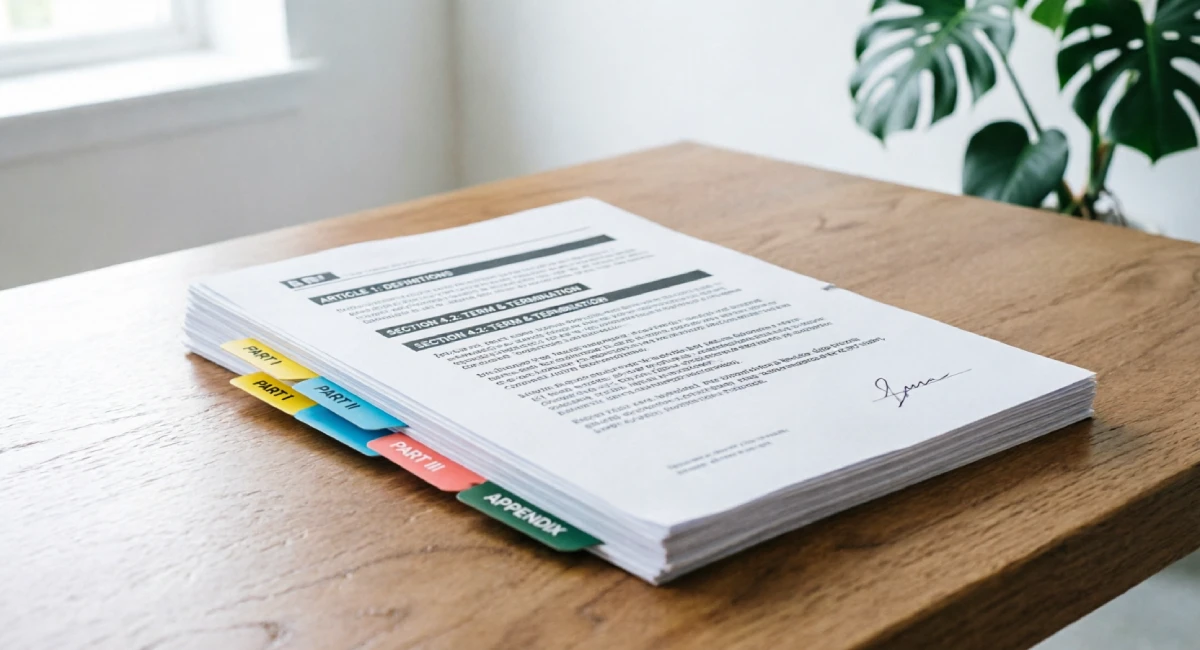
Good contract template basics come down to a logical order. Each section builds on the one before it. If you follow this structure, you cover the essential ground without overcomplicating anything.
Identifying the Parties — Names, Roles, and Contact Details
Start with who is entering the agreement. Use full legal names for individuals. For businesses, use the registered company name exactly as it appears on official documents.
Writing “Jake” instead of “Jake Morrison” or “The Design Studio” instead of “Morrison Creative Ltd.” can cause problems if you ever need to enforce the contract. A judge needs to identify the correct legal person or entity.
A simple format works well here:
This Agreement is entered into by Jake Morrison (“the Service Provider”) and ABC Consulting Ltd. (“the Client”).
Include an email address or registered address for each party. This becomes the official contact for all notices under the contract.
The Scope of Work — The Section Most People Write Too Vaguely
This is where most DIY contracts fall apart. Vagueness in the scope of work benefits whoever did the least. If the contract says “design a logo,” the client can reasonably expect unlimited revisions, multiple file formats, and a brand guidelines document. None of that was agreed upon.
Compare these two versions:
Vague: “The Service Provider will design a logo for the Client.”
Specific: “The Service Provider will design three logo concepts in vector format. The Client may request up to two rounds of revisions on one selected concept. Final files will be delivered as AI, EPS, and PNG formats.”
The second version leaves almost no room for argument. Write your scope the same way. Every deliverable should be named. Every limitation should be stated.
Payment Terms — Amount, Schedule, and Late Fees
State the total amount, when each payment is due, and what happens if the payment is late. Do not leave any of these open.
A simple clause for a deposit might read:
The Client shall pay a non-refundable deposit of 50% ($1,000) upon signing this Agreement. The remaining 50% ($1,000) is due upon delivery of final files.
For late fees, specify a percentage and the period it applies to. Something like: Invoices unpaid after 14 days will incur a late fee of 1.5% per month on the outstanding balance. That rate is enforceable in most Tier-1 markets when stated clearly in a signed agreement.
Always specify the currency. If you work with international clients, “1,500” means nothing without knowing whether that is USD, GBP, CAD, or AUD.
Timeline and Deliverables — Setting Clear Deadlines
Specific dates beat vague timelines every time. Replace “as soon as possible” with an actual date. Replace “final delivery within a few weeks” with “final files delivered by 15 July 2026.”
Also, protect yourself from client-caused delays. A simple clause like this works well:
If the Client fails to provide required materials, feedback, or approvals within five business days of request, the delivery date will be extended by an equivalent number of days.
That one sentence prevents you from being held responsible for a delay the client caused.
Termination Clause — How Either Party Can Exit
Every contract needs an exit path. A fair termination clause covers three things: how much notice is required, what happens to work already completed, and whether any payments already made are refundable.
A practical example:
Either party may terminate this Agreement with 14 days’ written notice. Work completed up to the termination date will be invoiced at the agreed hourly rate. The initial deposit is non-refundable.
This is straightforward enough that both sides understand it on first reading. That is exactly the point.
Governing Law — Which Country or State’s Rules Apply
Add one line specifying which country or state’s law governs the contract. Without it, a cross-border dispute could be argued in either party’s jurisdiction, which is expensive and uncertain.
Keep it simple: This Agreement is governed by the laws of [your country/state].
Always name your own jurisdiction here. Agreeing to the client’s jurisdiction puts you at a significant disadvantage if you ever need to take action.
Key Clauses to Add When Writing a DIY Legal Contract
The sections above give you the skeleton. These clauses add real protection. Most free templates skip them entirely, which is why so many contracts that look fine on paper still leave freelancers and small business owners exposed.
Intellectual Property Ownership — Who Owns the Final Work
For anyone doing creative work, this clause is not optional. Without it, ownership of the finished work defaults to local copyright law — and depending on the jurisdiction, that may not automatically transfer to the client upon payment.
There are two common approaches:
Work-for-hire clause (client owns everything upon full payment): Upon receipt of full payment, all intellectual property rights in the deliverables are assigned to the Client.
Licensing clause (freelancer retains copyright, grants usage rights): The Service Provider retains copyright in all deliverables. Upon receipt of full payment, the Client is granted a non-exclusive, perpetual licence to use the deliverables for the purposes described in this Agreement.
Choose the one that fits your working model and include it in every contract. Leaving it out is a common and costly mistake.
Confidentiality — When to Add a Basic NDA Clause
If a client is sharing sensitive business information with you, a basic confidentiality clause is appropriate. This applies when you are receiving trade data, client lists, product pricing, or business plans as part of the engagement.
A simple clause that works for most situations:
Each party agrees to keep confidential all non-public information received from the other party and not to disclose it to third parties without prior written consent.
This is not a substitute for a formal non-disclosure agreement in situations involving genuinely sensitive IP or high-value commercial data. In those cases, a standalone NDA is worth the extra step.
Dispute Resolution — Mediation Before Court
Legal action is expensive and slow. A dispute resolution clause requires both parties to attempt mediation before going to court. Courts in most countries look favourably on this, and it often resolves disputes faster and at far lower cost.
A one-sentence clause is enough for most simple contracts:
In the event of a dispute, both parties agree to attempt resolution through mediation before initiating any legal proceedings.
This clause does not prevent either party from going to court. It just creates a required first step that often makes the court unnecessary.
Limitation of Liability — Protecting Yourself From Outsized Claims
Without this clause, a dissatisfied client could theoretically claim not just the value of your contract but the downstream business losses they say resulted from your work. That kind of claim can dwarf what you were paid.
A limitation clause caps your exposure:
The Service Provider’s total liability under this Agreement shall not exceed the total fees paid by the Client in the three months preceding the claim.
This is particularly important for service providers. A web developer whose site goes down, or a consultant whose advice a client blames for lost revenue, can face claims far larger than the original fee. This clause limits the risk to a reasonable amount.
Agreement Writing Tips — How to Word Your Contract Clearly
A contract written in plain English is no less enforceable than one filled with legal terminology. Courts interpret contracts based on what the words mean, and plain words are less likely to be disputed. Here are the agreement writing tips that make the biggest practical difference.
Write in Plain, Specific Language — Not Legal Jargon
Compare these two versions of the same clause:
Legalistic: The party of the first part shall hereinafter be obligated to remit compensation in the amount heretofore specified within the period designated therein.
Plain English: The Client will pay the agreed amount within 14 days of receiving an invoice.
Both say the same thing. The second version is understood immediately by both parties and interpreted consistently by anyone reading it later. The first version invites argument about what “hereinafter” and “therein” actually refer to.
Courts often apply the “contra proferentem” rule: when a clause is ambiguous, it is interpreted against the party who wrote it. Writing clearly protects you as the drafter.
Avoid These Common Wording Mistakes That Weaken Contracts
Four specific mistakes appear repeatedly in DIY contracts:
- Using “shall” inconsistently: “Shall” implies a mandatory obligation. If you use it in some clauses but not others, it creates uncertainty about which terms are binding. Pick one approach and use it throughout. “Will” works just as well and reads more naturally.
- Writing “approximately” for dates or amounts: “Approximately $2,000” or “approximately four weeks” means nothing enforceable. Use specific numbers and specific dates every time.
- Leaving currency unspecified: On international contracts, always state the currency. “$2,000” in a contract between a Canadian freelancer and a US client is genuinely ambiguous.
- Using “and/or”: This construction creates confusion. “The client and/or the contractor” does not specify who is responsible. Choose “and” or “or” based on what you actually mean.
Use Numbered Clauses and Defined Terms for Clarity
Number every clause. When a dispute arises, referring to “Clause 4.2” is far cleaner than saying “the part about late fees.” It removes any ambiguity about which part of the contract is being discussed.
Define key terms once, near the top of the contract, then use those defined terms consistently throughout:
“The Client” means ABC Consulting Ltd., registered at [address].
After that line, “the Client” appears everywhere instead of the full name. It keeps the document clean and removes the risk of inconsistency if the name is ever written differently in different sections.
How to Sign and Store Your Contract Properly
Writing a solid contract is only half the job. Getting it signed correctly and keeping a reliable record of it matter just as much. A contract you cannot produce in evidence is very difficult to enforce.
Are E-Signatures Legally Valid?
Yes, in all four major Tier-1 markets. Electronic signatures are recognised under the following laws:
- USA: The ESIGN Act (2000) and the Uniform Electronic Transactions Act
- UK: The Electronic Communications Act (2000)
- Canada: The Uniform Electronic Commerce Act, adopted in all provinces
- Australia: The Electronic Transactions Act (1999)
Commonly used e-signature tools include DocuSign, HelloSign, and Adobe Sign. Any of these creates a timestamped, auditable record of who signed and when.
For high-value contracts, property transactions, or any agreement that local law specifies must be in writing and witnessed, a physical “wet” signature is still the safer choice. E-signatures are ideal for the day-to-day contracts that freelancers and small business owners work with regularly.
Where and How to Store Signed Contracts
Keep signed contracts in a dedicated cloud folder organised by client name and project date. If the contract went through several rounds of revision before signing, keep those versions too. Revision history can matter if either party later claims the terms were different.
Store both a signed PDF and the original editable file. The signed PDF is your legal record. The editable file is your reference when you write the next contract for the same client.
Most accountants and legal professionals recommend keeping business contracts for at least seven years. This covers the standard limitation period for contract disputes in most Tier-1 markets.
What to Do When a Client Refuses to Sign
Do not start work without a signed agreement. That rule is worth holding to even when the client pushes back.
If a client is genuinely reluctant but verbally confirms the terms, send a follow-up email summarising everything that was agreed: scope, price, timeline, and payment terms. Start the email with something like: “As agreed in our conversation today, here is a summary of the terms for this project…”
That email creates a paper trail. Courts in several jurisdictions have treated clear written exchanges as binding agreements, even without a formal signed contract. It is not as strong as a signature, but it is far better than nothing.
Free Contract Templates — What to Use and What to Watch Out For
Downloading a free template is a reasonable starting point. The risk is not the template itself. The risk is using one designed for a different legal jurisdiction without checking whether its clauses apply where you work.
Where to Find Reliable Simple Contract Templates
Government small business portals are the most trustworthy source. These include:
- USA: The Small Business Administration (sba.gov) and state-level business portals
- UK: GOV.UK business resources
- Australia: Business.gov.au
- Canada: Canada Business Network (canada.ca)
Professional freelancer associations often publish reviewed templates specific to their industry. Legal aid organisations in many countries also provide free, lawyer-reviewed templates for small business use.
These sources are preferable to random template sites because the documents are checked against the legal requirements of the relevant jurisdiction and updated when laws change.
How to Customise a Template Without Weakening It
Four steps make this process much safer:
- Replace every placeholder immediately. Names, dates, amounts, and addresses. Leaving a “[INSERT CLIENT NAME]” in a final contract is embarrassing and can create ambiguity about whether the document was ever properly completed.
- Remove clauses that do not apply, but read them first. A clause about sub-contracting may seem irrelevant until you realise it is the one that would have protected you from a client claiming you delegated their work without permission.
- Check the governing law clause. If the template was written for a US audience but you are based in Canada, update that clause to reflect your jurisdiction.
- Read the finished contract aloud. If a sentence stops you because it sounds odd or unclear, rewrite it. If you find it confusing, a court will too.
Conclusion
Writing a simple legal contract does not take a law degree. It takes clarity, a logical structure, and the right clauses in the right order.
Five things will protect you in almost every situation: name both parties correctly, describe the scope of work with specific detail, state payment terms without ambiguity, include the protection clauses that most templates skip, and sign and store the document properly.
If you want to go deeper on what makes any contract actually enforceable, the parent guide on What Makes a Contract Legally Binding? covers the legal principles behind every step in this article.
Knowing how to write a simple legal contract is one of the most practical skills you can build as a freelancer or small business owner. You do not need a lawyer for every project. You do need a clear agreement that both parties understand and respect. Start with the structure above, and you are already ahead of most people doing business without any protection at all.