

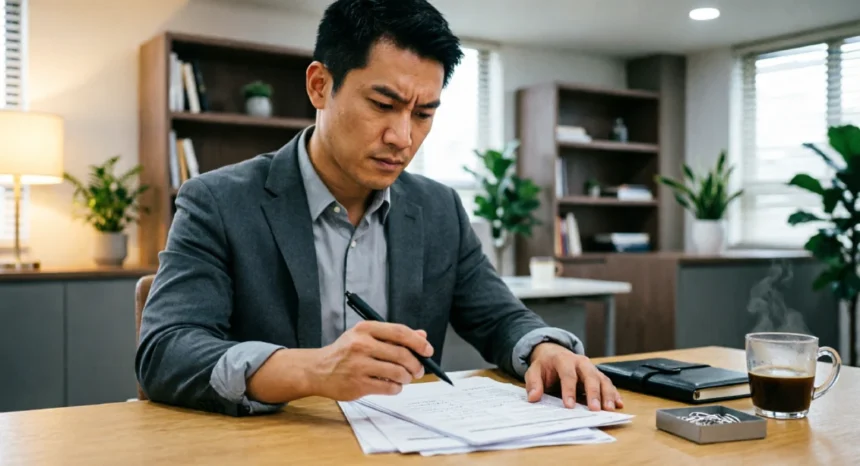
Someone slides a contract across the table and tells you it is standard. You scan a few pages, nothing jumps out, and the pressure to just sign takes over. Most people never consider the risk of signing without a lawyer until something goes wrong.
- What Does It Mean to Sign a Contract Without Legal Review?
- Common Situations Where People Skip Legal Advice on Contracts
- Real Risks of Signing a Contract Without a Lawyer Reviewing It
- When Contract Review Becomes Non-Negotiable
- When Signing Without a Lawyer Is Generally Acceptable
- Practical Alternatives to Full Legal Review
- Common Contract Mistakes to Avoid When Signing Without Legal Support
- Conclusion
Not every contract needs a lawyer. But the ones that do rarely look risky on the surface. This article explains what legal review covers, which situations call for it, and when you can safely move forward without one — so you can make that call with confidence every time.
What Does It Mean to Sign a Contract Without Legal Review?
Legal review is not just someone reading a document. It is a trained professional assessing whether the terms are fair, enforceable, and complete based on the laws that apply to your situation.
Reading a contract yourself is something anyone can do. Understanding what it commits you to is a different matter. Legal language is precise in ways that plain reading can miss. A clause that looks like a formality can be the very thing that determines the outcome of a dispute years later.
The stakes vary widely between contract types. Agreeing to an app’s terms of service carries very little personal risk. Signing a commercial lease or a business partnership agreement without review is a different situation entirely. Context determines whether skipping a professional review is a reasonable shortcut or an expensive mistake.
The Difference Between Reading a Contract and Understanding It
You can read every word of a contract and still miss what it actually means. Legal documents use defined terms that carry specific meanings, and those definitions are often buried in earlier clauses or attached schedules.
Consider a freelance services agreement that says the client owns all “work product.” That sounds straightforward. But if the definition of work product includes anything you created using your own tools or time — even work unrelated to the project — you may have unknowingly assigned ownership of materials you intended to keep.
Implied terms, jurisdiction-specific rules, and conflicts between clauses add further complexity. Two sections of the same contract can contradict each other, and a court will apply legal principles to resolve the conflict — principles most people have never heard of.
What a Lawyer Actually Checks During a Contract Review
When an attorney reviews a contract, they are looking for risks that a general reading would not catch.
They check whether key clauses are enforceable under the applicable law. They look for missing protections, such as what happens if one party fails to perform. They assess liability limits, termination rights, and whether the dispute resolution process is practical for someone in your position.
They also look at what is not in the contract. Missing terms can be just as important as problematic ones. A contract with no clear payment schedule, no warranty, and no exit clause is not just incomplete; it is a source of future conflict.
Common Situations Where People Skip Legal Advice on Contracts

Most people skip legal advice on contracts for four reasons: time pressure, cost, social pressure, or a belief that the document is too simple to warrant attention. Some of those reasons are valid. Others create real exposure.
The situations below are the ones people most often wish they had reconsidered. Some carry moderate risk. Others carry serious financial or professional consequences.
Employment Contracts: When the Offer Feels Too Good to Question
When a job offer arrives, the instinct is to accept quickly before something changes. That urgency can cause people to skip the parts of the contract that will shape their career long after the excitement fades.
Non-compete clauses can prevent you from working in your industry for one to two years after leaving. IP ownership clauses can assign your employer the rights to work you create in your personal time using your own equipment, if the clause is broad enough. At-will employment language can eliminate protections you assumed you had.
These terms are legal, common, and often negotiable. Most people never ask.
Rental and Lease Agreements: Trusting the Landlord’s Template
A lease presented as “standard” is standard for the landlord, not necessarily for you. Landlord-drafted leases are written to protect the landlord’s interests, and that is entirely normal. It just means the tenant needs to read carefully.
Clauses around security deposit deductions, early termination penalties, who is responsible for specific repairs, and subletting restrictions vary significantly from one lease to another. A clause that says the tenant is responsible for all maintenance under a certain dollar threshold could cost hundreds of dollars over a tenancy.
These are not obscure legal traps. They are ordinary terms that carry real financial consequences if ignored.
Business and Vendor Agreements: Where the Stakes Are Highest
B2B contracts operate under different rules than consumer agreements. Consumer protection laws offer a safety net for individuals. Businesses negotiating with other businesses are largely expected to look after themselves.
That means indemnification clauses, limitation of liability caps, and payment terms are all negotiable. The version you are handed is almost always the one that benefits the other party most. Financial consequences in these agreements scale with the deal size, and a problematic clause in a six-figure contract can be costly to unwind.
Real Risks of Signing a Contract Without a Lawyer Reviewing It
The following are not hypothetical. They are problems that come up regularly when people sign agreements without adequate review.
Agreeing to Terms You Cannot Legally Exit
Lock-in clauses and automatic renewal terms are two of the most common sources of contract regret. A service agreement that automatically renews for another 12 months unless you cancel within a 15-day window each year is easy to miss at signing and very difficult to escape once triggered.
The absence of a termination right is equally significant. Some contracts have no exit provision at all, meaning your only options are to fulfil the full term, negotiate a mutual release, or breach the contract and accept the consequences.
A lawyer reviewing the contract would identify this immediately, and either flag it or help you negotiate a clear exit mechanism before you sign.
Waiving Rights You Did Not Know You Had
Contracts routinely include waivers of rights that most signers do not realise they hold. Mandatory arbitration clauses, for example, require you to resolve disputes through a private process rather than through the courts. Class action waivers prevent you from joining with others in a collective legal claim.
Courts in many jurisdictions uphold these waivers even when the signer argues they did not understand what they were agreeing to. The legal principle is simple: if you sign it, you are presumed to have read and understood it.
The practical effect is that some waivers make it financially impractical to pursue a legitimate grievance, because the cost of arbitration or individual litigation exceeds the value of the claim.
Personal Liability Hidden in Plain Sight
Personal guarantee clauses appear frequently in business contracts, and they are easy to overlook because they are often positioned among other routine terms rather than highlighted separately.
A personal guarantee means that if the business entity cannot meet its obligations under the contract, the individual who signed the guarantee becomes personally responsible for the debt or damages. This exposes personal assets, not just business assets, to a claim.
Business owners and directors are the most common targets of these clauses, but they also appear in contracts signed by employees or representatives who do not always realise what they are agreeing to.
Jurisdiction and Governing Law: The Clause Most People Ignore
The governing law clause determines which jurisdiction’s legal system applies to any dispute arising from the contract. The dispute resolution clause determines where and how that dispute must be handled.
If a contract requires disputes to be resolved through arbitration in another country, under that country’s laws, the cost of enforcing your rights may be far beyond what the dispute is worth. In practice, this means you have signed away your ability to seek a practical remedy even if you are clearly in the right.
This clause is typically short, positioned near the end of the contract, and almost universally skipped by people reading without legal guidance.
When Contract Review Becomes Non-Negotiable
Some situations call for legal review before you even read the first clause. If your situation matches any of the following, get legal input before signing.
High-Value or Long-Term Commitments
A useful rule of thumb: if the financial exposure under the contract — including potential liability, not just the stated value — exceeds a few thousand dollars, professional review is worth the cost.
The same logic applies to long-term commitments. A five-year commercial lease, a three-year software licensing agreement, or any contract that limits your options for an extended period should be reviewed carefully. The longer you are bound, the more a single problematic clause can cost you.
Property, equity, and intellectual property transactions belong in this category regardless of the specific dollar amount, because the assets involved carry value that goes beyond the immediate deal.
Contracts Involving Your Business, IP, or Future Earnings
Partnership agreements define how profits are split, how decisions are made, and how the partnership ends. Licensing deals determine what you can and cannot do with your own creative or technical work. Revenue-sharing arrangements can be structured in ways that seem fair on paper but compound against you over time.
IP assignment clauses deserve close attention. Signing away intellectual property rights, even partially, can have long-term consequences that are difficult and expensive to reverse. A lawyer reviewing these documents before signing costs a fraction of what it costs to dispute the terms later.
Situations Where the Other Party Has Legal Representation
When the other party has a lawyer, and you do not, you are reading a document that was designed by a legal professional to serve the other side’s interests. The terms presented may appear fixed or industry-standard. Most of the time, they are neither.
Professionally drafted contracts are not written to be balanced. They are written to be favourable to the drafting party while remaining legally enforceable. Without equivalent input on your side, you are accepting terms you may not fully understand, drafted by someone who understands every word.
When Signing Without a Lawyer Is Generally Acceptable
Not every contract requires paid legal review. The goal here is not to create anxiety about every piece of paperwork. It is to help you tell the difference between contracts where your own reading is enough and those where it is not.
Standard Consumer Agreements and Low-Stakes Transactions
App terms of service, subscription agreements, and low-value purchase contracts generally do not require a lawyer. The terms are often non-negotiable, the financial exposure is limited, and the downside is small.
Reading them carefully still matters. Knowing what data an app collects, understanding a return policy, or checking whether a subscription auto-renews are all worth knowing. They just do not require a lawyer.
Contracts With Clear Plain-Language Terms and No Hidden Clauses
Some contracts are straightforward. Before deciding whether to sign without review, run through this quick check:
- Are the obligations of both parties clearly stated?
- Are the payment terms, deadlines, and deliverables specific?
- Is there a clear way to end the contract if needed?
- Are there no cross-references to documents you have not seen?
- Is the language plain and free of dense legal terminology?
If the answer to all five is yes, you are likely looking at a lower-risk document. If you are unsure about any of them, that is the moment to ask questions before signing.
Practical Alternatives to Full Legal Review

Full legal review from a private attorney is not the only option. Cost and access are real barriers for many people, and the gap between “hire a lawyer” and “sign blind” contains several useful alternatives.
Online Legal Review Services and Flat-Fee Consultations
A growing number of legal services offer contract review at fixed, transparent prices. These typically range from a written summary of key risks to a brief consultation with a qualified lawyer. For straightforward agreements, this can be sufficient, and the cost is predictable.
Many bar associations and legal aid organisations also operate lawyer referral schemes that include reduced-cost initial consultations. These vary by region, but they are worth checking before assuming that legal advice is financially out of reach.
Using AI Contract Review Tools: What They Can and Cannot Do
AI-based contract analysis tools can scan a document and flag unusual or potentially problematic clauses. They are a useful first filter, particularly for identifying terms that warrant a closer look.
They have clear limitations, though. They cannot provide legal advice. They cannot assess how a specific clause interacts with the laws of your jurisdiction. And they are only as good as the data they were trained on. For routine, lower-stakes contracts, an AI review tool can be a helpful starting point. For anything high-value or complex, treat it as a preliminary screen, not a final answer.
Negotiating Contracts Before Signing: You Have More Room Than You Think
Most commercial contracts are presented as final documents, and most people accept them that way. In practice, nearly all of them are negotiable.
Asking for a different payment schedule, requesting the removal of an automatic renewal clause, or pushing back on an overly broad IP assignment are all standard practice. Parties who use standard templates often expect some negotiation and are prepared for it.
Common areas where negotiation often succeeds include liability caps, payment terms, notice periods for termination, and the scope of IP ownership. You do not need a lawyer to ask for changes. You may, however, want one to confirm that the changes actually protect you.
Common Contract Mistakes to Avoid When Signing Without Legal Support
Even when legal review is not realistic, most contract mistakes are avoidable with the right habits. These are the errors that come up repeatedly when contracts turn into disputes.
Signing Under Time Pressure Without Requesting an Extension
Urgency is frequently manufactured. “We need this by the end of the day” is a negotiating tactic as often as it is a genuine constraint. A counterparty with a real interest in working with you will almost always grant a short extension for review.
If someone refuses to give you 48 hours to read a contract properly, that is useful information. It may signal that the terms would not survive scrutiny, or it may simply reflect poor business practice. Either way, treat pressure to sign right away as a reason to slow down and ask why.
Not Keeping a Signed Copy for Your Own Records
This is one of the simplest contract mistakes, and it happens constantly. Both parties sign, the counterparty takes the copy, and you are left without a record of what you agreed to.
Always retain a fully executed copy of every contract you sign, including all attached schedules, exhibits, and any amendments that follow. If a dispute arises later, you need to be able to produce exactly what was agreed. Relying on the other party to share the document when a disagreement has already started is not a position you want to be in.
Assuming Verbal Assurances Override Written Terms
This is where skipping legal review causes the most visible damage. Someone tells you before signing that a particular clause “never really gets enforced” or that they will handle things differently in practice. You sign on that basis. The relationship later breaks down.
The legal principle known as the parol evidence rule generally prevents either party from introducing verbal statements made before signing to change the meaning of a written contract. Courts apply the document, not the conversation.
If a verbal assurance matters to you, it needs to be in the contract. Ask for it to be added before you sign. If the other party refuses to include something they claim is already understood, that tells you something important about the agreement you are being asked to make.
Conclusion
Skipping legal review is not always a mistake. For routine, low-value agreements with plain language and limited liability, your own careful reading is often enough. The question is whether you can honestly identify which category your contract falls into.
The risk of signing a contract without a lawyer becomes real when the stakes are high, the language is dense, the other party has professional support, or when your rights are being waived in ways you have not noticed. In those situations, the cost of an hour with a lawyer is almost always less than the cost of untangling a problem after signing.
Before you put pen to paper on anything significant, take the time to understand what you are agreeing to, and if any part of it is unclear, ask for clarification or get a second opinion. A short delay before signing is far easier to manage than a long dispute after.