
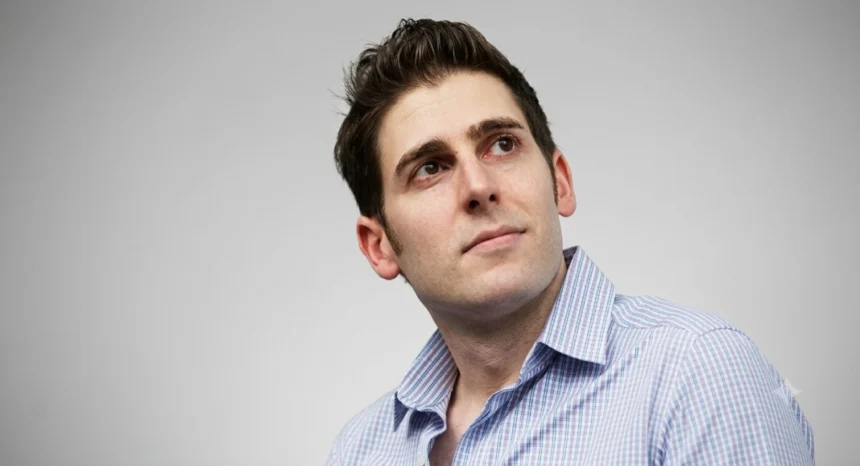
Most people know Eduardo Saverin as the character Andrew Garfield played in The Social Network — the co-founder who was cut out of Facebook by Mark Zuckerberg. That story made for great cinema, but it’s only half the picture.
The more interesting story is what happened after Saverin lost his seat at the table of the world’s largest social network. As of May 2026, the answer is a net worth of $33.2 billion, according to Forbes.
This article looks at where that fortune actually comes from — not just the Facebook stake most articles focus on, but the venture capital firm Saverin has spent the last decade building, and why it’s become just as important to his current wealth.
Where Eduardo Saverin Came From
Eduardo Luiz Saverin was born on March 19, 1982, in São Paulo, Brazil, into a family that was already wealthy. His father, Roberto Saverin, ran businesses across clothing, shipping, energy, and real estate, and his grandfather Eugenio had founded Tip Top, a well-known chain of children’s clothing shops in Brazil.
In 1993, the Saverin family left Brazil for Miami, Florida, a move influenced in part by Brazil’s economic instability at the time. Eduardo attended Gulliver Preparatory School and became a U.S. citizen at eighteen.
By the time he reached Harvard, Saverin already had a track record with money. While studying economics, he used an interest in meteorology to track hurricane patterns and reportedly earned roughly $300,000 investing in oil futures. He graduated magna cum laude in 2006 with a degree in economics, served as president of the Harvard Investment Association, and belonged to the Phoenix S.K. Club and the Alpha Epsilon Pi fraternity.
Co-Founding Facebook
Saverin met Mark Zuckerberg through their shared fraternity during his junior year at Harvard. In 2004, the two of them, along with fellow students, launched “thefacebook.” Each contributed $1,000 to get it running, and later added another $18,000 apiece. Saverin took the title of chief financial officer and handled the company’s early incorporation and advertising strategy.
He was Facebook’s first real business operator — Zuckerberg wrote the code, Saverin structured the company and brought in early revenue.
That partnership didn’t last. By 2005, Saverin’s role at Facebook had effectively ended amid growing disputes over his equity. Internal emails later published by Business Insider showed plans to reduce his ownership stake, along with attorney warnings about the legal risk of doing so. Facebook sued Saverin over a 2005 stock agreement; he countersued over alleged misuse of company funds. The case settled out of court in 2009, with Saverin retaining recognition as a co-founder and agreeing to a non-disclosure agreement about the terms.
Whatever the specifics, the outcome was clear: Saverin was pushed out of a company that went on to become one of the most valuable in the world, and he watched much of that growth from outside it.
The Move to Singapore
In 2009, Saverin relocated to Singapore. In 2011, ahead of Facebook’s 2012 IPO, he renounced his U.S. citizenship.
The decision drew immediate scrutiny. Reports at the time estimated he avoided roughly $700 million in U.S. taxes by renouncing before the IPO, and the IRS listed him in its official record of individuals who had expatriated that year.
Saverin has consistently said tax planning wasn’t the reason. He has pointed to his interest in Asia’s technology scene and his relationship with Elaine Andriejanssen, an Indonesian businesswoman he had known since their college years — she attended Tufts while he was at Harvard. The couple married in 2015.
Whichever explanation carries more weight, the move positioned him well for what came next.
Building B Capital
This is the part of Saverin’s story that gets far less coverage than the Facebook years, despite arguably being more consequential to his current wealth.
In 2015, Saverin co-founded B Capital with Raj Ganguly, a friend from Harvard, along with Howard Morgan. Rather than start small and expand gradually, the firm opened offices in San Francisco, Los Angeles, New York, and Singapore from the outset, and formed a strategic alliance with Boston Consulting Group that gave its portfolio companies access to BCG’s consulting network.
B Capital’s first fund raised $360 million. The firm has grown steadily since:
| Year | Fund | Amount Raised |
|---|---|---|
| 2015 | B Capital Fund I | $360 million |
| 2022 | Ascent Fund II | $254 million |
| 2026 | Ascent Fund III | $500 million (hard cap) |
Ascent Fund III closed in July 2026, oversubscribed and nearly double the size of its predecessor, driven by investor demand for early-stage AI companies. The fund has already backed more than 20 companies across AI infrastructure, robotics, and healthcare, including Apptronik, Havoc AI, and Star Catcher. That close pushed B Capital’s total assets under management past $12 billion.
Saverin has also personally invested in Antler, an early-stage venture fund and accelerator founded by fellow Harvard alum Magnus Grimeland.
“No matter how lucky or blessed I might be, I will never retire on a beach,” Saverin has said of his continued involvement in the firm.
Eduardo Saverin’s Net Worth in 2026
As of May 13, 2026, Forbes estimates Saverin’s net worth at $33.2 billion, ranking him 68th richest in the world. That makes him:
| Category | Ranking |
|---|---|
| Wealthiest Brazilian | #1 |
| Wealthiest person in Singapore | #1 |
| Richest person in Latin America (by origin) | #3 |
| Global billionaire rank | #68 |
Most of that wealth still traces back to his remaining Meta stake — the exact size of which isn’t public, due to the 2009 settlement’s non-disclosure terms. But B Capital’s growth has become an increasingly meaningful part of the picture. His net worth has climbed substantially over the past several years: Forbes valued him at around $10 billion in 2019, roughly $25–27 billion in 2023, and $33.2 billion by mid-2026 — a trajectory shaped both by Meta’s stock and by the expansion of his venture capital business. It’s worth noting that estimates vary by source and by the day markets move; other trackers have placed the figure anywhere from $30 billion to the high $30 billions depending on when the snapshot was taken.
Family and Philanthropy
Saverin and Elaine Andriejanssen married on June 25, 2015. She comes from a prominent Indonesian business family. The couple has children together.
In 2023, they registered the Eduardo and Elaine Saverin Foundation in Singapore, directing their giving toward education, wildlife conservation, healthcare, and mental health. According to the Straits Times, the foundation ranks among Singapore’s ten largest private donors.
What the Story Actually Teaches
A few things stand out from Saverin’s path that are worth taking seriously if you’re building something of your own:
A setback doesn’t have to define you. Saverin was removed from a company before it became one of the most valuable in history. He didn’t fade from view — he used his capital, connections, and financial instincts to build something separate from it.
Where you locate yourself matters. Moving to Singapore put Saverin closer to Asia’s growing technology sector, and B Capital’s multi-region structure reflects that early positioning.
A second career still requires full effort. B Capital isn’t a passive holding for Saverin. The size and pace of its recent fundraising, including the $500 million Ascent Fund III close in 2026, suggests he’s still actively running the firm rather than stepping back from it.
Public narratives change. For years, Saverin was mostly known as the person from The Social Network who renounced citizenship before an IPO. Today, in investment circles, he’s more often discussed as the co-CEO of a multibillion-dollar global venture firm.
Frequently Asked Questions
What is Eduardo Saverin’s net worth in 2026?
Forbes estimates his net worth at $33.2 billion as of May 2026, making him the wealthiest Brazilian and the wealthiest person in Singapore.
How did Eduardo Saverin make his money?
His wealth started with his early Facebook equity as a co-founder. He has since grown it substantially through B Capital, the venture capital firm he co-founded in 2015, along with other personal investments.
Does Eduardo Saverin still own Facebook stock?
Yes. He retains a stake in Meta, though the exact size is not public due to the confidentiality terms of his 2009 settlement.
Why did Eduardo Saverin renounce his U.S. citizenship?
He renounced his citizenship in 2011, ahead of Facebook’s 2012 IPO, after relocating to Singapore. He has attributed the decision to his interest in living and working in Asia rather than tax planning, though reports at the time estimated it saved him roughly $700 million in U.S. taxes.
What is B Capital?
B Capital is a venture capital firm Saverin co-founded with Raj Ganguly and Howard Morgan in 2015. It invests across North America and Asia and manages more than $12 billion in assets. Its early-stage fund, Ascent Fund III, closed at a $500 million hard cap in July 2026.
Final Thoughts
Eduardo Saverin’s net worth is $33.2 billion, but the figure itself is the least interesting part of his story.
What stands out is the pattern behind it: an early bet on oil futures that paid off in college, a very public split from one of the most valuable companies ever built, and a decision to relocate and start over rather than stay defined by that split. B Capital’s growth — from a $360 million first fund in 2015 to a $500 million early-stage close in 2026 — is the clearest evidence that the second act has been just as deliberate as the first.
For anyone looking at Saverin’s career for lessons, the takeaway isn’t really about Facebook. It’s about what comes after the first chapter doesn’t go the way you planned.
Net worth figures fluctuate with market conditions. For the most current estimate, check Forbes’ real-time billionaire tracker.