

Most people who want to travel long-term never leave. Not because they lack the desire, but because they believe they need $20,000 in the bank before they can justify going. That belief stops more trips than anything else.
- What “Long-Term Travel With Little Money” Actually Means
- How to Travel Long Term With Little Money by Choosing the Right Destinations
- Building a Long-Term Travel Budget When Your Savings Are Low
- How to Work While Traveling to Fund Your Trip as You Go
- Volunteering and Work Exchanges That Reduce Daily Costs to Near Zero
- Free and Low-Cost Accommodation Options Beyond Work Exchanges
- Eating Well on a Long-Term Travel Budget Without Sacrificing Nutrition
- Transport Strategies That Keep Your Long-Term Travel Budget Intact
- Managing Money Abroad Without Losing It to Fees and Bad Exchange Rates
- Conclusion
The truth is, traveling long-term with little money is mostly about strategy, not savings. The travelers who make it work are not the ones with the biggest bank accounts. They are the ones who pick the right destinations, keep daily costs low, and build income on the road.
This guide walks through exactly how to do that, step by step. Whether you have $5,000 or $1,500 saved, there is a realistic path forward.
What “Long-Term Travel With Little Money” Actually Means
Before diving into strategies, it helps to define terms. “Long term” and “little money” mean different things to different people.
Long-term travel generally means anything from three months to a year or more. It is not a two-week holiday. It is a sustained period of living abroad, moving between places, and managing your finances on the road as a routine, not an occasional treat.
“Little money” in this context does not mean broke. It means you are not sitting on a $30,000 travel fund. Realistically, “little money” looks like one of two situations: you have a lump sum of $5,000 to $10,000 saved, or you have a modest ongoing income of around $500 to $1,000 per month that you can earn remotely.
If either of those describes you, this article applies directly. The strategies here are built for that reality.
How to Travel Long Term With Little Money by Choosing the Right Destinations
Destination choice is the single biggest financial decision you will make as a long-term traveler. It matters more than how much you pack, which airline you use, or how many budget tools you download.
Spending $35 a day in Vietnam covers a private room, three meals, local transport, and occasional activities. That same $35 in Paris covers a dorm bed and two coffees. The money is identical. How far it goes is completely different.
This is why budget long-term travelers gravitate toward Southeast Asia, Central America, South Asia, and parts of Eastern Europe. Daily costs in these regions run $25 to $55 for a comfortable lifestyle. In Western Europe, a basic daily budget runs $80 to $120. The math is obvious.
As noted in our guide on two-week Europe trip costs, even within Europe, prices vary dramatically between, say, Poland and Switzerland. The same logic applies globally, but the gap is far wider across continents.
Countries Where Your Money Lasts the Longest
Here are ten countries where long-term travelers consistently report the lowest daily costs, with realistic averages across accommodation, food, and local transport:
- Vietnam: $25–$35/day. Private guesthouses from $8–$12/night, street meals from $1.50–$2.50.
- Cambodia: $25–$40/day. Cheaper than Vietnam in some areas; strong backpacker infrastructure.
- Indonesia (outside Bali tourist zones): $30–$45/day. Bali itself runs higher in peak areas.
- Nepal: $20–$35/day. One of the cheapest countries for food and accommodation in Asia.
- India: $20–$40/day depending on region. Major cities cost more; smaller towns far less.
- Guatemala: $30–$45/day. One of the most affordable countries in Central America.
- Nicaragua: $25–$40/day. Often overlooked, with very low food and transport costs.
- Georgia (Eastern Europe/Caucasus): $35–$55/day. Growing in popularity, still well below Western European costs.
- Romania: $40–$55/day. The most affordable EU country for long-term stays.
- Morocco: $30–$50/day. North Africa entry point with low food and accommodation costs.
These figures assume budget accommodation, local food, and public transport. Not luxury, but not punishing either.
Why Slow Travel Is the Most Effective Budget Strategy
Moving fast costs money. Every time you switch cities, you pay for transport, lose time settling in, and default to overpriced restaurants near transport hubs.
Slow travel means staying in one place for two to four weeks instead of three to four days. That one shift changes your entire cost structure.
Here is a direct comparison for a 90-day trip:
| Approach | Moves | Transport Cost Est. | Monthly Accommodation |
|---|---|---|---|
| Fast travel (every 3–4 days) | ~25 moves | $1,200–$1,800 | Nightly rates ($600–$900) |
| Slow travel (every 2–4 weeks) | ~4–5 moves | $200–$400 | Monthly rates ($300–$500) |
Slow travel also means eating where locals eat, using local transit confidently, and spending on what you enjoy instead of constant logistical friction.
Building a Long-Term Travel Budget When Your Savings Are Low
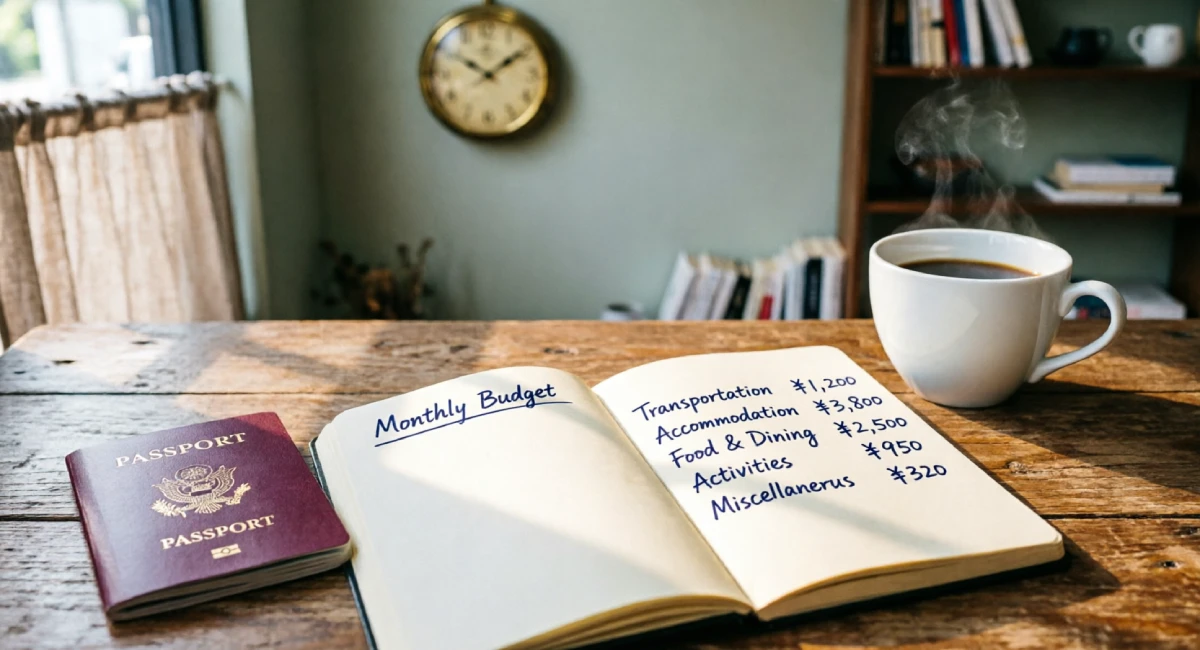
A low savings balance does not disqualify you from long-term travel. But it does mean you need a budget grounded in real numbers, not optimistic guesses.
The core spending categories for any long-term traveler are: accommodation, food, transport, activities, communication (SIM cards and data), travel insurance, and an emergency buffer. None of these is optional.
Here is what a realistic monthly budget looks like in a low-cost country like Vietnam, Thailand, or Guatemala:
$1,000/month budget:
- Accommodation: $300 (monthly guesthouse rate, private room)
- Food: $180 (local meals, occasional cook-in)
- Local transport: $60
- SIM/data: $15
- Activities: $60
- Travel insurance: $50 (based on ~$600/year SafetyWing)
- Emergency buffer: $75
- Misc/buffer: $260
$1,500/month budget:
- Accommodation: $400–$500 (better room or occasional upgrade)
- Food: $250 (more variety, less street-only eating)
- Local transport: $80
- SIM/data: $20
- Activities: $150
- Travel insurance: $50
- Emergency buffer: $150
- Misc: $300–$350
Neither of these requires a six-figure income or a large lump sum. They require consistency.
How to Calculate Your Minimum Monthly Travel Budget
Use this process before you book anything:
- Pick your target destination and research its average daily cost on sources like Numbeo or recent travel blogs (within 12 months).
- List your fixed costs: insurance, subscriptions you keep from home, phone plan, and any debt repayments.
- List your variable costs: accommodation, food, transport, and activities.
- Multiply your daily variable estimate by 30. Add fixed costs on top.
- Add a 15–20% buffer for unexpected costs, slow travel days, and miscalculations.
The most important variable in this calculation is accommodation. It typically accounts for 40 to 50 percent of total monthly spend. If you can bring that number down through monthly rates, work exchanges, or house-sitting, every other category gets easier to manage.
The Real Cost of Travel Insurance — and Why You Cannot Skip It
Travel insurance is the expense most budget travelers try to cut first. That is the wrong call.
SafetyWing’s Nomad Insurance runs approximately $45–$56/month (roughly $540–$672/year) for travelers under 39. World Nomads sits closer to $600–$900/year, depending on coverage level and nationality. These are not trivial amounts on a tight budget.
But a single medical emergency abroad can run $3,000 to $15,000 or more without coverage. A broken leg in Thailand, food poisoning requiring IV treatment in Cambodia, or a motorbike accident in Bali will cost you far more than a full year of premiums in one bill. Insurance is not optional. It is part of the baseline cost calculation.
How to Work While Traveling to Fund Your Trip as You Go
A small savings cushion gets you started. Ongoing income keeps you going. For most long-term travelers, the goal is to reach a point where work covers monthly costs, so savings become a backup rather than a countdown.
There are three main income models worth knowing: remote employment (a regular salary paid remotely), freelancing (project-based income across multiple clients), and online business (digital products, content monetization, or affiliate income). All three work. None happens overnight.
If you are leaving in three months with $6,000 saved, your most realistic goal is to have some income established before you go, even if it only covers half your monthly costs. Starting from zero on the road while burning through savings is a stressful way to travel.
Remote Work Jobs That Are Easiest to Secure Before You Leave
Some job categories convert to remote work far more easily than others. These are the ones where entry-level positions exist, platforms are well-established, and the work requires a laptop and internet rather than physical presence:
- Customer support / virtual assistance: High demand, entry-level friendly, consistent hours. Platforms: Remote. We Work Remotely.
- Content writing and copywriting: Flexible hours, scalable income. Platforms: Upwork, Contently, ProBlogger Job Board.
- Software development: Highest earning potential; requires existing skills. Platforms: Remotive, Toptal, GitHub Jobs.
- Online tutoring/language teaching: Reliable demand, especially English to non-native speakers. Platforms: iTalki, Cambly, VIPKid.
- Social media management / graphic design: Good entry point for creatives. Platforms: Fiverr, Upwork.
Be realistic about income timelines. Freelance platforms typically take one to three months to generate consistent income. Remote employment applications take four to eight weeks. Build that lead time into your planning.
How to Transition a Current Job to Remote Before Traveling
Many aspiring long-term travelers overlook the most obvious option: keeping their current job and making it remote.
This is not always possible, but it is possible more often than people assume. Here is what works: for 60 to 90 days before you leave, build a visible track record of results your employer can point to. Document your output. Make your productivity measurable.
Then have the conversation framed around a trial, not a permanent change. “I’d like to try working remotely for 30 days” is a much easier ask than “I want to leave the office permanently.” Many employers will agree to the trial. Many trials become permanent. If yours does not, you have still improved your case for the next employer.
Volunteering and Work Exchanges That Reduce Daily Costs to Near Zero
Work exchange programs let you trade a few hours of daily work for free accommodation and, in many cases, free meals. For a long-term traveler trying to stretch a low savings balance, this eliminates the largest single expense.
The standard arrangement is four to five hours of work per day, five days per week, in exchange for a bed and sometimes food. Hosts range from organic farms and small guesthouses to language schools, surf camps, and community projects.
The catch — worth saying plainly — is that host quality varies. Some placements are well-organized and genuinely rewarding. Others are poorly communicated, overworked, or in locations that are hard to reach. Vetting listings carefully before committing is not optional.
Workaway vs. WWOOF vs. HelpX — Which One Fits Your Style
These are the three main platforms connecting volunteers with hosts:
| Platform | Annual Fee | Best For | Common Placements | Strong Regions |
|---|---|---|---|---|
| Workaway | ~$49/year (couple: ~$59) | General travelers, varied skills | Hostels, guesthouses, schools, farms | Worldwide, strong in Europe and Latin America |
| WWOOF | $20–$40/year (varies by country) | Nature-focused travelers | Organic farms exclusively | Strong in Europe, Australia, the USA, and Japan |
| HelpX | ~$20 for 2 years | Budget-first travelers | Farms, homestays, boats | Europe, Australia, New Zealand |
WWOOF is the right fit if you genuinely want farm and agricultural work. Workaway gives you the widest variety of placement types. HelpX has the lowest cost and works well in Oceania and Europe specifically. Many long-term travelers register on two platforms to widen their options.
How to Write a Strong Profile That Gets Accepted by Good Hosts
Your profile is your application. Hosts with good reviews receive dozens of messages. A weak profile gets ignored.
The basics that matter: a clear, friendly photo of just you (not a group shot), an honest list of practical skills (cooking, gardening, handyman work, childcare, languages), and a short personal description that explains why you are traveling and what kind of placement you want.
When messaging a host, do not send a generic copy-paste message. Reference something specific about their listing. A message that works looks like: “I read that you are looking for help with your garden and guesthouse kitchen. I have experience with both from working on a small farm last year, and I am available from [date] for [duration]. I would love to hear more about your setup.”
Specificity and personability win placements. Generic messages do not.
Free and Low-Cost Accommodation Options Beyond Work Exchanges

Work exchanges are one tool. There are several others that long-term travelers use to keep accommodation costs low without working for them directly.
Traveling with low savings is largely an accommodation problem. Solve accommodation, and every other budget category becomes easier to manage.
House-Sitting as a Free Long-Term Accommodation Strategy
House-sitting means staying in someone’s home for free while they travel, in exchange for looking after the property and any pets. You do not pay rent. They do not pay for a pet hotel. It is a direct exchange with no cash involved.
The main platforms are TrustedHousesitters (approximately $129/year for sitters) and Nomador (free basic tier, paid for full access). Both connect homeowners with vetted sitters globally.
Responsibilities typically include feeding and walking pets, watering plants, taking in mail, and keeping the property secure. It is not demanding work, but it does require reliability and clear communication.
Building a profile with no prior sits is the main hurdle. To get around it: start with short sits (2–5 days) close to your home before you leave, get references from friends or past employers who can vouch for your reliability, and write a profile that is honest and specific. Most new sitters land their first confirmed sit within four to eight weeks.
How Hostels and Guesthouses Offer Deep Discounts for Long Stays
The nightly rate you see on Hostelworld or Booking.com is not the rate you have to pay if you are staying for a month.
A private room listed at $15/night works out to $450/month at the rack rate. The same room, negotiated directly with the owner for a 30-day stay, often drops to $250 to $320 per month. That is a $130 to $200 saving for asking one question.
This works most consistently in Southeast Asia and Latin America, where guesthouses are often family-run, and owners prefer the certainty of a long-term guest over the uncertainty of nightly bookings. Walk in, introduce yourself, mention you are looking for a month-long stay, and ask what their best rate is. Most will negotiate.
Book one or two nights first to check the room and the wifi before committing to a month.
Eating Well on a Long-Term Travel Budget Without Sacrificing Nutrition
Food is the second largest budget category after accommodation, and the one most travelers overspend on without realizing it. Eating at tourist restaurants near major attractions can cost three to five times what a local meal costs two streets away.
Three strategies consistently work: cooking your own meals when you have access to a kitchen, eating at local markets and street stalls instead of restaurants, and meal-prepping batch ingredients when your accommodation includes a kitchen.
A full meal at a street stall in Thailand or Vietnam costs $1.50 to $3. A similar meal at a tourist-facing restaurant in the same city costs $8 to $12. Over a month of three meals a day, that difference is roughly $300 to $500. On a tight long-term travel budget, that gap matters.
How to Find the Cheapest Local Food in Any New Country
The cheapest food is always where locals eat, not where tourists are directed. Finding it takes small adjustments in how you look.
Practical habits that work anywhere:
- Walk at least two streets away from the main tourist square before choosing where to eat.
- Go out at local lunch hours (usually 11:30 am to 1:00 pm) when the best local spots are busy and easy to spot.
- Search Google Maps for restaurants using the local language name for the dish you want, not the English translation. Results will be different and generally more local.
- Ask hostel staff or guesthouse owners where they eat. They almost always have a specific spot they recommend.
- Follow the queues. A line of locals outside a small stall at noon is a reliable signal.
None of these tips is country-specific. They apply equally in Morocco, Mexico, India, and Poland.
Transport Strategies That Keep Your Long-Term Travel Budget Intact
Transport is the budget category most travelers underestimate, partly because each journey seems small. But if you are moving every few days, those costs add up to hundreds of dollars a month.
The strategies that reduce transport costs at a structural level: commit to slow travel (covered earlier), use overnight transport to save on accommodation, book budget airlines strategically rather than impulsively, and use local ride-share apps instead of tourist taxis.
An overnight bus from Chiang Mai to Bangkok, for example, costs approximately $10 to $18 and takes 9 to 12 hours. You arrive in the morning, having traveled and slept. The equivalent flight costs $35 to $65 and still requires two taxi rides and airport time. The overnight bus saves $20 to $50 and cuts one night of accommodation costs simultaneously.
When Flying Is Actually Cheaper Than Ground Transport
There are specific situations where a budget flight beats the bus or train on both price and time.
Flying wins on cost when: the route is longer than 10 to 12 hours overland, two or more low-cost carriers compete on the same route, and you book during shoulder season with flexible dates.
Real examples where this applies regularly:
- AirAsia routes within Southeast Asia: Kuala Lumpur to Bali, Bangkok to Yangon, Penang to Singapore often dip below $20 to $35 when booked ahead.
- Wizz Air in Eastern Europe: routes between Bucharest, Warsaw, Budapest, and Sofia regularly undercut bus prices when booked two to four weeks ahead.
- FlixBus in Western Europe: technically ground transport, but worth mentioning as the dominant budget option where budget airlines do not compete.
The rule of thumb: check both options every time rather than assuming one is always cheaper. On high-competition routes with budget carriers, flying can be the better financial choice.
Managing Money Abroad Without Losing It to Fees and Bad Exchange Rates
Banking fees are invisible to most travelers until they add up. On a one-week holiday, a $5 ATM fee barely registers. Over six months, paying $5 to $8 per withdrawal several times a week drains your budget quietly but steadily.
The solution: use a card built for international use. The three most widely used by long-term travelers are Wise (formerly TransferWise), Revolut, and Charles Schwab (US account holders).
Wise converts currency at the mid-market rate with a small transparent fee and works well for both ATM withdrawals and card payments. Revolut offers fee-free spending in most currencies up to a monthly limit on its free tier, with paid plans removing that limit. Charles Schwab reimburses all ATM fees worldwide at the end of each month, which makes it particularly useful in countries where ATM fees run high.
Beyond card choice, two habits reduce currency losses significantly: always choose to pay or withdraw in the local currency — never accept dynamic currency conversion, which routes the transaction through the bank’s unfavorable rate — and avoid airport and hotel exchange booths entirely. Their margins run 5 to 10 percent worse than the mid-market rate.
Conclusion
Figuring out how to travel long term with little money is not a matter of luck. It is a series of decisions that compound: pick a cheap region, move slowly, bring accommodation costs down through monthly rates or work exchanges, earn something on the road, eat where locals eat, and use a bank card that does not charge you for existing abroad.
None of these strategies requires a large savings balance. They require planning before you leave and consistent habits once you are there.
Start with one thing. Pick the destination that fits your budget, build a realistic monthly number, and work backward from there. If you are still figuring out what a realistic trip budget looks like at a regional level, our article on what a two-week budget trip to Europe actually costs shows how much destination choice changes everything.
The gap between “I want to travel long term” and “I am traveling long term” is usually one decision, not one bank transfer.