
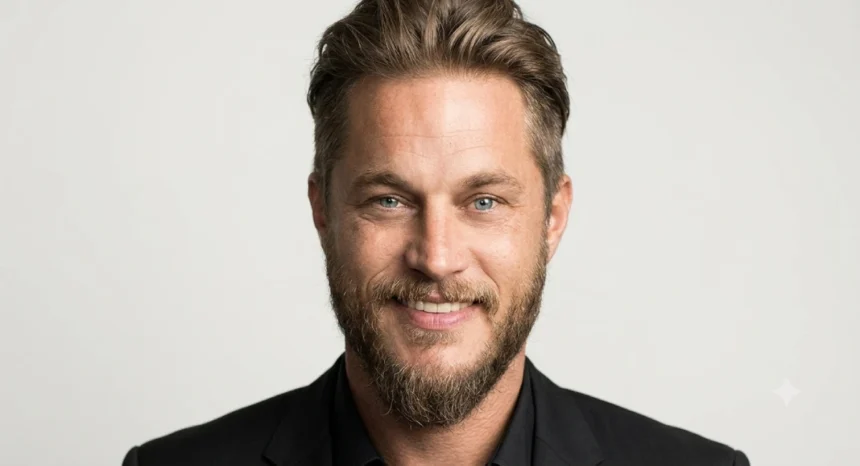
Most people know Travis Fimmel as Ragnar Lothbrok, the Viking king who anchored the History Channel’s biggest drama for four seasons. Fewer know that he grew up on a cattle farm in rural Victoria, once dreamed of playing professional Australian rules football, and only got into acting after a modeling career took him to Los Angeles almost by accident.
- Travis Fimmel’s Net Worth in 2026
- Early Life: From a Cattle Farm to a Modeling Agency
- Building Wealth: The Modeling Years
- Television and Film: Where the Real Earnings Came From
- Travla: His Move from Actor to Business Owner
- Real Estate
- How Does He Compare to His Vikings Co-Stars?
- What Is Travis Fimmel Doing Now?
- How Actors Like Fimmel Actually Build Wealth
- Key Takeaways
So how much is Travis Fimmel actually worth, and how did he get there? Here’s the full picture.
Travis Fimmel’s Net Worth in 2026
Travis Fimmel’s net worth is estimated at $8 million. That number comes from a mix of television salaries, film paydays, his early modeling income, and his stake in Travla, the beer brand he founded in 2022.
Estimates on celebrity wealth sites vary widely, and Fimmel’s page is no exception — some trackers list figures as low as $3 million, others as high as $13 million, and a few clearly satirical “highest-paid actor” rankings put out numbers that don’t hold up to scrutiny. The $8 million figure is the one that shows up most consistently across established net worth trackers, so it’s the most reasonable working estimate.
Compared to some of his peers who led long-running franchise television, that number is modest. That’s not an accident. Fimmel has spent his career avoiding the parts of Hollywood that generate the biggest paydays — talk show circuits, franchise sequels, constant public visibility — in favor of smaller, more selective work.
Early Life: From a Cattle Farm to a Modeling Agency
Fimmel was born on July 15, 1979, in Echuca, Victoria, Australia, the youngest of three sons of Jennie, a recreation officer for people with disabilities, and Chris, a cattle farmer. He grew up in the small town of Lockington and, like a lot of Australian kids, had his sights set on professional football. He moved to Melbourne hoping to play for the AFL’s St Kilda Football Club, but a broken leg ended that plan before it started.
He’d been accepted into an architecture course at RMIT, deferred it to travel, and ended up working out at a gym in Hawthorn, a suburb of Melbourne, where he was spotted by someone connected to Chadwick Models. That chance encounter changed the direction of his life. He signed with the agency, moved to Los Angeles in 2002, and landed with LA Models after arriving with very little money.
Building Wealth: The Modeling Years
Before any acting credits, Fimmel became one of the more recognizable faces in fashion advertising through a high-profile Calvin Klein campaign. That kind of exposure did two things for him: it gave him enough income to pursue acting seriously, and it put him directly in front of casting directors who were looking for someone with his exact physical presence.
Modeling wasn’t where his real money came from, but it was the door that opened everything else.
Television and Film: Where the Real Earnings Came From
Fimmel’s acting career started with the WB series Tarzan, where he played the title role opposite Sarah Wayne Callies, and The Beast, where he starred alongside Patrick Swayze. Neither show ran long, but both kept him working steadily in television.
The role that changed everything was Ragnar Lothbrok in Vikings, which he played from 2013 to 2017. Lead actors on cable dramas of that era typically earned somewhere between $50,000 and $200,000 per episode, depending on a show’s budget and an actor’s negotiating position, and with more than 40 episodes across four seasons as the lead, that adds up to a significant chunk of his career earnings. Vikings also continues to perform well on streaming platforms years after it ended, which means ongoing residual payments each time it’s watched or licensed.
In 2016, he took the lead in Warcraft, the video game adaptation directed by Duncan Jones. The film underperformed in North America but pulled in more than $430 million worldwide, largely on the strength of its international box office. That kind of global performance usually means a strong upfront fee and, depending on the deal, a share of the film’s profits.
After Vikings, Fimmel moved into premium science fiction with Raised by Wolves, Ridley Scott’s ambitious HBO Max series, in which he played Father. He followed that with a genre switch entirely in Heels, a Starz wrestling drama, and more recently appeared in Black Snow and Dune: Prophecy, playing Desmond Hart — a role that keeps him connected to the science fiction space that’s worked well for him since Raised by Wolves.
Travla: His Move from Actor to Business Owner
In 2022, Fimmel founded Travla, an Australian beer brand. This isn’t a case of a famous name being licensed onto a product he had no real involvement with — it’s a business he built himself.
That matters because it represents a shift most actors at his level never make: moving from earned income (get cast, get paid, repeat) to ownership income, where a brand can generate revenue whether or not he’s currently working on a set. For someone whose public image has always been low-key, building a company tied to his home country fits both his personality and his long-term financial planning.
Real Estate
In December 2016, Fimmel bought a 14-acre ranch property in Santa Clarita, California, for $500,000. It’s a working retreat rather than a showpiece — consistent with someone who prefers surfing, motorbiking, camping, and fishing over red carpets.
How Does He Compare to His Vikings Co-Stars?
Vikings had a large ensemble cast, and comparisons among them are common online. Fimmel sits in the middle of that group rather than at the top. Some co-stars, like Katheryn Winnick, have kept up a steady run of television work since the show ended. Others moved into different franchises entirely. Fimmel is somewhat unusual in that he left the show’s lead role voluntarily after season four and has stayed highly selective about what he takes on since — a choice that has almost certainly limited how high his earnings could have climbed, in exchange for more control over his own schedule and the kind of work he does.
What Is Travis Fimmel Doing Now?
As of 2026, Fimmel remains active with roles like Dune: Prophecy and continues developing acting and producing work, which gives him more creative input and a larger share of any potential profits compared to a straight acting fee.
He’s also kept his reputation as one of the most private actors working today. No podcast, no consistent social media presence, minimal press. Fans who have run into him describe someone warm and unbothered by his own fame — the kind of person who shows up, does the work, and goes home.
How Actors Like Fimmel Actually Build Wealth
If you’re wondering how the money actually flows for someone in his position, it generally breaks down into a few categories:
- Per-episode salary — the most visible number, ranging from tens of thousands to hundreds of thousands of dollars per episode, depending on a show’s budget and an actor’s leverage in negotiations.
- Residuals — payments triggered every time a show reruns, streams, or sells into a new market. For a title like Vikings that still performs well years later, this can be a meaningful ongoing income stream.
- Backend participation — a percentage of a project’s profits, sometimes called “points.” Harder to negotiate, but potentially significant if a film or show becomes a hit.
- Brand deals — a Calvin Klein campaign in the early 2000s would have paid well, but as a one-time deal rather than a recurring one.
- Business ownership — ventures like Travla convert an actor’s public profile into a company that can generate income independent of any single acting job.
Key Takeaways
- Travis Fimmel’s net worth is estimated at $8 million, built through modeling, television, film, and his beer brand Travla.
- Vikings remains the financial and cultural foundation of his career, both through his original salary and ongoing residuals.
- He has been deliberately selective about roles and public visibility, which has likely limited his ceiling but preserved his creative freedom.
- Travla represents his shift from being paid for acting work to owning a business that can generate income on its own.
- His path — cattle farm to Calvin Klein to Vikings to founder — is a genuinely unusual one among actors at his level.