


Most people have a version of Coco Chanel in their heads. A scrappy, instinctively elegant woman who saw that women were overdressed and uncomfortable, and fixed it. A self-made icon. A story of talent meeting opportunity.
- The Woman Who Rewrote Her Own Beginning
- What Her Early Life in the Orphanage Actually Looked Like
- The Lies She Told — And Why She Chose Those Particular Lies
- Coco Chanel Early Life Career Beginnings — From Cabaret Singer to Couturiere
- Arthur “Boy” Capel — The Relationship That Funded the First Chapter
- What the Myth Was Actually Doing — Ambition Disguised as Origin Story
- Conclusion
That version is not exactly wrong. But the Coco Chanel early life career beginnings real story is something stranger and more deliberate than the polished legend allows. The truth involves an orphanage she spent decades denying, a set of lies maintained with extraordinary consistency, and a level of strategic self-construction that started long before she picked up a pair of scissors.
This is not a piece about fashion history. It is a piece about a woman who understood, earlier than almost anyone around her, that controlling your story is its own kind of power.
The Woman Who Rewrote Her Own Beginning
There is a version of Gabrielle Bonheur Chanel that she spent her entire adult life building and defending. In that version, she had a modest but respectable provincial childhood. She had an aunt who taught her to sew. She was younger than she actually was. She came from somewhere, not nowhere.
None of it was true.
What makes Chanel interesting is not that she lied. People lie about their pasts, especially people who grew up poor. What makes her interesting is the precision of it. She did not simply omit the difficult parts. She replaced them with a carefully designed alternative that served specific social and professional purposes. Every fabricated detail solved a real problem she faced as a woman trying to enter a world that would have dismissed her the moment it knew where she actually came from.
Understanding that is the only way to understand her. The lies are not a footnote to her ambition. They are the first expression of it.
What Her Early Life in the Orphanage Actually Looked Like

Gabrielle Chanel was born on 19 August 1883 in Saumur, France. Her mother, Jeanne Devolle, was a laundrywoman. Her father, Albert Chanel, was a traveling street vendor who sold workwear at markets. They were not poor in a romantic sense. They were poor in the ordinary, exhausting, undignified way that leaves very little room for warmth.
Her mother died of bronchitis in 1895, when Gabrielle was eleven. What happened next defined everything. Albert Chanel drove his five children to separate fates. The two boys were sent to work as farm laborers. Gabrielle and her two sisters, Julia and Antoinette, were deposited at the orphanage of Aubazine, in the Corrèze region of central France.
He left and did not come back.
Abandoned at Twelve — What the Records Actually Show
Biographers Justine Picardie and Hal Vaughan, working independently from archival records, confirmed the core of this story. Albert Chanel placed the girls at the orphanage run by the nuns of the Congregation of the Sacred Heart of Mary. Gabrielle remained there until she was around seventeen or eighteen, when she was transferred to a boarding school in Moulins.
The records show a child who had no certainty about whether her father would ever return. He occasionally appeared over the years, according to some accounts, but never to reclaim her. She was not adopted. She was not fostered. She waited in an institution for years, and the man who put her there simply got on with his life.
Psychologically, what that does to a person is not complicated to understand. It teaches you that other people’s accounts of you are unreliable. That your circumstances can be used against you. And that the only story you can fully control is the one you tell about yourself.
The Visual Language of Aubazine — And Where It Showed Up Later
The orphanage at Aubazine is a twelfth-century Cistercian abbey. Its aesthetic is severe and deliberate. Stone floors. High ceilings. The nuns wore black habits with white collars. The windows contained intricate stained glass medallions, including interlocking geometric shapes that some design historians have identified as an early version of the interlocking C motif Chanel would later make famous.
Whether or not that specific attribution is exact, the broader point holds. The visual environment of her childhood was one of stripped-back austerity. No ornamentation for its own sake. Black and white as the dominant palette. Clean lines as the organizing principle.
Chanel grew up surrounded by a visual language that rejected excess. When she later built a design philosophy around exactly those qualities, she was not inventing an aesthetic from nothing. She was formalizing what she had absorbed as a child, in a place she refused to admit she had ever lived.
The Lies She Told — And Why She Chose Those Particular Lies
Chanel lied about her past for her entire adult life. Not occasionally. Not when pressed. Consistently, elaborately, and with enough detail that the fabrications became the accepted record for decades after her death.
She told interviewers, lovers, and biographers that she was born in 1893, not 1883. She took ten years off her age and stuck to it. She said her mother died when she was very young and that she was subsequently raised by aunts in the countryside. The orphanage did not exist in her account. The nuns did not exist. The years of institutional life were replaced with a domestic, feminine origin story of family and inheritance.
She maintained this across different decades, different countries, and different interrogators. When the journalist Paul Morand interviewed her extensively in the 1940s for the book that became “The Allure of Chanel,” she was still doing it.
The pattern, looked at carefully, is very specific. She did not lie about everything. She lied about the things that would have made people pity her or dismiss her. She removed every detail that marked her as unwanted, disposable, or low-born. What remained was a version of herself that had origins without shame attached to them.
Ten Years Younger and From a Respectable Family — Unpacking the Core Fabrication
The age lie is often treated as vanity. It was not, or not primarily. In Belle Epoque Paris, a woman’s age determined a great deal about how she was perceived in both social and professional contexts. When Chanel was building her first business in 1910, claiming to be twenty-seven rather than twenty-seven-and-actually-thirty-seven gave her a different kind of credibility.
The class lie was more fundamental. French society in the early twentieth century was deeply stratified in ways that were not always visible from the outside but were acutely felt by anyone trying to move across the lines. The children of traveling market vendors who ended up in state orphanages did not become Parisian couturieres. That was not the path available to those people.
Chanel understood that if her actual origins became known in the circles she was entering, it would function as a permanent ceiling. The lie was not about pride. It was about access.
The Seamstress Aunt Who Never Existed
In the version of her life that Chanel preferred to tell, her sewing skills came from aunts. Warm, provincial, domestically skilled women who passed on their craft in a family setting. This is the version that places her skills within a respectable inheritance, a feminine tradition with dignity built in.
The reality is that she learned to sew at the orphanage. The nuns at Aubazine taught all the girls practical needlework as part of the institutional curriculum. It was vocational training, not family tradition. It was the kind of skill you acquired because you had no one to rely on but yourself.
By replacing the nuns with aunts, Chanel was doing something more deliberate than hiding poverty. She was retrofitting her story with warmth and mentorship and belonging. The fictional aunts did not just make her seem more respectable. They made her seem loved. In that small substitution, you can see exactly how her mind worked. She was not patching holes. She was building something better from scratch.
Coco Chanel Early Life Career Beginnings — From Cabaret Singer to Couturiere
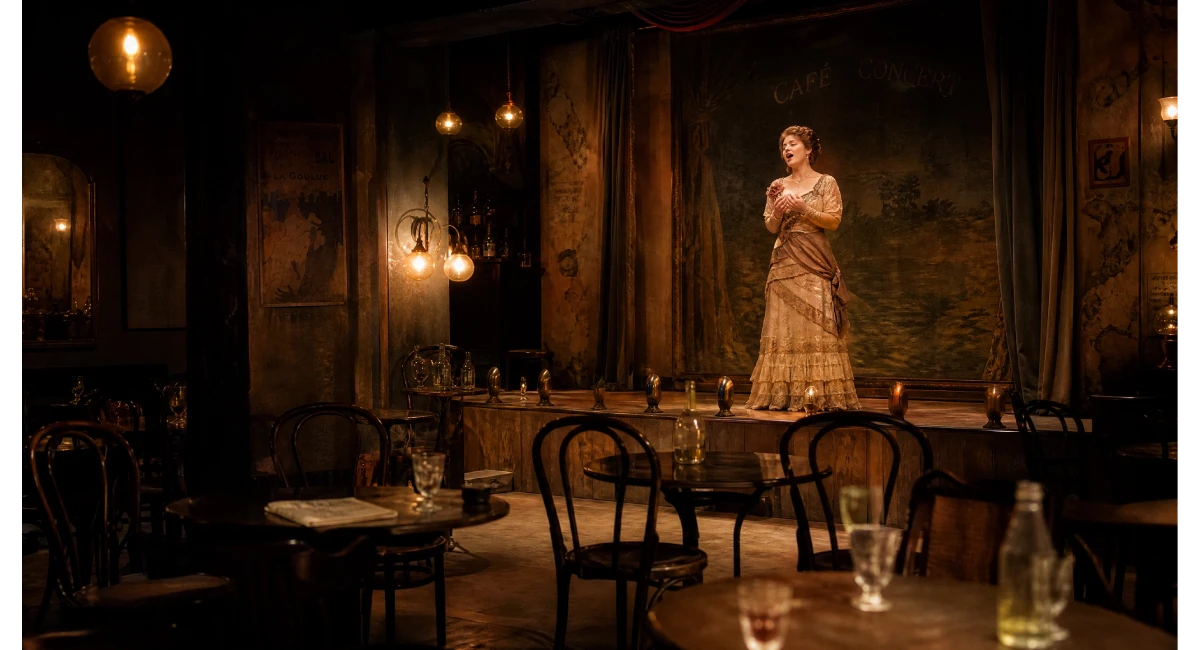
Before there was Chanel the couturiere, there was Gabrielle the cafe-concert singer. This is the part of her career beginnings she scrubbed most thoroughly from the record, possibly because it was the hardest to reframe as respectable.
From roughly 1905 to 1908, she performed at small venues in Moulins and Vichy. These were not prestigious theaters. Cafe-concerts occupied a social tier that was considered acceptable entertainment but not entirely respectable employment for a woman. The performers were working-class, the audiences were mixed, and the atmosphere was a long way from the Parisian salons she would later frequent.
She sang a small repertoire of popular songs. One of them was called “Qui qu’a vu Coco dans l’Trocadero,” a song about a lost dog. She performed another called “Ko Ko Ri Ko.” It is widely accepted by biographers that her famous nickname came from this period, from the songs she sang and the way audiences called back to her.
This matters. Her whole career, in a very literal sense, began on a stage. She learned to perform a version of herself before she ever designed a garment. She learned how to hold an audience, how to project a persona, how to make people in a room pay attention to her. Every skill she later used to build her public identity had its origins here, in a period she refused to acknowledge.
The Nickname “Coco” and What It Actually Came From
Chanel preferred a different story about her nickname. In some tellings, “Coco” was what her father called her as a child. A term of endearment. A sign of closeness between them. This version is almost certainly sentimental invention, particularly given that her father was the man who left her in an orphanage and never came back.
The cabaret origin is better supported by evidence and accepted by most serious biographers. She sang songs with “Coco” in the title. Audiences used the word. It stuck.
That she worked to replace this origin with a paternal affection story tells you something important. A single name became her most valuable asset. “Chanel” became synonymous with an entire aesthetic sensibility. Controlling what “Coco” meant, where it came from, what it implied about her origins and her relationships, was not a trivial concern. It was brand management, conducted instinctively, decades before that concept existed in its modern form.
Etienne Balsan and the Strategic Use of Wealthy Men
Around 1906, Chanel began a relationship with Etienne Balsan, heir to a textile fortune and a man with an established social world of horse racing, country estates, and aristocratic connections. She moved into his property, theChâteauu de Royallieu near Compiegne.
The arrangement was not ambiguous. She was what was then called a cocotte, a kept woman, a mistress in a social world where wealthy men maintained such relationships openly. This is what she was, and reducing it to something more flattering would misrepresent the actual conditions of her life at that point.
What is worth examining is what she did with the access. At Royallieu, she was surrounded by women who belonged to the class she intended to eventually dress. She observed what they wore, what they rejected, where they were uncomfortable, what they actually wanted. She borrowed Balsan’s shirts and jackets and wore them in ways that the women around her found striking. She was already editing. Already testing responses. Already treating every social situation as information she could use.
She was not passive in her dependence. She was studying.
Arthur “Boy” Capel — The Relationship That Funded the First Chapter
Arthur Capel, known universally as “Boy,” was an English businessman, polo player, and one of the most significant people in Chanel’s life. Their relationship began around 1908 and lasted until he died in a car accident in December 1919.
It was Capel who financed her first professional venture, a millinery shop on Rue Cambon in Paris, which she opened in 1910. He also backed a boutique in Deauville in 1913, where she first sold the simple, practical sportswear that would begin to establish her design identity.
By most accounts, including Chanel’s own rare moments of candor late in life, she loved him genuinely. His death at thirty-eight hit her in a way that the deaths of other people in her life did not. She was reported to have said, years afterward, that she lost everything when she lost him.
Both of these things are true, and neither cancels the other out. The relationship was real. It was also the financial mechanism that made her first career steps possible. Without Capel’s money, there is no Rue Cambon shop. Without that shop, there is no subsequent expansion. The emotional and the structural were inseparable.
What this tells us about her is not that she was calculating in love. It is that she occupied a position where love and strategy could not be cleanly separated. For a woman without family money or inherited connections in 1910, the people who cared for her were also the people who made things possible. She did not invent that condition. She navigated it.
The Rue Cambon Shop — What Starting Small Actually Looked Like
The boutique that opened at 21 Rue Cambon in 1910 was not a couture house. It was a millinery shop. Chanel made and sold hats.
This sounds modest because it was modest. The Parisian fashion world of 1910 was dominated by the grandes maisons, elaborate couture operations run by established names. Chanel was not in that world. She was a newcomer with a small rented space, making hats that her early clients found refreshingly simple compared to the elaborate constructions fashionable at the time.
Her early customers came through personal connections, women from the social world she had entered through Balsan and Capel. They told other women. The word-of-mouth growth was real but slow. She was not an overnight success in any meaningful sense. She was a woman in her late twenties running a small shop, working without the name recognition, established clientele, or institutional backing that the major houses had spent decades building.
The distance between that starting point and where she ended up is the actual measure of what she built. It is also a reminder of how provisional everything was at the beginning, how easily it could have stayed small, how much of what followed depended on decisions and risks that had no guaranteed outcome.
What the Myth Was Actually Doing — Ambition Disguised as Origin Story
Step back from the chronology for a moment and look at the architecture of what Chanel built around herself.
She did not simply hide her past. She replaced it with a story that performed specific functions. The fictional aunts gave her respectable origins and a believable source for her skills. The adjusted age gave her more time and more social currency. The erased orphanage removed any trace of having been abandoned or institutionalized, statuses that carried stigma and would have invited a particular kind of condescending attention from the people she needed to take her seriously.
Every lie addressed a real vulnerability. Together, they constructed a version of herself that had no pity attached to it. And that was the point. Chanel understood, at some level that might not have been fully conscious, that pity is the enemy of authority. You cannot simultaneously feel sorry for someone and take direction from them. The myth she built was designed to entirely foreclose the pity response.
The first product she ever marketed was not a hat. It was herself. The story she told about her origins was as carefully constructed as any garment she ever produced, and it served the same purpose: to create a specific impression in the mind of the person receiving it.
Other women from similar backgrounds who did not control their stories were treated accordingly. There were women in the demimonde of early twentieth-century Paris who came from comparable circumstances, who were known to have done comparable things to survive, and who were never able to shake the social categories that knowledge placed them in. They remained defined by where they started. Chanel did not.
How Her Story Compares to Other Women Who Rewrote Themselves
Chanel was not the only woman of her era to reconstruct herself. But she was unusually thorough and unusually successful at it.
The courtesan and actress Liane de Pougy, a contemporary of Chanel’s in certain social circles, came from difficult origins and also managed her public image carefully. But de Pougy’s reinvention was always legible as reinvention. The gap between who she had been and who she presented herself as was visible, at least to insiders. Her transformation was read as social climbing, which carries a different weight than authority.
What Chanel achieved was something harder: she made the invented version the only version most people ever encountered. By the time anyone was digging into the facts of her biography seriously, she had been Coco Chanel for so long that the true story felt like the revisionist account. That is not just ambition. That is execution at a level very few people manage.
Conclusion
The Coco Chanel early life career beginnings real story does not produce a simpler or more sympathetic person than the legend does. If anything, it produces someone more difficult to hold in a single frame.
She was abandoned by her father and raised in an institution. She worked as a cabaret singer. She was kept by wealthy men. She lied about all of it for decades, not out of weakness, but because she had diagnosed exactly what the truth would cost her and decided not to pay that price.
The lies did not make her. She made herself, using the lies as raw material alongside everything else available to her: her eye, her relationships, her capacity for work, her refusal to stay in the category the world assigned to her at birth. The fabricated origin story was not the foundation of her success. It was the protection she built around it while she was building it.
If you are interested in how women throughout history have constructed extraordinary lives from the most unlikely starting points, the story of Coco Chanel belongs in the same conversation as the others. Read our piece on how Oprah Winfrey escaped poverty to become a billionaire, and see how many of the instincts look familiar.