

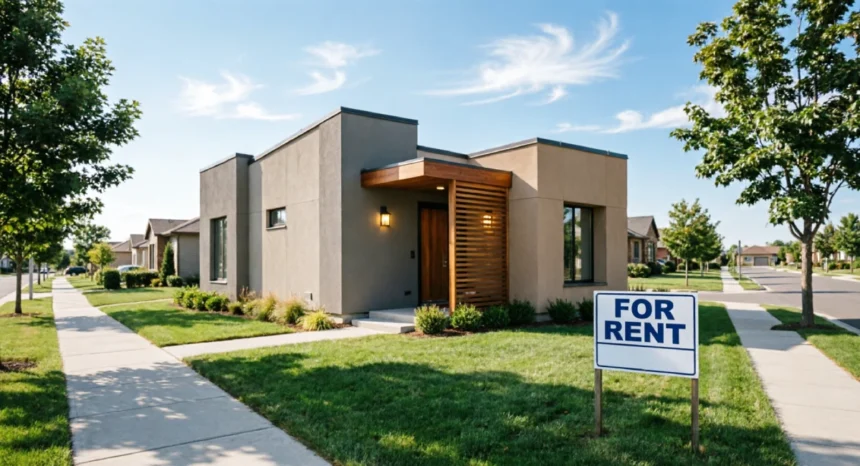
Rental properties generate passive income through five streams that work together: monthly rent, long-term appreciation, tenant-funded equity growth, tax deductions, and supplemental fees. Most investors focus only on the rent check. Understanding all five is what separates properties that build lasting wealth from those that barely break even.
- What Makes Rental Property Income Different From Other Investments
- How Rental Properties Generate Income — The Core Revenue Streams
- Appreciation — The Income Stream Most Investors Overlook
- Equity Building — How Tenants Help Pay Down Your Mortgage
- Tax Advantages That Increase Your Real Income
- Additional Income Streams Beyond Base Rent
- Risks That Can Reduce or Eliminate Rental Income
- Conclusion
Some of these streams put cash in your pocket each month. Others build quietly for years before converting to spendable income. No other common investment layers all of these returns into a single asset the way real estate does.
This guide breaks down each income source with real numbers and practical examples so you can see exactly how the full picture works.
What Makes Rental Property Income Different From Other Investments
When you buy stocks, you collect dividends or wait for the price to rise. One primary outcome. Rental property works differently.
A single rental property can generate income in five ways at once: monthly rent, appreciation, equity growth, tax savings, and supplemental fees. No other common investment combines all of these in one asset.
That layered structure is what makes rental property income unique. Understanding each layer helps you decide which properties to buy, when to hold, and when to sell.
Active Income vs. Passive Income — Where Rental Property Fits
Active income is money you earn by trading time. A salary, a freelance project, a consulting fee — these stop the moment you stop working.
Passive income works without that direct time exchange. Rental property sits firmly in this category for most investors. The IRS classifies rental income as passive in most circumstances, which carries specific tax benefits. The key point: passive income continues generating returns even when you are not actively involved.
One exception: if you qualify as a real estate professional under IRS rules — spending more than 750 hours per year on real estate activities — your rental income may be reclassified. For most investors who use a property manager or handle light self-management, the passive classification holds.
A salaried employee earns $5,000 this month because they showed up and worked. A landlord collects $1,800 because a signed lease is in place. One requires presence; the other requires a good system.
Why Investors Treat Rental Properties as Long-Term Wealth Vehicles
Rental properties are not just income assets. They are wealth-building tools that get stronger over time.
As property values rise, equity grows. As inflation pushes prices higher, rents tend to follow — income adjusts without any action from you. Housing demand also remains one of the most reliable forces in any economy, through good cycles and bad.
This combination of recurring income and built-in asset growth is why long-term investors hold rental properties for decades.
How Rental Properties Generate Income — The Core Revenue Streams
To understand how rental properties generate income, look at each revenue stream on its own before seeing how they combine.

Monthly Rental Payments — The Primary Income Source
Monthly rent is the most visible income source. It is the foundation everything else rests on.
When a tenant pays rent each month, they cover your costs — and ideally leave money on top. That surplus is your cash flow. But understanding it starts with the difference between gross rent and net rent.
Gross rent is the full amount the tenant pays. Net rent is what remains after all property-related expenses are subtracted. Here is a simple example:
A property rents for $1,800 per month. Monthly expenses, including mortgage, insurance, property tax, and a maintenance reserve, total $900. Net rent equals $900 per month, or $10,800 per year.
The lease is what makes this income predictable. A 12-month lease locks in a payment schedule, defines the tenant’s obligations, and gives you legal standing if anything goes wrong.
Cash Flow — What Stays in Your Pocket After All Expenses
Cash flow and gross rent are not the same thing, and confusing the two is one of the most common mistakes new investors make.
Cash flow is what lands in your pocket after every expense is paid. The formula:
Gross Rent − Mortgage Payment − Property Taxes − Insurance − Maintenance Reserve − Vacancy Allowance = Net Cash Flow
Using real numbers: a property generating $2,000 in gross rent with a $1,050 mortgage, $150 in taxes, $100 in insurance, $100 in maintenance reserve, and $100 in vacancy allowance leaves you with $500 per month in net cash flow.
Positive cash flow means the property earns more than it costs. Negative cash flow means you cover the shortfall from your own pocket. That is not always a mistake — if appreciation is strong and you have reserves, it can work. But it requires deliberate planning.
For most beginning investors, targeting positive cash flow from day one is the safer path.
Short-Term vs. Long-Term Rentals — How Income Differs
A long-term rental on a 12-month lease offers predictability. You know what is coming in each month, vacancy is lower, and management is minimal once a good tenant is in place.
A short-term rental, such as a vacation property listed on Airbnb, can generate significantly higher gross income per night. A property that rents long-term for $1,800 per month might earn $3,500 per month through short-term bookings in a high-demand season.
But costs are higher too. Cleaning fees, platform commissions, furnishing, and active management eat into that premium. Vacancy is less predictable.
| Factor | Long-Term Rental | Short-Term Rental |
|---|---|---|
| Monthly Gross Income | $1,800 | $3,500 (peak season) |
| Operating Costs | Lower | Higher |
| Vacancy Risk | Lower | Higher |
| Management Effort | Lower | Higher |
| Income Predictability | High | Variable |
The right choice depends on your goals, the property’s location, and how much involvement you want.
Appreciation — The Income Stream Most Investors Overlook
Monthly rent gets all the attention. Appreciation quietly builds wealth in the background.
Appreciation is the increase in a property’s market value over time. It does not put money in your account each month, but when you sell or refinance, it converts to real, spendable income. For long-term investors, appreciation often ends up being the largest single contributor to total returns.
There are two types worth understanding, and they work very differently.
Market Appreciation and Its Effect on Net Worth
Market appreciation happens when property values rise due to demand, limited supply, economic growth, or neighborhood improvement. You do not have to do anything to earn it. It happens on its own.
Here is a straightforward example. A property purchased for $200,000 in a market that appreciates at an average of 4% annually would be worth approximately $296,000 after ten years. That is $96,000 in additional equity created without any active effort.
That growth increases your net worth directly, and you can convert it into cash through a sale or cash-out refinance. One caveat: market appreciation is not guaranteed. Markets vary by city, neighborhood, and economic cycle. Never buy a property based solely on appreciation without a solid cash flow foundation.
Forced Appreciation Through Renovations and Upgrades
Forced appreciation is value you create through improvements. Unlike market appreciation, this one is in your control.
A $15,000 kitchen renovation — new countertops, cabinets, and appliances — can raise rent from $1,600 to $1,800 per month. That is $200 more per month, or $2,400 per year. At a 6% cap rate, that income increase adds roughly $40,000 to the property’s value.
Cost: $15,000. Value created: $40,000. That is forced appreciation in its simplest form.
Other high-impact improvements include adding a bathroom, finishing a basement, improving curb appeal, or converting unused space into a rentable unit.
Equity Building — How Tenants Help Pay Down Your Mortgage
Here is something many first-time investors miss: every time a tenant pays rent, part of that payment goes toward your mortgage balance. Your tenant is building your net worth for you.
This is not immediate cash in hand. It is a slow, steady shift of ownership from the bank to you. Over a 30-year mortgage, that adds up to the full purchase price of the property.

How Mortgage Amortization Builds Wealth Over Time
An amortized mortgage front-loads interest in the early years and shifts more of each payment toward principal over time. This is why long-term investors benefit so much from holding.
Here is a simplified illustration using a $200,000 mortgage at 7% over 30 years:
| Year | Monthly Payment | Interest Portion | Principal Portion |
|---|---|---|---|
| Year 1 | $1,331 | $1,163 | $168 |
| Year 10 | $1,331 | $1,025 | $306 |
| Year 20 | $1,331 | $766 | $565 |
| Year 30 | $1,331 | $9 | $1,322 |
In the early years, most of the payment goes to the bank. By Year 20, more than 40% goes straight to building your equity. And all of this is funded by the tenant’s rent.
Cash-Out Refinancing — Converting Equity Into Spendable Income
Once you have built meaningful equity, you can access it without selling — through a cash-out refinance. You replace your existing mortgage with a new, larger loan and pocket the difference in cash.
For example, if your property is worth $320,000 and your remaining mortgage balance is $180,000, you might refinance at 75% loan-to-value to pull out $60,000 in cash. That $60,000 can then be used as a down payment on a second investment property.
The trade-off is a higher monthly payment and a larger loan balance. But if the new payment still leaves positive cash flow and the second property produces returns, the math often works.
Tax Advantages That Increase Your Real Income
Tax benefits do not show up in your bank account directly, but they reduce the income you owe taxes on. The effect is the same — more money stays with you.
This section is investor education only. For guidance specific to your situation, always work with a qualified tax professional.
Depreciation — Getting a Tax Deduction on a Growing Asset
Depreciation is one of the most powerful tax tools available to rental property investors, and it is also one of the least understood.
The IRS allows residential property owners to deduct the cost of the building (not the land) over 27.5 years. This is called straight-line depreciation. On a property where the structure is valued at $250,000, the annual depreciation deduction is approximately $9,090.
That $9,090 deduction reduces your taxable rental income each year, even as the property’s market value rises. You get a tax break on a growing asset.
When you eventually sell, the IRS recaptures that depreciation and taxes it at up to 25%. This is called depreciation recapture. It is manageable with planning, but worth understanding before you sell.
Deductible Expenses That Reduce Your Taxable Rental Income
Beyond depreciation, rental owners can deduct operating expenses from taxable income. Here is how that math works:
| Income / Expense Item | Monthly Amount | Annual Amount |
|---|---|---|
| Gross Rental Income | $2,000 | $24,000 |
| Mortgage Interest | -$900 | -$10,800 |
| Property Taxes | -$150 | -$1,800 |
| Insurance | -$100 | -$1,200 |
| Repairs and Maintenance | -$100 | -$1,200 |
| Property Management Fee | -$180 | -$2,160 |
| Depreciation Deduction | — | -$9,090 |
| Taxable Rental Income | — | -$2,250 (loss) |
In this example, a property generating $24,000 in gross annual rent shows a tax loss of $2,250 after legitimate deductions. That means no tax on the rental income — and potentially a deduction against other income, subject to IRS income limits and passive activity rules.
Other commonly deductible items include professional fees, advertising costs, and reasonable travel expenses related to property management.
The 1031 Exchange — Deferring Taxes to Compound Wealth Faster
When you sell a rental property at a profit, you normally owe capital gains tax on that profit. A 1031 exchange lets you defer that tax by rolling the proceeds directly into a new, like-kind investment property.
For investors building a portfolio over time, this is significant. Instead of losing 15% to 20% of your gains to tax at each sale, you keep the full amount working in the next property. The tax does not disappear — it is deferred until you sell without doing another exchange.
Many experienced investors use 1031 exchanges repeatedly, deferring taxes for decades while their portfolio grows.
Additional Income Streams Beyond Base Rent
Monthly rent is just the starting point. Properties can produce extra income through fees and services many landlords never charge.
Pet Fees, Parking, and Storage — Small Additions That Add Up
These are not large amounts on their own, but together they add up fast.
- Pet rent: $25 to $75 per month, per pet, in addition to a one-time pet deposit
- Assigned parking: $50 to $150 per month for a dedicated spot or garage bay
- Storage unit rental: $30 to $75 per month for a basement or exterior storage area
If one tenant pays $75 in pet rent, $75 for parking, and $30 for storage, that is $180 per month beyond base rent. Over 12 months, that is $2,160 from one unit — without raising the rent.
At scale, across a multi-unit property, these numbers compound quickly.
Laundry, Vending, and Utility Billing — Options for Multi-Unit Properties
Owners of duplexes, triplexes, or small apartment buildings have a few more income tools available.
Coin-operated or card-operated laundry in a shared laundry room can generate $100 to $400 per month, depending on the number of units and usage patterns. After machine lease costs, net income is typically modest but requires almost no ongoing effort.
Vending machines in common areas are low-maintenance and can generate $50 to $200 per month, depending on foot traffic.
RUBS (Ratio Utility Billing System) divides utility costs among tenants based on unit size or occupancy, instead of the owner covering them in full. This works especially well for properties where utilities are included in rent. It can reduce or eliminate a major operating expense without raising base rent.
Each of these requires upfront setup but becomes a hands-off income stream once in place.
Risks That Can Reduce or Eliminate Rental Income
Rental income comes with real risks. They are manageable with the right preparation, but ignoring them is a mistake.
Vacancy — The Biggest Threat to Consistent Cash Flow
A vacant property costs money every day it sits empty. On a property renting for $1,800 per month, a single month of vacancy represents $1,800 in lost income. Two months means $3,600 gone.
This is why professional investors build a vacancy allowance into every cash flow calculation from the start. The industry standard is 5% to 8% of annual gross rent. On a $1,800/month property, that is $1,080 to $1,728 set aside each year as a buffer.
Reducing vacancy risk comes down to three things:
- Thorough tenant screening so good tenants stay longer
- Competitive rent pricing so the property does not sit on the market
- Fast turnover preparation so the gap between tenants is measured in days, not weeks
Unexpected Repairs and Maintenance Costs
Properties age. Systems break. A roof that was fine last year may need replacing next year. Investors who treat maintenance as a surprise expense rather than a planned cost often find themselves wiping out months of cash flow in a single repair bill.
The standard guideline is to reserve 1% to 2% of the property’s value annually for maintenance. On a $300,000 property, that means setting aside $3,000 to $6,000 per year.
The most expensive repairs tend to involve:
- Roof replacement: $8,000 to $20,000+
- HVAC system: $5,000 to $12,000
- Major plumbing issues: $2,000 to $10,000
None of these is unusual over a 10- to 20-year holding period. Building the reserve from the start turns them into a managed cost, not a crisis.
Problem Tenants and Late Payments
A tenant who regularly pays late is an inconvenience. A tenant who stops paying entirely is a financial emergency. A formal eviction can cost legal fees, court filing costs, lost rent, and potential property damage. In many markets, eviction takes two to four months and costs $3,000 to $7,000 or more.
The best protection is prevention. Screening before move-in — credit checks, income verification, rental history — is far cheaper than dealing with the alternative.
Conclusion
Rental property income is not a single stream. It is monthly cash flow, long-term appreciation, tenant-funded equity growth, tax advantages, and supplemental fees — all building on each other over time. When these work together, the total return on a well-chosen property can outperform most other investments.
Understanding how rental properties generate income — not just at the surface — gives you the clarity to make better decisions. It helps you analyze deals more accurately, set realistic expectations, and build a strategy that holds up over time.
If you are ready to start but not sure how to begin with limited capital, the next step is What Is the Best Way to Start Investing in Real Estate With Little Money? — it covers the entry-level strategies that make everything in this article actionable.