

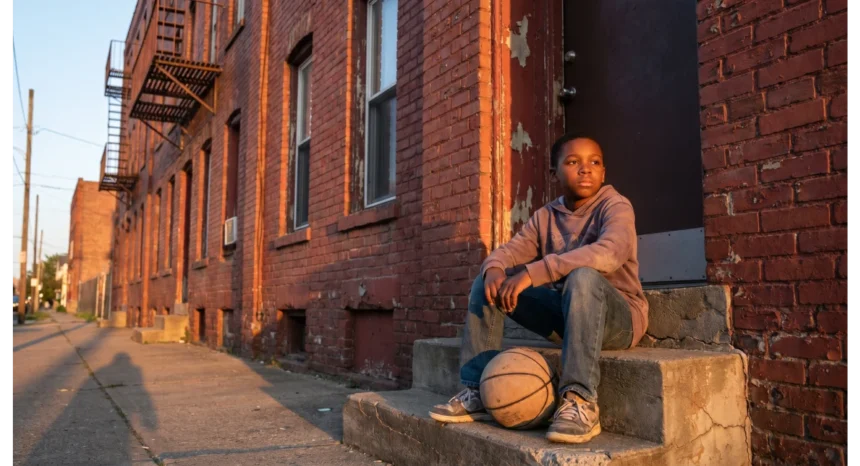
Most people know LeBron James as a four-time NBA champion, a global icon, and one of the greatest basketball players who ever lived. But the story of LeBron James’ early life before fame looks nothing like the highlight reels.
- Where Did LeBron James Grow Up?
- Who Raised LeBron James — And How Did She Do It?
- How Unstable Was LeBron’s Housing Growing Up?
- How Did LeBron James First Get Into Basketball?
- What Was LeBron’s School Life Like Before High School?
- LeBron James Early Life Before Fame — The Basketball Years That Built His Name
- What Challenges Did LeBron Face That Had Nothing to Do With Basketball?
- How Did High School Change Everything for LeBron?
- Conclusion
It starts in Akron, Ohio, with a teenage mother, no father in the picture, and an address that kept changing. Before the sold-out arenas and the shoe deals, there was a kid who spent a chunk of fourth grade not in a classroom because his family had nowhere steady to land.
This is that story — not a rags-to-riches summary, but an honest look at what his childhood actually felt like, who showed up for him, and how basketball became something far more important than a sport.
Where Did LeBron James Grow Up?
Akron, Ohio, is about 40 miles south of Cleveland, and by the time LeBron was born in 1984, the city had been dealing with economic decline for nearly a decade. This was not a prosperous suburb. It was a place where real financial hardship shaped daily life for a large portion of its residents, and the neighbourhoods where LeBron grew up sat right at the centre of that reality.
Understanding where he came from is not about framing his story as tragic. It is about being accurate. The conditions he grew up in shaped his instincts, his loyalty, and his drive in ways that a comfortable childhood simply could not have.
What Akron Looked Like in the Late 1980s and Early 1990s
Akron was once called the rubber capital of the world. Companies like Goodyear and Firestone built their empires there, and for decades factory work provided working-class families with a reliable income. By the late 1980s, that era was fading fast.
Manufacturing jobs were disappearing. Unemployment climbed. Families who had counted on steady industrial work were now scrambling. The city’s poverty rate during LeBron’s childhood years was well above the national average, and the neighbourhoods where lower-income residents lived showed those pressures in real, visible ways: deferred maintenance on housing, underfunded schools, and limited options for young people outside of sports or the streets.
The Exact Neighbourhoods Where LeBron Spent His Childhood
LeBron and his mother Gloria moved frequently, but the areas they cycled through were concentrated in Akron’s poorer districts. Spring Hill, a public housing complex in Akron, was one of the places they called home for a period. Elizabeth Park, another low-income area, was part of that rotation too.
These were not neighbourhoods with well-kept parks and community resources on every corner. Housing was dense, maintenance was often poor, and the social environment made growing up there genuinely difficult. For a child moving between these areas repeatedly, there was no sense of a home base, no bedroom that stayed yours, no street where you knew everyone by name for more than a few months at a time.
Who Raised LeBron James — And How Did She Do It?
Gloria James was 16 years old when LeBron was born on December 30, 1984. That single fact tells you a great deal about what the early years looked like. She was not a grown woman with savings, a support network, and a plan. She was a teenager, suddenly responsible for another life, with almost no resources to fall back on.
There is no easy way to frame that. It was hard. And the way she handled it — imperfectly, but with genuine love and sacrifice — is one of the more important parts of LeBron’s story.
Gloria James at 16 — What She Was Dealing With
LeBron’s father, Anthony McClelland, was not present. He had a criminal record and played no role in raising his son. That left Gloria entirely on her own from the start.
She had not finished her own education. She had no career, no stable income, and no partner to share the financial or emotional weight. What she had was her mother, Freda James, and for the first few years of LeBron’s life, that made a meaningful difference. Gloria worked whatever jobs she could find, but money was consistently scarce, and stable housing was something she spent years chasing.
What is worth noting here is that Gloria did not disappear on her son. She stayed. She moved with him, sacrificed with him, and carried the burden of keeping them both afloat even when the situation looked genuinely bleak.
The Role of Freda James — LeBron’s Grandmother
Freda James was the stabilising force in the household during LeBron’s earliest years. She helped hold the family together while Gloria tried to get her footing, and her presence gave young LeBron something close to consistency.
Then, on Christmas Day 1987, Freda died of a heart attack. LeBron was three years old.
The loss changed everything. Gloria lost her primary support system almost overnight. The financial and emotional weight that Freda had helped carry now fell entirely on a 19-year-old who was already stretched beyond her limits. The family’s situation, already precarious, became significantly more unstable after that Christmas morning.
How Unstable Was LeBron’s Housing Growing Up?

This is the part of LeBron’s story that does not get enough attention. People mention the poverty, but the specific, grinding reality of unstable housing is something different. It is not just about being poor. It is about never knowing how long you will be in one place, and what that does to a child’s ability to function, trust, and grow.
Moving More Than a Dozen Times Before Age 12
By most accounts, Gloria and LeBron moved more than a dozen times before he was 12 years old. The reasons varied: eviction for unpaid rent, seeking slightly better or safer conditions, staying temporarily with whoever could help at the time.
Each move meant leaving behind whatever small sense of place LeBron had built. New neighbourhood, new dynamics, new risks. For a child, that kind of repeated uprooting does not just create logistical problems. It creates anxiety, withdrawal, and a distrust of permanence. You stop investing in friendships because you already know you might not be around next month.
It also disrupted his schooling in concrete, measurable ways. Changing addresses often meant changing schools, and changing schools mid-year meant starting over academically and socially each time.
What It Means to Grow Up Without a Stable Address
Children who experience housing instability at this level tend to show lower academic performance, higher rates of anxiety, and more difficulty forming long-term relationships. None of that is speculation — it is well-documented across child development research.
For LeBron specifically, the instability built something in him that showed up later in unmistakable ways. His obsessive loyalty to childhood friends, his decision to take his talents back to Cleveland after years away, his founding of the I PROMISE School in Akron for at-risk children — all of it traces back, at least in part, to what it felt like to have none of that as a kid.
He knew what it meant to lack a foundation. So when he could build one, he did.
How Did LeBron James First Get Into Basketball?
The popular version of this story says a gifted kid picked up a basketball and the rest was inevitable. The real version is more complicated, and more interesting.
LeBron did not walk onto a court one day and discover his destiny. He found basketball because a man named Frank Walker Sr. decided to pay attention, and because his mother made a painful but necessary decision to let her son go live somewhere more stable.
Frank Walker Sr. — The Man Who Gave LeBron a Home
Frank Walker Sr. was a youth football coach in Akron who noticed LeBron and took a genuine interest in the boy’s welfare — not just his athletic potential. When LeBron was around nine years old, Gloria made the decision to allow him to move in with the Walker family.
This was not a small thing. Gloria was giving up daily life with her son because she recognised that what she could offer him at that moment was not enough. The Walker household had structure: regular meals, consistent bedtimes, a stable address, and adults who showed up. LeBron started attending Portage Path Elementary School consistently for the first time.
Frank Walker Sr. created an environment where LeBron could simply be a kid with a routine. That alone was more than he had experienced in years.
From Football to Basketball — How the Switch Happened
LeBron actually started with football, not basketball. He played youth football and showed real ability on the field. It was Frank Walker Sr. who introduced him to basketball, and the transition happened naturally once LeBron had the time and space to actually practise.
What basketball offered beyond the sport itself was community. The game gave him a team, a purpose on weekday evenings, and adults outside his family who invested in his growth. It gave him somewhere to be where the rules were clear, and effort was rewarded.
That combination of structure, belonging, and physical release was exactly what a nine-year-old who had spent years in chaos needed. Basketball was not just where his talent lived. It was where he felt safe.
What Was LeBron’s School Life Like Before High School?
Housing instability and consistent schooling do not go together well. For much of his early childhood, LeBron’s education was as fragmented as his home life. The absences piled up, the transfers happened mid-year, and the ability to build any kind of academic momentum was nearly impossible.
Attendance Problems and What Caused Them
In fourth grade, LeBron missed 83 days of school. That number stands out because it is so specific and so severe. In a standard school year of around 180 days, missing 83 means a child is absent for nearly half the year.
The cause was not indifference. It was the chaos at home. Gloria was moving, working unstable jobs, and managing a life with very few resources. Getting LeBron to school every single day was not always possible when basic stability was out of reach.
Teachers and school staff noticed the absences, but the systemic support for families in that situation was limited. LeBron was not a child who was being neglected out of carelessness. He was a child caught in circumstances that the adults around him were also struggling to manage.
How Stability at the Walkers’ Home Changed His School Performance
The contrast after moving in with the Walker family was significant. With a fixed address, a routine, and adults who could ensure he got to school each day, LeBron’s attendance improved sharply.
This is the clearest evidence that his earlier problems were circumstantial rather than personal. He was not a difficult student. He was not disinterested in learning. He was a kid who had been set up to fail by conditions outside his control, and when those conditions changed, so did his outcomes.
The improvement in attendance also gave him social continuity for the first time. He could build friendships that lasted more than a few months. He could develop a reputation with teachers. He could simply be known, which is something children in constant transition rarely get to experience.
LeBron James Early Life Before Fame — The Basketball Years That Built His Name
By the time LeBron reached his early teens, basketball had shifted from a safe activity to a serious pursuit. The talent was obvious, but the context around it was what made those years genuinely formative.
The Northeast Ohio Shooting Stars AAU Team
Around ages 10 and 11, LeBron joined the Northeast Ohio Shooting Stars, an AAU (Amateur Athletic Union) travel basketball team. With him on that team were three boys who would become his closest and most enduring friends: Sian Cotton, Dru Joyce III, and Willie McGee. Together they were eventually called the Fab Four, and the bond they formed during those years lasted well into LeBron’s professional life.
AAU basketball was a significant step up in every way. The competition was tougher, the travel was real, and the exposure to coaches and scouts from outside Akron began almost immediately. For a group of kids from working-class backgrounds, travelling to tournaments across Ohio and beyond was an experience far outside their normal world.
It also showed LeBron what was possible. The basketball world was much bigger than his neighbourhood, and he was clearly one of the best players in it.
What Made LeBron Stand Out at That Age
The talent was not just physical, though the physical gifts were remarkable. By the time he was 11 or 12, LeBron was significantly bigger and stronger than most boys his age, which gave him an obvious advantage. But coaches who worked with him during that period consistently pointed to something harder to teach: his ability to read the game several seconds ahead of play.
He passed when most athletic kids his age would have shot. He saw angles that others missed. He communicated on the court, directed teammates, and seemed to understand the game as a whole rather than just his own role within it.
That combination of size, speed, and basketball intelligence at such a young age was unusual enough that word spread quickly. By the time he was in middle school, people in the Ohio basketball community already knew his name.
What Challenges Did LeBron Face That Had Nothing to Do With Basketball?
Take basketball out of the picture entirely, and LeBron’s childhood was still defined by significant emotional weight. Growing up without a father, watching your mother struggle financially, and navigating a neighbourhood where the path forward was not obvious — that leaves marks regardless of what sport you play.
Growing Up Without a Father — What LeBron Has Said About It
LeBron has spoken about his father publicly on multiple occasions over the years, though not always at length. Anthony McClelland was absent throughout LeBron’s entire childhood, and LeBron has been open about the fact that he did not have a father figure in the traditional sense.
In various interviews and in the documentary More Than a Game, LeBron described the absence as something he had to learn to live with rather than something that was ever resolved. He has spoken about channelling that feeling into motivation, about finding father figures in coaches and mentors, and about making sure his own children grew up knowing their father was present.
The absence shaped his values in a direct way. His loyalty to the people who did show up for him is, by his own account, a direct response to the people who did not.
Watching His Mother Struggle — And What He Took From It
LeBron has credited Gloria repeatedly in interviews as the person most responsible for who he became. Not because she had resources or connections, but because she stayed and she cared with everything she had.
Watching her work multiple jobs, make sacrifices so he could eat and have clothes for school, and carry the full weight of parenthood alone gave LeBron a grounded understanding of what real effort looks like. It also gave him a deep awareness of financial insecurity and what it costs people.
That awareness shows up in his career decisions, his philanthropy, and his business focus. He has spoken about never wanting to be in a position where he could not take care of his family. When you know what it looked like when that security was absent, you build it differently.
How Did High School Change Everything for LeBron?
By the time LeBron entered high school, the survival chapter of his story was effectively closing. The chaos of constant moves had settled. He had found stable ground, a community, and a sense of direction. High school was where recognition began to replace hardship as the dominant experience.
Why St. Vincent–St. Mary Was a Significant Choice
LeBron did not default into the nearest public school. He chose to attend St. Vincent–St. Mary High School, a private Catholic school in Akron known for strong academics and a competitive athletic programme. That choice was intentional.
The school offered a structured environment with clear expectations, and its basketball programme was serious without being a factory. For LeBron and his closest friends from the Shooting Stars, attending the same school meant the group they had built together would stay together through high school. That continuity mattered enormously to kids who had learned the hard way that things do not always last.
It was also a signal about direction. Choosing a rigorous private school when easier options existed said something about what LeBron and the people around him believed was possible.
The Moment National Media Started Paying Attention
By his sophomore year at St. Vincent–St. Mary, LeBron James was no longer just a name in Ohio basketball circles. ESPN had begun covering his games. In his junior year, Sports Illustrated put him on the cover with the headline “The Chosen One” — a label he famously had tattooed on his back.
For a 16 or 17-year-old from Spring Hill and Elizabeth Park, that level of attention was staggering. The pressure it created was real: expectations from the media, scrutiny of every game, and the weight of a narrative that had already decided he was destined for greatness before he had played a single minute of professional basketball.
What made him handle it as well as he did was likely rooted in everything that came before. A kid who had already navigated housing instability, absent parents, and years of uncertainty was not going to be broken by a magazine cover.
Conclusion
LeBron James did not become who he is despite his childhood. He became who he is, in large part, because of it.
The years defined by moving between Akron’s toughest neighbourhoods, watching his mother manage impossible circumstances alone, and finding stability only through the generosity of people who chose to show up for him — those experiences built something in him that the talent alone never could have. The loyalty, the resilience, the awareness of what it means to not have enough: all of it was forged before a single professional contract existed.
Understanding LeBron James ‘ early life before fame matters because it reframes the story from a tale of pure talent to one about survival, community, and the specific people who made the difference. Frank Walker Sr. gave him structure. Gloria James gave him love. The Walkers gave him a stable address. Without any one of those, the story might have ended very differently.
If this kind of story resonates with you, explore how other public figures built their lives from difficult beginnings. You might find that the backgrounds behind the success are often the most interesting part of the story.