
There is a quiet pressure many solo travelers feel before a big trip. You have sorted your flights, packed your bag, and planned your route — but somewhere in the back of your mind, you wonder who you will actually talk to.
- Why Making Friends Without Apps Works Better Than You Think
- The Problem With Relying on Technology to Socialize
- What Makes Offline Travel Friendships Last Longer
- Choose Accommodation That Puts You Around Other Travelers
- Put Yourself in Shared Activity Spaces
- How to Make Friends While Traveling Alone Naturally at Local Spots
- Regulars at Cafés, Markets, and Neighborhood Restaurants
- Community Boards, Expat Meetups, and Local Events
- Use the Right Conversation Starters in the Right Moments
- Travel Solo but Move With Others — The Art of Temporary Companionship
- Solo Travel Social Tips for Introverts Who Find This Difficult
- Sustaining Travel Friendships After You Part Ways
- Conclusion
If you have been searching for ways to make friends while traveling alone, naturally, you are not short of options. The truth is, some of the best travel friendships start not with a swipe or a profile, but with a glance across a hostel kitchen or a comment about the view from a lookout point.
This post covers practical, offline ways to meet people while traveling — no apps, no awkward profiles, and no complicated strategies. Just real situations, honest advice, and approaches that actually work.
Why Making Friends Without Apps Works Better Than You Think
A lot of travelers assume that without a social app, meeting people on the road is hard. That assumption is wrong, and understanding why matters before anything else.
Apps create a filtered version of social interaction. You are choosing who to talk to before you have even been in the same room. That removes the spontaneity that makes travel friendships so memorable in the first place.
When you meet someone at a night market because you both reached for the same dish, or laugh with a stranger on a crowded bus when the luggage rack collapses, there is no algorithm behind that. It just happens. And those moments tend to stick.
The Problem With Relying on Technology to Socialize
When you are glued to a screen looking for connection, you stop noticing the connections available right in front of you.
App-based socializing also creates a habit of passive waiting. You post, you swipe, you wait for someone to respond. On the road, that habit works against you. The traveler who closes the phone and orders a coffee at the communal table is always going to meet more people than the one scrolling in a corner booth.
There is also a confidence issue. The more you outsource social interaction to an app, the rustier your in-person social instincts get. Traveling without apps forces those instincts back online, and most people find that after the first conversation, the rest come easier.
What Makes Offline Travel Friendships Last Longer
Think about the travel friends you remember most. Chances are, they are people you shared something real with — a long bus ride, a wrong turn that became an adventure, a meal you could not name but ate anyway.
Offline connections carry shared physical experiences. You both stood in the rain waiting for a boat. You both got lost in the same alley. That shared context builds trust quickly, and trust is what turns a pleasant chat into a friendship worth keeping.
There is also a vulnerability element to solo travel that speeds things up. When two people are both far from home and figuring things out in real time, the usual social barriers come down faster than they would back in normal life.
Choose Accommodation That Puts You Around Other Travelers
Where you sleep is one of the most direct choices you make as a solo traveler, and it shapes your social experience more than almost anything else. This is one of the most underestimated solo travel social tips — and it costs nothing extra to get right.
A private room in a large chain hotel is comfortable and quiet. It is also completely isolated. If meeting people matters to you, your accommodation choice has to reflect that.
How Hostels Create Natural Social Environments
Hostels are built around shared space. That is the entire point of them, and it works.
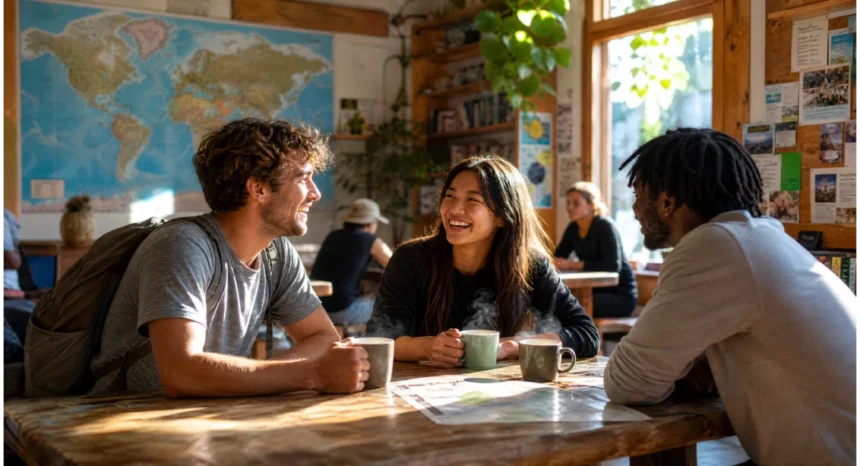
Dorm rooms mean you are sleeping near strangers from the start, which sounds uncomfortable until you realize it immediately breaks the ice. Communal kitchens give everyone a shared reason to be in the same room. Rooftop areas, lounge corners, and TV rooms do the same.
Many hostels also organize events specifically to get guests talking — pub crawls, group dinners, movie nights, and local excursions. You do not have to initiate anything. You just show up.
The social environment in a hostel is almost pre-built. The challenge is not finding people to talk to — it is deciding which conversation to join first.
Guesthouses, Homestays, and Locally-Run B&Bs
If hostels are not your style, locally-run guesthouses and homestays offer a different kind of connection — one that often goes deeper.
Staying with a local host puts you in direct contact with someone who knows the area, has opinions about it, and usually enjoys sharing both. A question as simple as “Where do you actually eat around here?” can turn into a two-hour conversation, a hand-drawn map, and a recommendation that no travel website has.
In some cases, a guesthouse host has introduced one guest to another because they were both traveling to the same region the next day. That kind of organic introduction happens when you are staying somewhere human-sized — not in a 300-room hotel where no one knows your name.
Put Yourself in Shared Activity Spaces
Proximity helps. Shared purpose is better.
Being in the same space as other travelers is a starting point, but what accelerates connection is doing something together. When two people are both trying to roll pasta dough without making a mess, they are going to talk. When two people are standing next to each other and looking at the same view, conversation is natural.
The activities you choose while traveling can either keep you in your own bubble or pull you into a group. Choosing group-friendly activities is one of the simplest ways to meet people while traveling.
Free Walking Tours as a Social Shortcut
Free walking tours are one of the most reliably social experiences on the road, and they attract solo travelers in disproportionate numbers.
The format is simple: a local guide leads a small group through a city for two to three hours, and you tip what you feel at the end. Because there is no fixed price, the barrier to joining is low. Because the group is walking and stopping together, conversation happens naturally during the pauses.
Look for free walking tours at the main square or tourist information point of most cities in Europe, Southeast Asia, and Latin America. Hostel staff usually know the best ones. Budget around a few dollars for a tip — it is expected, and the guides earn their living from it.
Cooking Classes, Craft Workshops, and Day Trips
Hands-on activities are social by design. When everyone in the room is focused on a task, no one feels the pressure of forced conversation. The activity carries the interaction.
A pasta-making class in Bologna, for example, puts eight strangers around a flour-covered table for three hours. By the time the food is ready, introductions have happened on their own. A batik fabric workshop in Yogyakarta, Indonesia, works the same way — the process is slow, the group is small, and the shared confusion about technique gives everyone something to laugh about together.
Day trips to nearby sites also work well. Shared transport, guided stops, and a long return journey give a group of strangers plenty of time to move from polite introductions to real conversation.
How to Make Friends While Traveling Alone Naturally at Local Spots
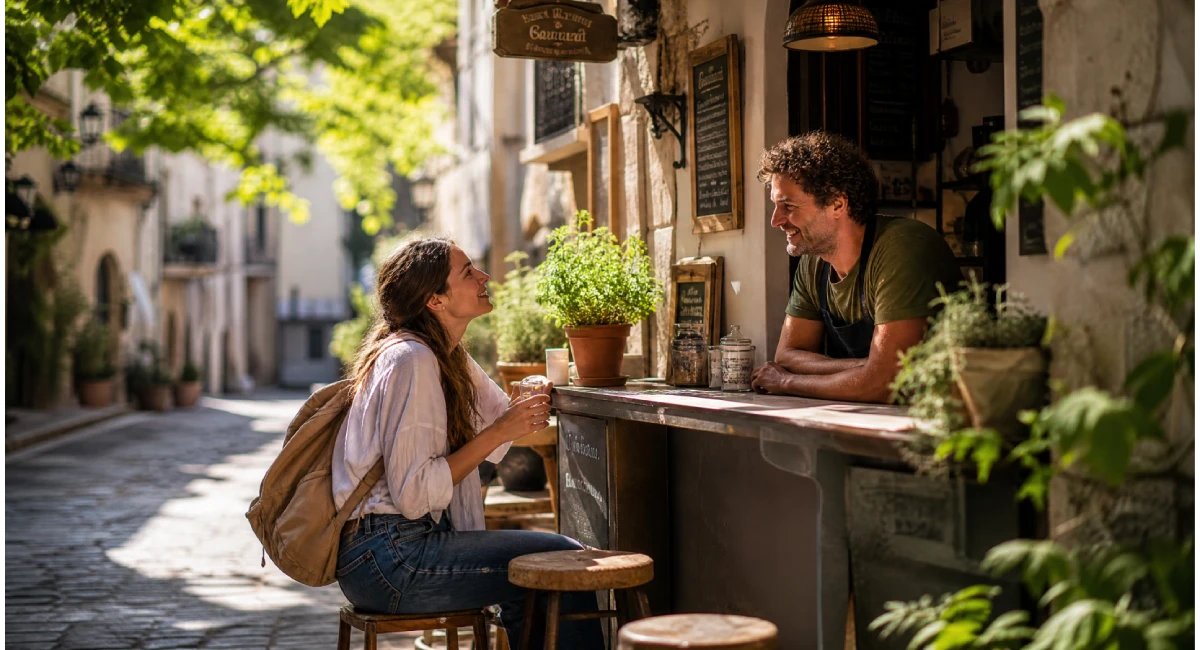
Tourist attractions bring travelers together, but local spots bring out a different kind of social experience. Integrating into everyday local life — even slightly — puts you in contact with both long-term residents and the kind of travelers who have been around long enough to know the good spots.
This approach takes a little more patience than showing up to a scheduled tour. But the connections it leads to tend to feel more genuine.
Regulars at Cafés, Markets, and Neighborhood Restaurants
The single most underrated social move in solo travel is returning to the same place two or three times.
When you visit the same morning café two days in a row, the person behind the counter recognizes you. By the third visit, they might ask where you are from. By the fourth, they might introduce you to the person who comes in every morning at the same time.
Regularity signals that you are not just passing through. It lowers the social guard of locals and opens doors that a single visit never would.
Practical tip: sit at the counter or at a communal table rather than tucking yourself into a corner. A private table signals that you want to be left alone. A counter seat signals that you are open.
Community Boards, Expat Meetups, and Local Events
Notice boards in hostels, co-working spaces, community centers, and laundromats are worth scanning every time you walk past one.
Language exchange events, local hikes, cultural evenings, volunteer days, and free concerts are regularly advertised this way in cities across the world. These events draw a mix of travelers and locals, and because they are organized around a shared interest, the conversation has a natural starting point.
For those who want a more structured option, websites like Meetup.com host in-person events in hundreds of cities. It sits in a middle ground between fully offline and app-driven — you find the event online, but the interaction happens entirely in person.
Use the Right Conversation Starters in the Right Moments
The fear of approaching a stranger is the real barrier for most solo travelers. It is not a lack of opportunity. It is the moment just before opening your mouth.
The good news is that conversation starters in travel contexts do not need to be clever. They need to be situationally appropriate and genuine. That combination is almost impossible to get wrong.
Situational Openers That Feel Natural
The best openers are ones that the situation practically writes for you. Here are several that work across different settings:
- At a hostel common room: “Have you been here a few days? Is there anything you’d actually recommend?”
- At a market stall: “Do you know what this is? I keep seeing it everywhere and have no idea what to do with it.”
- On a walking tour: “Are you traveling by yourself too, or did you come with people?”
- At a viewpoint: “I cannot figure out which direction is which — have you got a better sense of the layout than I do?”
- In a cooking class: “Is yours turning out the way it is supposed to? Mine looks nothing like the example.”
- At a café counter: “Is this place always this busy in the morning?”
- On a long bus or train journey: “How long does this section usually take? I have heard very different estimates.”
None of these openers requires charm or confidence beyond the willingness to speak. They are low-stakes questions that invite a natural response rather than demanding one.
Reading Body Language and Knowing When Not to Push
Not everyone who is traveling alone wants to talk, and that is completely fine.
Before approaching someone, take a quick read of the situation. Headphones in with no eye contact usually means they are not open to conversation. A book held up close to the face is a similar signal. Someone who is actively looking around, making brief eye contact with people nearby, or sitting without any obvious activity is much more likely to welcome a short exchange.
If you start a conversation and the responses are short and do not lead anywhere, take that as a natural close. A polite “Enjoy the rest of your trip” and moving on is not rejection — it is social awareness. Keeping that perspective makes the whole process much less intimidating.
Travel Solo but Move With Others — The Art of Temporary Companionship
Not every travel friendship needs to last a week. Some of the best ones last a day.
A temporary companion is someone you end up spending a few hours or a couple of days with before you each move on. These connections form all the time on the road, and the solo traveler who recognizes and acts on those opportunities will rarely feel isolated for long.
How to Spot a Fellow Solo Traveler
Solo travelers give off specific signals, and once you know what to look for, they are easy to spot.
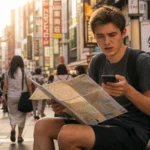
Look for: one person sitting at a table designed for two, someone studying a paper map or a guidebook alone, a single small backpack at a hostel locker, someone eating dinner alone but glancing around occasionally rather than looking down at a phone the whole time.
These are not guarantees, but they are strong indicators. Approaching someone who is clearly traveling alone removes a layer of social calculation because the context is shared from the start.
Proposing a Plan Without Pressure
Once a conversation has been going comfortably for a few minutes, floating a casual plan together is surprisingly easy.
The key is to phrase it as low-stakes as possible. Something like: “I was thinking of heading to the old market this afternoon — want to come along?” works well because it makes it easy for the other person to say yes or no without either answer feeling like a big deal.
Avoid building it up as more than it is. You are not asking someone to commit to anything. You are inviting them to share an afternoon. Most solo travelers, when approached this way, say yes more often than you might expect — because they were probably thinking the same thing and just waiting for someone else to suggest it first.
Solo Travel Social Tips for Introverts Who Find This Difficult
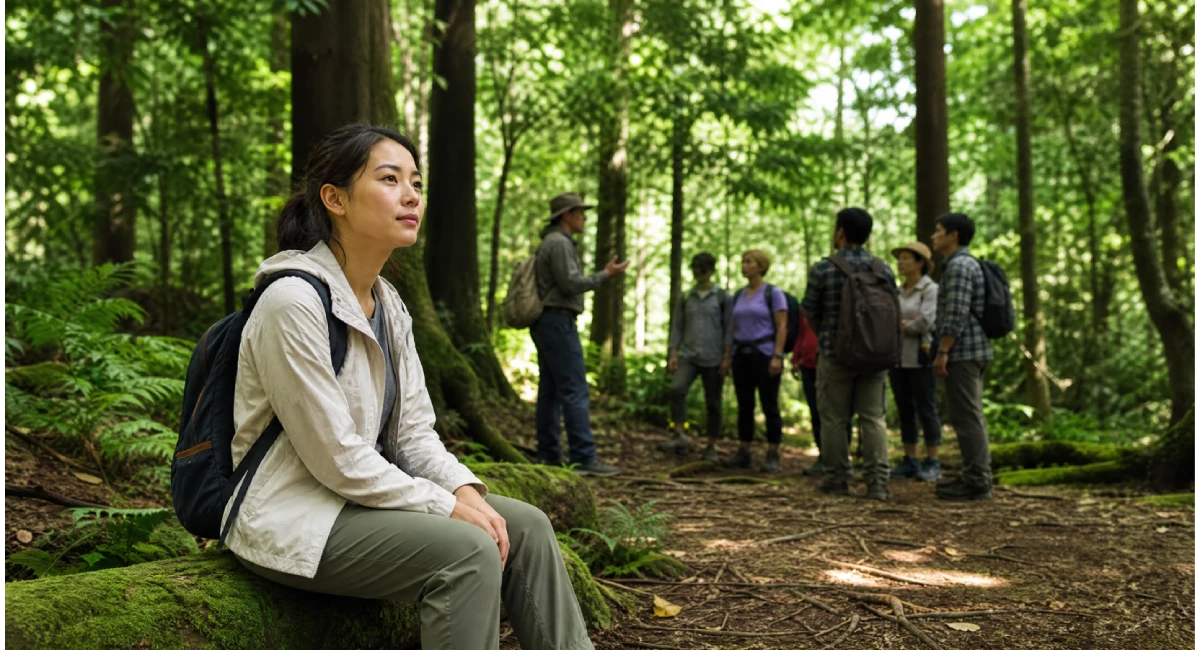
Not every solo traveler is naturally social. Some people travel alone precisely because they need space, quiet, and control over their environment. The advice in this post still applies to introverts — it just needs a slight adjustment in how it is applied.
The goal is not to become extroverted. The goal is to create the conditions for connection without draining yourself in the process.
Structured Activities Require Less Social Energy
For introverts, the hardest part of socializing is the unstructured kind — walking into a room full of strangers with no clear reason to speak to any of them.
Structured activities remove that problem entirely. When you join a cooking class, a guided hike, or a walking tour, the activity tells you what to do and gives everyone in the group a natural reason to interact. You do not have to initiate. You just have to participate.
This is genuinely one of the most practical solo travel social tips for introverts because it produces real connection without requiring the kind of effortful social performance that drains introvert energy fast.
The Power of Small, Repeated Gestures
You do not always need words to begin a connection.
Showing up to the same hostel breakfast table two mornings in a row, smiling at the person you passed on the stairs yesterday, making brief eye contact, and giving a nod to the person at the next locker — these are micro-gestures that communicate openness without demanding anything in return.
Travel friendships often begin this way. A few small gestures over two days can create enough familiarity that a full conversation starts on its own, without either person feeling like they made a move. For introverts, this gradual approach feels natural and is just as effective over a slightly longer timeline.
Sustaining Travel Friendships After You Part Ways
Meeting someone great on the road and then watching them board a bus in the opposite direction is one of the more bittersweet parts of solo travel. Most travel friendships are brief by nature. That does not mean they have to end the moment you part.
Keeping a connection alive after travel takes very little effort — but the effort needs to happen at the right time and in the right way.
Exchanging Contact Details the Right Way
The worst time to exchange contact details is when both of you are rushing. If you are splitting at a bus station or scrambling to get to different checkouts, a hurried exchange of numbers or handles tends to lead to nothing.
The better approach is to suggest it during a calm moment before you part. If you have spent a day or two together, something simple works well: “I should grab your number before we lose track of each other.” Most people respond positively because they were likely thinking the same thing.
Match the medium to the relationship. A phone number or email suits someone you had a real conversation with over several hours. A social media handle works for someone you met briefly but genuinely liked.
Turning a Travel Friend Into a Long-Term Connection
Most travel friendships fade. A small number do not, and the ones that last tend to share one thing in common: someone made a small, low-effort gesture a few weeks after parting.
Sending a photo from something you experienced together — the view from the hike, the dish from the cooking class, a picture of the street you wandered down — reopens the thread in a way that feels natural rather than forced. It signals that you thought of them without putting any pressure on them to respond at length.
That kind of light-touch contact, repeated once or twice over a few months, is often enough to turn a brief travel friendship into something that actually continues.
Conclusion
Meeting people on the road has nothing to do with having the right app. It has everything to do with putting yourself in the right spaces, staying open to brief exchanges, and following through on the small moments that could turn into something more.
The advice in this post is not complicated. Stay somewhere social. Show up to shared activities. Return to the same café. Ask a simple question. Invite someone along. None of it requires a profile, a rating, or a screen.
If you want to make friends while traveling alone naturally, the only real requirement is presence — being somewhere, being open, and trusting that the right moment will come.
Pick one approach from this post and try it on your next trip. Even one genuine conversation with a stranger in an unfamiliar city can shift the entire tone of a solo journey. And if you are still thinking about whether solo travel is the right choice for you, the next post on whether solo travel is safe for beginners in unfamiliar countries is worth reading before you book anything.