

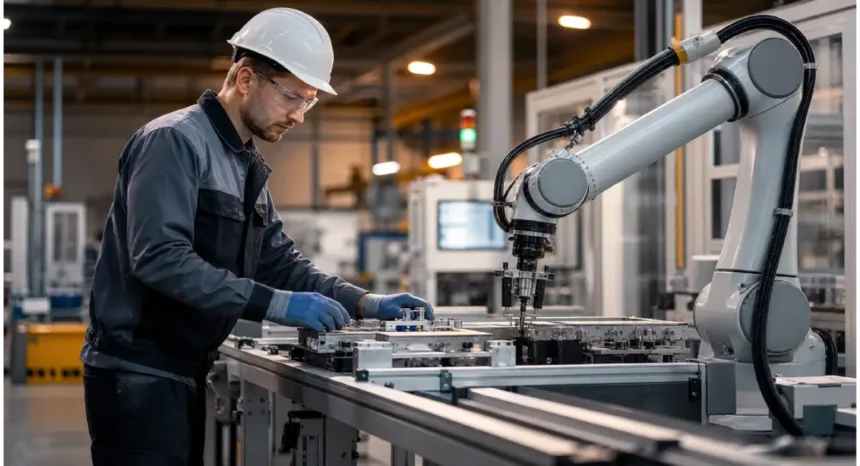
The question is no longer hypothetical: how is automation changing jobs, industry by industry? Workers in manufacturing plants, bank branches, hospital offices, and retail stores are watching their roles shift in real time. Understanding the impact of automation on jobs by industry means making sense of what is already happening — not predicting a distant future.
- What Automation Actually Means for the Modern Workforce
- Automation Impact on Jobs in Manufacturing and Logistics
- How Automation Is Reshaping Retail and Customer Service
- The Healthcare Sector: Automation That Assists Rather Than Replaces
- Finance and Banking: White-Collar Jobs Under Pressure
- Transportation and Delivery: The Promise and the Delay
- Industry Automation Examples in Agriculture and Construction
- The Skills That Protect Workers Across Every Sector
- Policy, Retraining, and What Governments Are Getting Right (and Wrong)
- Conclusion
Automation does not hit all industries equally, and it does not hit all workers within an industry equally. Some roles are disappearing. Others are being restructured around new tools. Some jobs that did not exist a decade ago are now in high demand.
This article works through the major sectors one by one, using specific examples and data, so you can see where the pressure is concentrated and where it is not.
What Automation Actually Means for the Modern Workforce
Before comparing sectors, it helps to define what automation actually covers, because the word spans a wide range of technologies with very different implications for workers.
Traditional automation refers to mechanical systems built to perform fixed, physical tasks. Think assembly-line robots that weld car frames, conveyor systems in warehouses, or CNC machines that cut metal to precise specifications. These systems replaced physical labor in specific, predictable tasks, but they could not read a contract, interpret a medical image, or answer a customer’s complaint.
AI-driven automation changes that. Machine learning systems, large language models, and predictive algorithms can now process language, recognize patterns in complex data, and make decisions based on probabilities. That extends automation’s reach into cognitive work, white-collar roles, and knowledge-based tasks once considered safe from disruption.
The distinction matters because it determines which workers are newly in scope for disruption — and why.
The Difference Between Automation and AI-Driven Automation
Mechanical automation follows a fixed program. A factory robot does exactly what it was instructed to do, every time, without variation. It cannot adapt to a situation it was not programmed for.
AI-driven automation learns from data and generalizes. A system trained on millions of medical images can identify anomalies in new scans it has never seen before. A language model can draft a legal summary, respond to a customer query, or generate a financial report from raw data.
This means the categories of workers facing displacement pressure have expanded. Paralegals, junior analysts, radiologists’ assistants, customer service agents, and content moderators now face risks that were absent only a few years ago.
Which Types of Tasks Are Most at Risk?
The pattern is consistent across research. Tasks that are routine and rules-based carry the highest automation risk, regardless of whether they are physical or cognitive.
A McKinsey Global Institute analysis found that around 60% of all occupations contain at least 30% of tasks that are technically automatable with current technology. The keyword is tasks, not jobs. Automation rarely eliminates an entire role at once. It absorbs specific task categories within a role, restructuring the job rather than deleting it outright.
Repetitive data entry, standard document processing, basic quality checks, and rule-driven customer interactions sit at the highest-risk end. Roles requiring judgment in ambiguous situations, physical dexterity in unpredictable environments, and sustained human interaction sit at the lower-risk end.
Automation Impact on Jobs in Manufacturing and Logistics
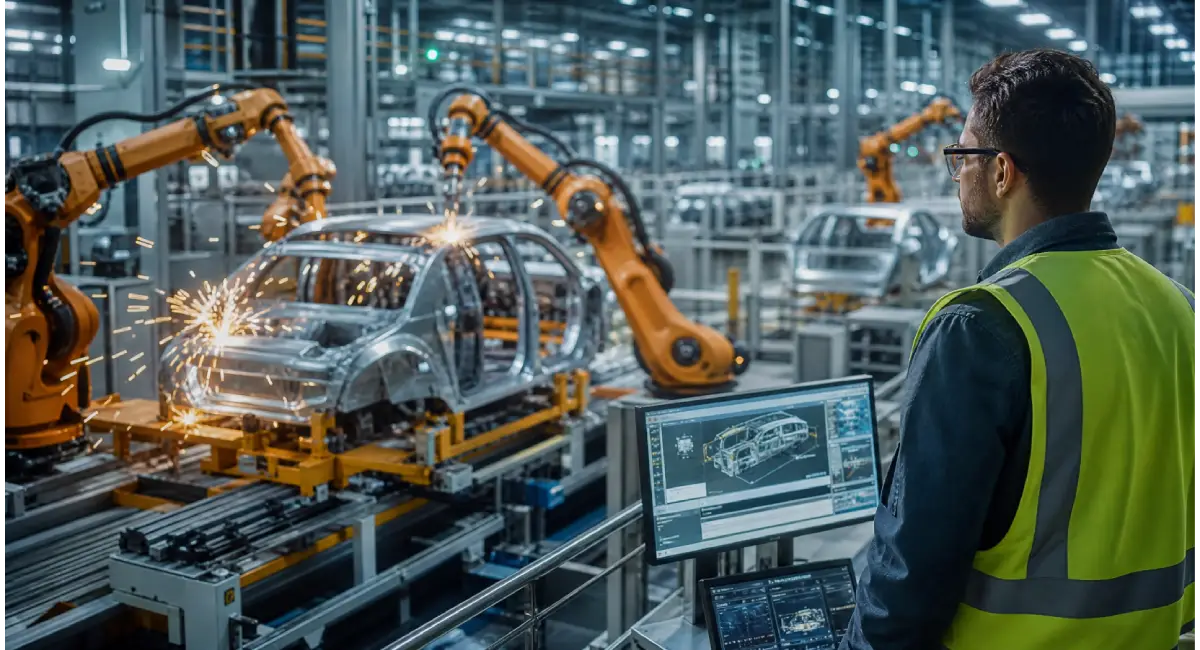
No sector has a longer history with automation than manufacturing. The process started decades ago and has not stopped. What has changed is the speed of adoption and the capability of the machines involved.
CNC machines replaced manual machining. Robotic arms replaced welders and painters. Automated guided vehicles now move inventory through warehouses without human drivers. The cumulative effect on employment has been significant, though more nuanced than the headlines suggest.
What the Factory Floor Looks Like Now
Toyota and BMW plants offer some of the clearest examples. Robotic welding arms handle the structural assembly of vehicle bodies with a precision and speed that human welders cannot match at scale. Humans on these floors increasingly work in supervisory, maintenance, and quality assurance roles rather than performing physical assembly tasks themselves.
Amazon’s fulfillment centers provide a logistics parallel. The company’s Kiva robots, now operating under the Amazon Robotics brand, move entire shelving units to human pickers rather than requiring workers to walk miles of warehouse floor per shift. Amazon has also piloted “dark warehouses” — facilities designed to run with minimal human presence, using robotics for sorting, stacking, and dispatch.
The International Federation of Robotics reported that the global stock of industrial robots exceeded 3.9 million units by 2022, a figure that has continued to grow. In highly automated manufacturing economies like South Korea, Singapore, and Germany, robot density per 10,000 workers runs well above the global average.
Which Manufacturing Roles Have Grown Because of Automation
The displacement story in manufacturing is real, but incomplete. Automation has simultaneously created demand for roles that did not exist at scale before.
Robot maintenance technicians, automation programmers, process engineers, and systems integration specialists are in short supply across the manufacturing sector. Manufacturers in Germany and the United States have repeatedly flagged skills gaps in these areas as a genuine operational constraint. Factories want to automate further but lack the trained workforce to maintain and program the systems they already have.
Quality control analysts who work with sensor data and automated inspection systems, along with supply chain analysts who manage increasingly complex logistics software, represent growing roles. Manufacturing work is shifting upward in complexity rather than simply shrinking.
How Automation Is Reshaping Retail and Customer Service
Retail is one of the largest employment sectors globally, and one where automation-driven job loss has been most visible to consumers. Self-checkout machines, inventory robots, and AI-powered customer service tools have all entered the sector within a short window.
The impact is uneven. Large chains with capital to invest in technology have automated more aggressively. Smaller retailers often lack the resources to follow. And not all automation experiments have succeeded.
Self-Checkout, Cashierless Stores, and What Happened to Cashiers
Self-checkout terminals have spread consistently across major grocery and retail chains for over a decade. Walmart, Kroger, and Tesco have all expanded self-checkout availability, reducing the number of staffed checkout lanes and, by extension, the number of cashier positions required per store.
Amazon took the concept further with its Amazon Go cashierless stores, which use computer vision and sensor fusion to let shoppers pick up items and walk out without any checkout process. The technology works, but Amazon’s rollout has been slower than initially projected. The company has closed several Go locations and scaled back expansion plans, citing high infrastructure costs and profitability challenges.
This matters: automation adoption in retail is not a clean, linear march forward. Technology gets deployed, encounters real-world problems, and sometimes gets pulled back. Cashier roles have declined, but they have not vanished.
AI Chatbots and the Future of Customer Support Roles
AI-powered customer service tools now handle a large volume of tier-1 support queries across retail, telecoms, banking, and software companies. These systems resolve password resets, order tracking requests, return initiation, and frequently asked questions without a human agent.
For call centers — particularly those in outsourced markets across the Philippines, India, and Eastern Europe — this creates real pressure on employment. The queries AI handles well are the high-volume, repetitive ones that fill much of the workload in entry-level support roles.
What remains for human agents is increasingly the complex, emotionally charged, or high-stakes interaction: complaints requiring judgment, distressed customers, exceptions to policy, and situations requiring cross-system problem-solving. These interactions are harder to automate and, handled well, carry more value for the business.
The Healthcare Sector: Automation That Assists Rather Than Replaces
Healthcare presents a different picture. Automation is entering rapidly, but its primary function in clinical settings is to support human decision-making rather than replace it.
The technology profile, regulatory environment, and human stakes of clinical work create conditions where full substitution is rare, and augmentation is the dominant pattern.
Diagnostic AI, Robotic Surgery, and Administrative Automation
In radiology, AI tools developed by companies including Google DeepMind and Zebra Medical Vision can analyze medical images and flag potential anomalies with accuracy that matches — or in narrow, specific tasks exceeds — that of experienced radiologists. DeepMind’s work on detecting eye disease from retinal scans is a well-documented example. These tools do not replace radiologists. They process image volume faster, prioritize urgent cases, and reduce the rate of missed findings.
Robotic surgical systems like the da Vinci platform allow surgeons to perform minimally invasive procedures with greater precision than manual instruments alone permit. The surgeon remains in control throughout. The robot executes movements but does not make decisions independently.
The area where healthcare automation most directly displaces roles is administrative. Billing automation, appointment scheduling software, insurance pre-authorization tools, and AI-assisted medical coding are reducing headcount in healthcare back offices. These roles involve less clinical training and carry a higher displacement risk than clinical positions.
Why Nurses, Doctors, and Therapists Remain Hard to Automate
The resilience of clinical roles comes down to structural factors that current technology cannot adequately address.
Physical presence is one. Clinical care frequently requires hands-on assessment, dexterous physical intervention, and environmental reading that goes far beyond what a robot in a controlled factory setting faces. A nurse adjusting a patient’s position, assessing skin color and texture, or responding to a sudden change in condition operates in continuous unpredictability.
Emotional judgment is another. Patients trust clinicians who respond to them as individuals, who communicate difficult information with appropriate sensitivity, and who adapt their approach in real time. Therapists work almost entirely in the domain of human relationships — a space where AI systems remain genuinely limited despite advances in conversational capability.
The World Economic Forum has consistently ranked healthcare workers among the occupational groups least exposed to automation displacement in its Future of Jobs reports. The administrative perimeter of healthcare is a different story.
Finance and Banking: White-Collar Jobs Under Pressure

Finance is where the automation story becomes most relevant to well-educated professionals who once considered their roles secure. Algorithmic trading, robotic process automation, AI-powered underwriting, and fraud detection systems are now standard infrastructure at major financial institutions.
The result is a sector that has reduced headcount in specific functions while adding new roles that require different skills.
Roles That Have Already Shrunk: Tellers, Data Entry, and Junior Analysts
The decline of bank branch tellers is one of the clearest data points in the broader automation picture. The US Bureau of Labor Statistics has tracked a sustained reduction in teller employment as ATM networks, mobile banking apps, and online banking have absorbed the transaction volume that once required in-person service.
Manual data entry positions in financial operations, trade settlement, and loan processing have been heavily reduced by robotic process automation tools. RPA software executes rule-based data tasks at far higher speeds and with far lower error rates than manual operators.
At the junior analyst level, JPMorgan’s COiN platform is the most cited example. COiN (Contract Intelligence) automated the review of commercial loan agreements — a task that previously consumed around 360,000 hours of lawyer and analyst time annually — completing it in seconds. This kind of automation does not eliminate the analyst role, but it fundamentally changes the task composition, shifting effort toward interpretation, client communication, and judgment-based work.
Where Finance Is Still Hiring and Why
Despite compression in operational functions, financial services firms are actively hiring in several areas.
Financial technology specialists who can build, maintain, and audit automated systems are in strong demand. Compliance and regulatory analysts who assess whether automated decisions meet legal and ethical standards have become more critical as automation has spread. Relationship managers who handle institutional clients and high-net-worth individuals work in a domain where personal trust and contextual judgment are the core value.
AI oversight roles — sometimes called model risk managers or AI auditors — are an emerging function. As banks rely more heavily on algorithmic decision-making in credit, trading, and fraud detection, they need humans who can evaluate whether those models are performing correctly, fairly, and within regulatory boundaries. These are not roles that can themselves be automated in any near-term timeframe.
Transportation and Delivery: The Promise and the Delay
Transportation is the sector where public discussion about automation and jobs has been loudest, and where the gap between predictions and actual deployment has been widest. The technology is real. The timeline is not what early forecasts suggested.
Truck drivers, delivery workers, and pilots have all been told that automation is coming for their roles. The more accurate picture is that automation is changing their roles, at different speeds, with different implications by vehicle type and operating environment.
Where Autonomous Technology Currently Stands
Autonomous trucking has attracted significant investment and produced real progress, but commercial deployment at scale remains limited. Waymo Via has conducted autonomous long-haul runs in the American Southwest. Aurora has begun supervised commercial operations with safety drivers. TuSimple, once a prominent player in the space, encountered serious regulatory and governance problems that effectively ended its US operations.
Drone delivery has advanced in controlled conditions. Amazon Prime Air has received regulatory approval for limited operations in specific US locations. Alphabet’s Wing program is running deliveries in parts of Australia and the United States. The operational scope remains narrow. Urban density, airspace regulations, payload limits, and weather constraints all restrict how broadly these services can currently function.
Autonomous taxis represent the most advanced category for passenger-carrying autonomy. Waymo One operates commercially in Phoenix and San Francisco. Cruise, General Motors’ autonomous vehicle unit, suspended operations in 2023 after a safety incident triggered a regulatory investigation. The sector is progressing, but not smoothly.
What This Means for Truck Drivers, Delivery Workers, and Pilots
For professional truck drivers, the near-term reality is partial automation rather than full replacement. Advanced driver assistance systems, lane-keeping technology, adaptive cruise control, and electronic logging devices are already standard in newer fleets. Platooning systems, where multiple trucks travel in a coordinated convoy with the lead vehicle handling navigation, reduce driver cognitive load without removing the driver.
Full autonomy in long-haul trucking requires solving for weather variability, construction zones, unexpected road conditions, and the complexity of urban pickup and delivery environments. None of these are solved at a commercial scale.
Aviation offers an instructive contrast. Commercial aircraft have had highly sophisticated autopilot systems for decades. Pilots spend a relatively small percentage of flight time in direct manual control. Yet global demand for pilots has remained strong and is projected to grow, driven by air traffic expansion, particularly in Asia. Automation changed what pilots do without eliminating the need for them.
Industry Automation Examples in Agriculture and Construction
Agriculture and construction rarely feature prominently in automation discussions, but both sectors are experiencing real change. In both cases, labor shortages have driven adoption as much as cost reduction, which shifts the employment picture.
Precision Agriculture and the Changing Role of Farm Workers
GPS-guided tractors that plant, fertilize, and apply crop treatments along pre-programmed paths are now common on large commercial farms across North America, Australia, and Europe. These systems reduce operator error and allow a single operator to manage larger areas of farmland.
Automated harvesting robots represent a more recent development. Agrobot has developed systems for harvesting strawberries, a crop that has historically resisted mechanization because of fruit fragility. Abundant Robotics, before ceasing operations, demonstrated apple-harvesting robots capable of picking fruit without bruising. Several other companies are developing similar systems for asparagus, lettuce, and other delicate crops.
AI-driven crop monitoring, using drone imagery and satellite data combined with machine learning analysis, allows farmers to identify disease, irrigation problems, and pest activity earlier and more precisely than visual inspection allows.
The automation push in agriculture is partly a response to a structural labor supply problem. Seasonal agricultural work is physically demanding, often poorly paid, and located in rural areas where workforce availability has declined. Farms in the United States, the United Kingdom, and Germany have reported persistent difficulties filling harvest roles for several years running. Automation in this context is partly filling a gap rather than purely displacing available workers.
Tasks that remain heavily human-dependent include anything requiring fine motor judgment in variable conditions, crop assessment in complex environments, equipment maintenance, and the logistical coordination of farm operations.
Robotics on Construction Sites and Where Human Judgment Dominates
Construction has been slower to automate than almost any other major industry, and the reasons are structural rather than technological.
The Hadrian X, developed by Australian company FBR, is a robotic system capable of laying bricks according to a digital building plan at speeds far exceeding manual bricklaying. Boston Dynamics’ Spot quadruped robot has been deployed on construction sites for inspection, surveying, and progress monitoring. Caterpillar and Komatsu both offer autonomous and semi-autonomous earthmoving equipment capable of operating to precise GPS-defined specifications.
Despite these advances, construction sites remain heavily human-intensive. The variability of outdoor environments, the unpredictability of ground conditions, the need to coordinate multiple trades simultaneously, and the constant problem-solving required when plans meet physical reality all make full automation genuinely difficult. A factory is a controlled environment designed around its machines. A construction site is an environment in continuous, unpredictable flux.
The coordination demands of managing subcontractors, inspectors, clients, and suppliers also involve layers of judgment and relationship management that are far beyond current automation capability.
The Skills That Protect Workers Across Every Sector
Across all the sectors covered above, clear patterns emerge about what makes a worker resilient to automation. These are not guarantees, but they represent consistent signals in the data and in employer behavior.
The most durable protection comes from combining technical literacy with human capabilities that automation cannot structurally replicate — not just capabilities that AI happens to struggle with today.
Technical Literacy vs. Technical Mastery: What Workers Actually Need
There is a common misconception about what automation preparedness requires. The assumption is that everyone needs to learn to code or retrain as a data scientist. That is not what the evidence suggests.
Technical mastery — the deep expertise required to build, program, and maintain automated systems — is in high demand and commands strong compensation. But the workforce cannot and should not all move in that direction.
What most workers benefit from is technical literacy: a working understanding of how the automated systems in their field operate, where those systems fail, what their outputs mean, and how to work alongside them. A nurse who understands how an AI diagnostic flag is generated can use it more effectively and catch its errors. A financial analyst who understands what an RPA system is doing with data can add value by interpreting and communicating the output.
This level of familiarity is achievable through targeted training, not multi-year technical programs.
Human Judgment, Coordination, and the Roles Automation Cannot Model
The MIT Work of the Future Task Force has identified a cluster of human capabilities that represent genuine structural resistance to automation — not just temporal resistance that disappears as AI improves.
Ethical reasoning in context-specific situations is one. When a decision has significant consequences for a specific person and requires weighing competing values, current AI systems lack the grounded judgment that human decision-makers bring. This matters in healthcare, legal work, financial advising, and management.
Cross-functional coordination — the ability to align people with different expertise, priorities, and communication styles toward a shared outcome — is another. This requires understanding motivation, managing conflict, building trust, and reading interpersonal dynamics. It remains structurally difficult to automate.
Creative problem-solving in genuinely novel situations, physical dexterity in unpredictable environments, and roles where the client relationship is itself the product all sit in similar territory. These are not niches. They exist across virtually every sector.
Policy, Retraining, and What Governments Are Getting Right (and Wrong)
No sector-by-sector analysis of automation is complete without addressing the systemic question: what are governments and institutions actually doing to prepare workers for this transition?
The record is mixed, and it is worth being specific about what has worked and what has not.
Retraining Programs That Have Shown Results
Germany’s Kurzarbeit scheme is one of the most studied examples of workforce policy working effectively during periods of economic disruption. By subsidizing shorter working hours rather than layoffs, it keeps workers attached to their employers during downturns and technology transitions, preserving skills and relationships that would otherwise be lost. It has been used successfully during both the 2008 financial crisis and the COVID-19 period.
Singapore’s SkillsFuture initiative gives every citizen above 25 a credit that can be applied toward approved training courses. The program is broad, continuously updated to reflect labor market demand, and reflects a national commitment to adult education as a continuous process rather than a one-time event.
Amazon’s Upskilling 2025 program committed $1.2 billion to train 300,000 employees in higher-demand skills including cloud computing, machine learning, and technical roles. Employer-led programs of this scale are significant because they target actual workforce transitions within a specific operational context.
What makes these programs effective is specificity. They are tied to real labor market demand, accessible to workers at different career stages, and funded consistently rather than as short-term initiatives.
Where Policy Has Fallen Behind the Rate of Change
The gaps in the policy response are also real and worth stating directly.
Regulatory frameworks have not kept pace with the speed at which automated decision-making systems are entering high-stakes domains. In lending, hiring, healthcare diagnostics, and law enforcement, AI systems are making or influencing decisions that affect people’s lives, often without adequate transparency or accountability standards in place.
Education pipelines still operate on timelines that do not match the pace of change. A curriculum revision cycle of five to ten years does not align with a technology landscape that shifts significantly every two to three years.
Retraining programs often fail to account for the geographic concentration of displaced workers. When a manufacturing region loses a major employer to automation, the problem is not just retraining individual workers — it is rebuilding an economic ecosystem in a location where the new jobs may not be.
Gig and platform workers, increasingly affected by algorithmic management and platform automation, frequently lack access to the portable benefits, training subsidies, and employment protections that traditional employees receive. This is a significant and growing gap in most policy frameworks.
Conclusion
Across every sector examined here, one conclusion holds: the automation impact on jobs by industry is uneven, context-dependent, and far more nuanced than either the optimistic or the alarmist narrative suggests.
Manufacturing has lost specific task categories but created new technical roles. Retail has contracted front-end staffing while expanding demand for complex customer interaction. Healthcare is automating its administrative perimeter while clinical roles remain structurally resilient. Finance has compressed operational headcount while growing compliance and oversight functions. Transportation is changing faster than five years ago, but more slowly than initial forecasts suggested. Agriculture and construction are adopting automation partly in response to labor shortages rather than purely to cut costs.
The clearest signal for workers is this: the jobs most at risk are those built primarily around executing repetitive, rules-based tasks. The most durable jobs are those that combine technical literacy with human judgment, coordination, and accountability.